Monday, April 09, 2007

Board of Directors

Corporate America is intensely focused on corporate governance and on the duties of Directors. Whether CEO compensation, corporate performance, ethics, financial statement integrity... boards are increasingly subject to exacting standards and accountability.

Students of finance are familiar with the principal-agent dilemma; management, agents of the principals, often fail to act in the best interests of the principals, shareholders. The degree to which directors are truly independent speaks to their ability to ensure agents maximize shareholder and not agent wealth.

Warren Buffet believes there are four key requirements for board members:

  1. owner-orientation
  2. business-savvy
  3. interest
  4. true independence
Private equity and venture capital structures eliminate large measures of principal-agent issues.

How? Ownership is concentrated into the hands of a few firms who have direct board level representation. By definition, VC board members are owner-oriented and interested. Whether they are business savvy is subject to a case by case analysis, while independence is not possible.

The question for venture capital boards, therefore, centers not on how best to represent owners, but rather on how best to create a productive board that maximizes the probability for company success.

On Wednesday, I am speaking at the LA VC 2007 Investor Conference. My panel is focused on "Building Boards." Since, my specialty is early stage venture, my thoughts on an ideal board follow (modeled on Buffet's four criteria.)

For aspiring entrepreneurs, I would seek a board with the following characteristics
  1. small and nimble
    1. 3-5 total directors (CEO, 1-2 VCs, 0-1 independent)
    2. start-ups are fast paced and iterative; often board issues are event driven and pre-scheduled meetings often fail to coincide with the natural cycle of progress
    3. being held hostage to scheduling logistics drives CEOs nuts and delays the time to decision and action
  2. economically aligned
    1. if the economic incentives of the board are different, consensus regarding financings, M&A events will become more complicated
    2. if people make money at very different exit outcomes...
  3. empowered
    1. ensure the VC board member is well established at their firm and has "juice."
    2. the start-up road is long and bumpy, VCs with limited internal power are often more proxies than decision makers and their limited internal power may unfairly taint the credibility of the company
    3. their political weakness will limit their ability to support the company in times of peril
  4. value-added
    1. VCs must be able to accelerate the cycle time to success and understand the business
    2. The best VCs truly understand the human, financial, and market dynamics of their companies
  5. effective CEO-board and director-director communication
    1. CEOs must share information - both good and bad
    2. Directors need to work well together in executive session issues: compensation, audit, financing and other core issues
    3. Failure to act quickly on compensation/bonus programs and other executive session issues impacts morale and limits the effectiveness of company management
  6. informed directors
    1. Early stage companies need to begin to track, measure and report on relevant and timely data. Good board packages make for good board meetings.
    2. This is normally an iterative process but data and KPIs enable informed decision making and analysis
  7. productive processes and meetings
    1. Develop well structured meetings with adequate frequency and cadence
    2. Focus the meetings on critical path issues

As companies grow, the size, make-up, and roles of the Board change with it. This post reflects my observations of the critical success factors for healthy, functionining Series A boards.

For a more in depth analysis, please read "The Basic Responsibilities of VC-Backed Company Directors."

Wednesday, March 28, 2007

Mulecon 2007

Today, Mulesource, the leading open source integration software provider, held its inaugural Mule developer conference. The event proved to be a smashing success.

See my prior post on Mule here.

Over 100 developers flew in from around the world to share their expereinces, use cases and passion for the Mule project. For a company less than a year old, the size, diversity, and evangelical nature of the audience was simply remarkable to observe.

The best companies create ecosystems of customers, partners, and developers who realize their own economic interests and dreams via the given company's platform and technology. For example, both eBay and Microsoft benefited from the energy, investment, and activity of the thousands of companies in their ecosystems. The leverage possible when you are the fulcrum by which third parties leverage their businesses is powerful indeed.

Typically, creating vibrant ecosystems takes years to accomplish and material investments in developer, partner, and customer acquisition and development programs. Mulesource, riding the momentum of an authentically grassroots open source project, hit the ecosystem milestone within 9 months of incorporation.

Today, Walmart.com, H&R Block, Fimat, MLB.com, etc...presented use cases, reference architectures, lessons learned, competitors considered, and endorsements of Mule. For those interested in Mule, Eugene Ciurana's very detailed Mulesource case study from The Serverside is definitely worth reading.

For the prospects in the audience, hearing first hand why the largest mission critical applications in e-commerce, trade processing, tax form processing, etc chose Mule over competitive open and closed source vendors, many of which already had enterprise license agreements with competitors in place, proved invaluable.

Watching the developers share best practices and their genuine appreciation for Mule's flexibility, ease of use, and value helped me realize that the company is in the enviable position of having a fully functioning ecosystem where the interests of the ecosystem and the company are becoming fundamentally intertwined. Historically, that proved to be a very good thing!

Congratulations to the Mulesource team and to the many third party customers and developers who are driving the project and company forward.

Thursday, March 22, 2007

Shift in the on-line video landscape

While the world focuses on Youtube's battles with mainline media, Move Networks is quietly altering the underlying infrastructure landscape powering on-line video.

The investment community and media are largely focused on the battle between copyright holders and Google, however, an equally important shift in on-line video transport is underway. While the battle for copyright, traffic, and the on-line ad dollar is raging, another battle is underway; that is, how best to stream live and archived television to web audiences.

Today, Youtube, NBC, CBS, etc use Flash Video and Flash Media Servers to deliver their content. Many pundits are also pushing the merits of P2P....

As of yesterday, however, ABC.com moved away from Flash and is now streaming full episode content via the Move Networks player. Full episodes of Lost, Desperate Housewives, etc are available via Move.

ABC joins Fox, Televisa, the CW, and other major content ownders who see five core reasons to move away from Flash:
  1. quality
    1. Move provides continuous play video with no buffering or jitter
    2. Improved quality ensures 8-10x longer viewing times
  2. increased revenue
    1. longer viewing times naturally create more ad avails and higher revenue
  3. reduced cost
    1. Move rides on HTTP and leverages the economics of commodity HTTP transport rather than proprietary RTP transport
    2. Flash Media Servers are materially more expensive than commodity web servers and web caches
  4. DRM
    1. Flash does not support DRM
  5. scale
    1. Move scales to an order of magnitude larger number of simultaneous streams
    2. Why? Move scales with the web not via deployments of proprietary media servers in CDN fabrics
Move is the only video delivery system that allows customers to deliver both live and on-demand content, supports continuous play, utilizes least-cost CDN pricing and routing, leverages commodity web infrastructure, provides full support for PVR features, and provides per stream, per user reporting and tracking.

The net results of Move’s solution is a 10x increase in average view times versus alternative technologies, a 10x reduction in delivery costs, and a 10x increase in the possible audience size. At $25 CPM rates, content owners enjoy 95% gross margins, or 1.5x more than broadcast economics, and the Web moves from a marketing vehicle for broadcast programming to a profit center in its own right.

With $55bn of TV ad spend at risk, the stakes have never been higher and the race is on to monetize video content on the web.

Disney's move (pun intended) to Move represents a remarkable shift in the on-line video infrastructure landscape. Two of the big four networks are now streaming via Move's protocol, and the era of jerky, unwatchable on-line video is coming to a close.

Check out the abc.com site and watch full-screen video - who knew web video could look so good?

See prior posts here
Move Networks
24 is on the Web!

Friday, March 16, 2007

How do you plan for M&A?

Happy St. Patrick's Day. Please find below my guest post on start-up company M&A from Ask the VC.

Question: How do you plan for M&A? Trying to build our company, thus far we went the regular path – market research, sales projection models, expenditure / P&L models, potential products/product lines and the like (text book?), but many people we met told us ("shouted") that we should plan for a strategic partnership/ M&A, how do you do that? Should there be a special business plan?How does a P&L look in that case? How do you plan the selling of your IP to a large company? Selling after you have a finished product? Selling the company after initial sales? Letting the company grow a bit more? Is it good practice / healthy to plan your business on somebody buying you? Will it be acceptable to prospective investors/ VCs?

Plan for Independence. There is a famous VC saying, "companies are bought and not sold." Accordingly, the best "plan" is to plan for success as an independent company.

The company’s operating plan, technology road map, and executive team should not focus on unnatural acts, in the hopes of attracting a buyer, but rather on building a company with the potential for independence. Companies built to "flip" often flop. They often flop due to the fact the team is not truly committed but, instead, looking for a quick buck. Bad motives drive bad behavior.

A fundamental concept that helps focus management on building to independence is optionality, or BATNA – which is MBA-speak for "best alternative to a negotiated agreement." BATNA is a fundamental tool for understanding negotiating leverage and strategy. If you work to ensure you have a BATNA – for example continued independence or a higher offer – the company is able to negotiate from a position of strength. If no BATNA exists (i.e. the choice is between a fire sale or running out of cash), the company is at the mercy of the buyer and the negotiation becomes an exercise in Russian roulette. Always have a BATNA.

Be Prepared for Acquisition: Sourcefire ("FIRE") went public this week. Since the last security company went public – NetScreen – there have been over 250 security M&A transactions.

So what?

While the security software market is an extreme example, it is far more probable that a successful tech company will be bought rather than go public. Accordingly, while no special plan for sale should be developed, it is highly logical to expect M&A to emerge as the path to liquidity.

While VCs believe "companies are bought and not sold," acquirers tend to believe that "successful partners make the best acquisition targets." Successful partnerships are characterized by

  • a history of successful joint customer engagements,
  • successful technical integrations and co-deployments,
  • a joint roadmap,
  • co-marketing and sales traction, and
  • management teams and team members with a track record of collaborating to reach shared objectives.

A great example of the partner-to-buy model is SAP and Virsa, although there are many such examples.

Keep Good Records: Finally, M&A is a diligence driven exercise. The final cliché is that "good record keeping makes for good diligence and good diligence makes for expedited outcomes." Good records include:

  • Articles of Incorporation/company charter
  • all Board minutes, contracts, signed employee assignment of IP forms
  • capitalization table
  • option plan records
  • prior financing documents
  • audited financials
  • patent filings
  • documentation relating to litigation, assessments, or claims

Any material gap in records will either 1) delay the sale process and/or 2) will lead to a higher escrow to offset potential liabilities that may "appear" post-close.

In summary, all clichés are common sense and the M&A related clichés noted in this post are no different:

  • build companies for independence (always have multiple BATNAs),
  • partner well,
  • keep good records

Thursday, March 15, 2007

Hedge Funds and Venture Capital

Brad Feld and Jason Mendelson kindly asked me to serve as a guest blogger on Ask the VC.

Today's question and my response follow. The original post can be found here.

Question: As the alternative asset classes continue to converge, there has been growing evidence of hedge funds looking to be more involved in venture (both passively and actively). As an early stage venture capitalist, what are your thoughts on this? Are you seeing the trend? Have you considered partnering with any hedge funds, and if so do you view hedgies as primarily a source of passive capital or are they demanding/receiving strategic places at the table?

Economic theory can be used to explain the phenomena described above. The theory in question, "economies of scope," states that a reduction in per-unit costs is possible via the production of a wider variety of goods or services. For platform funds, the incremental cost of the nth fund is significantly less than the cost of establishing and managing the first.

Accordingly, alternative asset platform funds – Carlyle, Bain Capital, Pequot Capital, Blackstone - are aggressively pursuing economies of scope in raising funds that leverage their LP relationships, back office systems, strategic relationships, etc Platform funds are aggregating assets in ways that maximize their resource base and economic interests. Whether the interests of LPs and the platform fund’s principals are aligned remains a more complicated question.

See my earlier post on alternative asset platform companies here. In short, I am not a big fan.

The center of gravity for platform players largely falls into two camps- private equity firms and hedge funds. The question above accurately reflects the fact that hedge funds are increasingly showing up in later stage deals. As an example, see $60m Brightcove financing led by Maverick Capital.

First, this is reminiscent of the late 1990s when the mezzanine market proved to very lucrative. Hedge funds piled into pre-IPO rounds in hopes of buying six to twelve months ahead of the IPO.

Second, one needs to separate the strategic vs. opportunistic players. Carlyle and Pequot, for example, have made long-term commitments to the venture category. The two firms built dedicated venture teams investing dedicated venture funds; not hedge fund managers investing "cross over" funds in one-off private deals. The opportunistic players’ presence in the market is tied to the economic cycle rather than to a secular commitment to the asset class – ie. fast money in, fast money out.

Finally, the decision to consider an investment from a hedge fund needs to be context sensitive. If the company is looking for mezzanine financing, a passive hedge fund investment makes perfect sense. The goal of the round is to raise expansion capital at the highest valuation and most company-favorable terms possible.

If the company is several years away from a liquidity event the decision is more complicated – I would suggest weighing the following variables in evaluating a hedge fun investor– will the investment be made from a dedicated venture fund, is there a dedicated venture team, does the fund keep adequate reserves for follow on rounds, does the company need an active net new board member, if so, could the partner in question add value, do they have referenceable portfolio companies and CEOs that can speak to their strengths…? The investor must be judged on their merits as value-added private company investors, not as easy sources of capital.

We would absolutely consider working with a hedge fund in a later stage round, however, we prefer to syndicate A round deals with likeminded investors with a successful history of A round investing and a long term commitment to the early stage venture asset class.

Friday, March 09, 2007

You Can Multi-task But Your Company Cannot

Yesterday, Verne Harnish, a start-up growth guru, visited Hummer Winblad.

Verne, founder of Gazelles Inc, is a thought-leader in start-up growth management and the author of a must-read book, Mastering the Rockefeller Habits. Please see my detailed post on the book here.

Verne's book is based on the management style of John D Rockefeller, whose management style centered on three key areas:
  • priorities
    • define the 1-5 most important organizational objectives
  • data
    • identify and manage to the key metrics and leading indicators, and
  • rhythm
    • run a well-organized set of daily, weekly, monthly, and quarterly meetings that keep everyone aligned and accountable
The core premise is that success is the sum total of all decisions being made in an organization. Leaders/managers influence decisions, and hence success, and need a framework regarding how best to do so.

Verne led eight Humwin CEOs through a presentation on how best to master, manage, and benefit from growth.

While the session proved rich in content, one lesson struck me as particularly profound.

"You Can Multi-task, but remember that your company cannot."

Entrepreneurs are by definition multi-taskers - they can juggle five to six balls at once and switch gears with no loss of momentum . Too often entrepreneurs ascribe to their companies those same capabilities and are amazed when people and organizations complain about being whipsawed and of being uncertain as to priorities and direction.

How best can a leader ensure a company moves quickly and as one? A leader must strive to harness the collective energy of an organization by defining common objectives and a common cadence.

Changing focus leads to energy diffusion, loss of momentum, plunging moral, and organizational confusion.

Think about crew...a boat with eight oars pulling to the same rhythm almost leaps out of the water...if the cadence is out of synch the boat wallows...

Organizations that shine channel energy towards common goals and benefit from the cumulative leverage of many brains and hearts focusing on the same objectives. An entrepreneur simply cannot run a company the way he runs his day.

The challenge for start-ups often lies in how quickly the market, product, and opportunity changes.

The great leaders, however, insulate their companies from the pernicious effects of course correction and shifting objectives and see the benefits of harnessing energy rather than unintentionally diffussing it.

Wednesday, March 07, 2007

Ernest Gallo: Passing of a Giant

Ernest Gallo, a true giant in Californian business and entrepreneurship, passed away yesterday.

Mr Gallo, who co-founded E&J Gallo Winery with his brother Julio 70 years ago, passed away at age 97.

Starting with $6,000 dollars and book on wine making from the local library he built the world's largest winery, which today produces over 62 million cases of wine each year.

Along the way, he pioneered many of today's standard business practices:

  • vendor managed inventory,
  • end cap product placement,
  • national sales forces;
  • brand advertising,
  • brand extensions;
  • modern distribution systems,
  • and, perhaps, most significantly, introduced wine to a country that only drank beer and hard liquor.
I once asked his son, the current CEO, why they use the Gallo name in their premium wines. He asked me, "how long do you think it will take consumers to see us a premium wine brand name?" I told him, "ten to twenty years." His response was telling - he said, "fine, we are not going anywhere."

In a valley that thinks in terms of months not decades and works to minimize time to exit, the Gallos are an amazing example of resiliency, vision, and multi-generational commitment to the business.

Mr Gallo was a great entrepreneur, pioneer, and Californian who will be sorely missed.

Updated Link for Introduction to Presentation Venture Capital Pitch

Apologies for the incorrect link to the presentation.

Please click here for the slides.

Tuesday, March 06, 2007

Introduction to Venture Capital

Today, I guest lectured at Stanford University.

The class, the Entrepreneurial Engineer, is a graduate course for engineers interested in starting their own companies.

The professor, Roger Melen, asked that I provide an overview of the venture capital industry, insights into the venture process, and a suggested play book for entrepreneurs looking to raise venture capital.

While a well-covered subject, I attach my slides for review and discussion. Also, if widget fails to load visit:

HWVP in the FT

The FT recently profiled John Hummer and Hummer Winblad.

The article, titled "Think boring is the tip from Silicon Valley," highlights conclusions from a review of Hummer Winblad's 18 year investment history.

In the spirit of George Santayana's quote, "those who cannot learn from history are doomed to repeat it...."the article reviews some of John's conclusions on the "model" that works best for HWVP and, equally as important, the model that doesn't work.

Chief among the conclusions are 1) a focus on capital efficiency with small A rounds, 2) a bias towards infrastructure companies, and 3) the importance of investing in disruptive platform shifts/waves.

While the above is not a universal recipe for success, I believe that introspection is fundamental to defining strategy and securing consensus and focus.

One thing I can vouch for is the leverage and productivity possible when the full team subscribes to a common model and measures investment opportunities along a common curve.

Friday, March 02, 2007

The Mathematics of Energy: Have We Reached a Tipping Point?

The VC industry profits from secular disruptions. In IT, platform transitions – mainframe to client/server to web, etc – create massive disruptions, new companies, and fantastic returns to investors.

In a absolute sense, disruptive companies initially operate on the margin of major industries. GOOG, for example, is the leader in the online ad market, a market which represents less than 6% of the total advertising market.

It is often not the absolute levels of market share that drive market capitalization but rather the rate of relative change in new technology platform adoption. The rate of change is a function of the economics and value of the emerging technology platform.

GOOG’s market cap reflects the market consensus that the online market’s share of total advertising will grow from 6% to 10% to 20% and that GOOG will disproportionately benefit from the reallocation of spend.

Okay, online advertising is 6% of the total.

Anyone care to hazard a guess as to clean energy’s share of the US energy market?

Clean energy, a new vc darling, is 2.3% of the US electricity market.

The 2.3% breaks down the following way:
1.5% from bio-mass
0.44% from wind
0.36% for geothermal
0.01% for solar power.

The other 97.7%?
49.7% coal-fired
19.3% nuclear
19.1% natural gas
6.5% hydro
3% oil-fired

Wow. 97.7% is non-renewable, with 50% carbon spewing coal.

Now, the environmental benefits of clean energy aside, is clean energy economically competitive?

Caveat….the environmental impact/cost of traditional energy is not captured by market prices. Non-price costs are referred to as externalities and, ultimately, serve to understate the costs of traditional energy. Pricing externalities remains beyond the scope of the market – ie. What is the cost of Greenland’s melting ice sheets, who should pay for it, how should it be imputed into the market price for energy?

The DOE provides interesting answers as to price competitiveness. For a plant coming on-line in 2015, the per kilowatt hour prices, by energy source, are forecast to be:

Coal $0.0531 per kwh
Wind $0.0558 per kwh, or 1.051x coal
Natural Gas $0.0525 per kwh, or .98x coal
Nuclear $0.0593 per kwh, or 1.12x coal
Solar $0.30 per kwh, or 5.65x coal
Biomass $0.075 per kwh, or 1.41x coal
Geothermal $0.075 per kwh, or 1.41x coal

In essence, the DOE believes that, independent of subsidies, that only natural gas will be cheaper than coal. Importantly, wind, nuclear, biomass, and geo-thermal are approaching the cost of coal.

The sad fact is that in the absence of either 1) subsidies, 2) innovations in pricing models that can capture the costs of externalities, or 3) a material breakthrough in technology, that the importance of coal will be undiminished. This is reflected in TXU’s plan to build monster coal fired plants in TX – they are economic actors.

For the clean energy sector, the math does not yet work. In order for the 2.3% to become 5% then 10% then 20%, we appear to need two things

1) the analog of Black-Scholes pricing models to emerge. We need to develop a pricing model, that the market will accept, that can capture the externalities and hidden costs of non-renewable energy production.
2) A breakthrough not only in the cost of alternative energy production, but also an ability to scale. Wind today can serve 20m homes – we need massive increases in scale.

Monster companies emerge not when they own 20% of a market but when the market realizes that the economic advantages of the new platform will create massive dislocations in the market. When we see clean energy reach 5%, it will be interesting to see if a GOOG type company is leading the reallocation of capital with an economic value proposition that leaves coal, thankfully, in the dust…

See WSJ.com/reports for an excellent analysis of the topic above

Tuesday, February 27, 2007

Framing: Creating the Right Mental Impression

George Lakoff, a professor at Berkeley, is a renowned expert in cognitive linguistics. His particular expertise lies in applying linguistics to the study of public political debate.

His core thesis is that metaphors and concepts are the building blocks of thought and the mechanism by which we process reality. He says, "Our ordinary conceptual system, in terms of which we both think and act, is fundamentally metaphorical in nature."

In Lakoff's vernacular, we think in "frames." He writes," Every word, like elephant, evokes a frame, which can be an image or other kinds of knowledge. Elephants are large, have floppy ears and a trunk, and are associated with circuses, and so on. The word is defined relative to that frame." When I say "elephant," you cannot help but think of the characteristics noted above.

This is very important as it argues that every word we choose to use carries with it related associations, emotions, imagery, correlated ideas, values, etc. He argues that we can control the way people think and relate to our positions by the words we use and the frames (ie. related meta-associations) that we choose to employ.

In politics, he credits the Republicans with a mastery of framing - for example, the concept of "tax relief" implicitly suggests that taxes are a burden and any opposing position would be pro-tax and pro-burden.

Why is this important? How is it relevant to start-ups and the venture process?

VC is fundamentally a patter recognition and classification exercise. Every time you pitch a VC, they are, in real-time, classifying the company and opportunity into a master taxonomy. VC is an exercise in decision making by metaphor - this company is Salesforce.com for X, Youtube for Y. The evaluation process involves first classifying the opportunity into a conceptual bucket and then quickly associating the company with the attributes of the given bucket.

If you can indeed control the associations, both positive and negative, that are an inherently part of any frame, then it is vital that we choose our words very carefully. Entrepreneurs must carefully consider the frames and buckets they choose to use to describe their businesses recognizing that each chosen word carries with it either "positive" or "negative" connotations and baggage. It should be the goal of every CEO to ensure "positive" categorization.

In the VC lexicon, there are certain buckets that are minefields or "third rails." It is important to control the categorization exercise and preemptively "frame" the discussion in your favor.

Example "third rails" or "negative frames" can be either failed markets (ASP, P2P file sharing, egovernment), business models ($50m to break even), or team dynamics (husband and wife team, 15 founders, etc). These frames all evoke negative emotions, memories of capital loss, and a desire to quickly end the meeting.

When you describe your business, unconsciously the words you employ are raising a set of memories, emotions, inclinations...in the mind of your listener. Be mindful how best to control the reaction of your audience by anchoring off positive tailwinds, successful companies, and other anchors that ensure your name evokes a smile not a smirk.

Thursday, February 15, 2007

Isolating Causality: Bad Market or Bad Company

Cervantes famously once said that, "proverbs are short sentences drawn from long experience." In venture capital, one often hears industry veterans say something like, "bad markets make for bad investments."

The importance of the growth, health, and timing of a market to a start-up's postive outcome is both vital and well-known. Cliched and yet, as with many proverbs, true.

When a company is behind plan, an investor must ask is it the market or is it the company? A frequent challenge for an investor is to isolate causality in a given investment. Isolating market (exogenous) or company (endogenous) causality is vital with respect to the appropriate remedial action. If it is the market, there is little chance that more money or new management will change the outcome. If it is the company, additional resources (both capital and human) may indeed impact the outcome and be reasonable.

I have seen some of the smartest people work the longest hours, code round the clock, make the most sales calls, and reap no reward. When the market does not care about your solution, or, worse yet, does not exist, no amount of management talent, hard work, or capital can remedy the situation.

If the market is the challenge, additional investment is a dangerous example of escalation of commitment that will result in capital loss. Often the signals as to the health of the market are ambiguous - are the data points in question indicative of the market's development and health or more random and indeterminant?

I have observed several key indicators that help identify market failure and that suggest further investment is a challenge:

  1. 3 VP sales...
    1. when the plan is missed, the favorite scape goat is the VP Sales.
    2. A single misfire may be legitimate, but every time that I have seen multiple VP Sales fired in a short amount of time the core problem is not sales management but the fact the market does not care nor exist.
    1. VP Sales turnover is a classic red herring.
  2. no competitors
    1. company's operating in non-existent markets are often unable to point to direct competitiors.
    2. While competitors may exist on the margin, the names vary from account to account and no clear enemy, or set of enemies, emerges. Lack of competition is a sure sign the market does not care.
  3. no RFPs
    1. no customers are soliciting the company and there is a dearth of inbound requests for proposals.
  4. no repeatability in customer deployments
    1. while good teams can generally get 2-3 customers, an early warning sign of a bad market is that there is no consistency in customer need, no common abstraction of use case, and no way to build a repeatable marketing, sales, and product positioning against a common set of needs.
  5. no partners
    1. companies in dead markets cannot explain where they sit in the market ecosystem and are characterized by no legitimate partner activity
  6. no energy
    1. the company culture begins to calcify and visitors can feel the lack of energy and nothing appears to change month to month - ie it's like groundhog day...
  7. no one knows what the company does
    1. companies that suffer from the above challenges are often the ones that cannot simply and clearly explain what they do. after 45-60 seconds of buzzwords, the listener is left bereft of any sense of clarity and their eyes begin to glaze over.
    2. when i first started in vc, i remember thinking..."wow, these guys are so smart, i have no idea what they just said." after a few years, i began to realize that if i have had no idea, then i could be damn sure the customers wouldn't either.
  8. thrashing
    1. the company begins to thrash, with constant changes to the positioning, core problem being solved, and the productand there is no longer a core mission or center of gravity
    2. tempers fray as the lack of common mission leads to each executive articulating their own and failing to agree on a direction
  9. companies that are in healthy markets close enough business to:
    1. develop a clear value proposition
    2. build repeatable marketing, sales, and delivery models around common uses cases
    3. know their top 2-3 competitors cold and see them in every account
    4. are solicited for business
    5. have real, active partners engaged in common customer accounts
    6. have highly energetic cultures where the changes month to month are signficant
    7. can explain what they do so that almost anyone can understand
    8. share a common mission that everyone in the company can articulate
If the market is dead, there is no hope. More money, yet another VP sales...will accomplish very little save to ensure further capital loss and wasted effort.

If the market is healthy, then there may in deed be logic in additional funding and new management. Understanding which of the two situations exists can help avoid unnecessary pain and capital loss.

All start-ups iterate their product and value proposition as they hone in on the eventual mission...the challenge is when to know if the challenges are part of the natural evolution or a symptom of operating in a market vacuum.

Tuesday, February 06, 2007

Krillion Launches

What do you get when you marry local search, an $18bn consumer durables market, and major off-line retailers? Krillion.

Krillion, backed by Hummer Winblad, provides a Localization Engine™ that scours the Web to find, integrate and present actionable local search results for the ready-to-buy consumer. As of this week's launch, Krillion has over 275 million pages of relevant local search results displaying local product information for major appliances in over 40,000 U.S. cities and towns.

For example, if you are looking for a white GE refrigerators within 10 miles of Mountain View, the query returns the following page. A landing page for each query result is dynamically generated, optimized for SEO, and placed into the indexes of the major search engines. By product, by location landing pages provide consumers with actionable information regarding where to buy the product in question and the price ranges across various retailers. See this page as an example result of a discrete SKU.

Why is this important?
Despite the fact that 75% of those who buy big-ticket items do all their research online and make over 90% of their purchases offline, today’s search engines typically are unable to find and deliver results pinpointing specific local stores with specific products. Krillion provides a bridge between the two worlds and helps drive big-ticket consumers into local big box stores.

Krillion delivers search results category-by-category and the first category to be covered is the $18 billion major appliance category: refrigerators, ovens, ranges, washers and dryers, and dishwashers. Moving forward, Krillion will deliver search results for additional categories such as consumer electronics, lawn and garden, seasonal appliances and others.

Congratulations to the team and please see Search Engine Watch's coverage of the Krillion launch here.

Friday, February 02, 2007

Get Feedburner's VC Network Feed as a Widget

Widgetbox, the leader in the web widget space, just released the ability to turn any RSS feed into a web widget. Widgetbox, who recently released a powerful widget syndication platform, is calling blog widgets blidgets.

As many of us read Feedburner's Venture Capital Network feed, I turned the feed into a blidget that can be easily added to your blog.

Click on the button below if you want to add the VC Network blidget to your blog.

Get this widget from Widgetbox

Wednesday, January 24, 2007

The Economics of SaaS: We Need a Platform

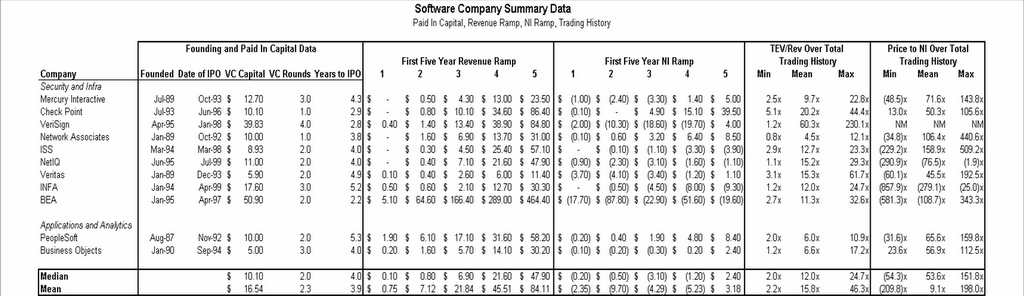
Recently, I wrote a post titled “When it Goes Right, What Does It Cost to Build a Great Software Company?"

Based on a universe of 1990s client/server companies, my analysis found that:
  • Median Capital Raised: $10.1m
  • Median 1st-4th Year Revenue Ramp: $.1m $.8m $6.9m $21.6m
  • Median revenue at profitability: $48m
  • Median Years to Exit: 4
  • Software model supports the creation of great companies on <$15m of capital
The post begged the question regarding the metrics associated with SaaS. This post, based on a review of the current public SaaS comps, is the SaaS analog. The analysis includes: WSSI, CRM, OMTR, RNOW, TLEO, and VOCS.

While the SaaS companies grew up in a different IPO market, the results suggest that SaaS companies take:

  • 1.6x longer to get liquid
  • 3.65x more capital
  • 1.75x more revenue to hit profitability
  • Salesforce, for example, raised $64.52m in equity, to Peoplesoft's $10. Websidestory raised $43m to BOBJ's $5m.

Click HERE to see data behind analysis

SaaS is here to stay – the advantages to customers and vendors are well established.

The remaining challenge, however, is how to build viable SaaS companies more cost effectively. Will the rise of AMZN S3 and EC2, Apex and AppExchange, etc eliminate the need for bespoke infrastructure investment. We will stop stop asking about MSDN subscriptions and ask instead about AMZN subscriptions?

One can only hope some form of platform infrastructure emerges to accelerate SaaS companies development. If not, the merits of SaaS will be challenged by the time, capital intensity, and delayed profitability of the model. Platform companies – Powersoft/Sybase, ORCL, MSFT – drove down the costs of building client/server application companies. The industry needs the SaaS analogs to unleash the power of the model at the cost optimal level.

A simple analysis holds that Fixed Costs/Gross Margin = breakeven revenue. While for SaaS this is a somewhat circular calculation (as in SaaS fixed costs are amortized into COGS), the rise of platforms will drive down fixed and allow SaaS companies to reduce capital required to get to scale. Fixed costs must be reduced in order to unleash the full power of the model and the rise of platforms will reduce the bespoke investments historically required to build SaaS companies.

Now, the data above is for public companies who came to prominence in very challenging times. We are active SaaS investors and are already seeing the fruits of leveraging commodity platforms and partners to build companies more cost effectively. However, the public record to date suggests that the SaaS industry remains relatively immature without the obvious parallels to the client server tools and server companies that drove the success of huge numbers of application companies in the 1990s.

The Three Most Important Letters in Open Source: CYA

Anyone who follows politics knows that one man’s given is another man’s question. In the software VC world, the merits of open source are regarded as givens- a business model innovation that brilliantly aligns customer and vendor interests.

However, outside of the software VC market, open source remains an enigma wrapped in a mystery. How does free pay? Is open source a backdoor towards communism? Is it anti-capitalist? Despite RHT’s market cap and the success of JBoss, I continue to meet many who question the wisdom and financial merits of open source.

Open source is rife with acronyms – GPL, MPL, OSS, etc. In my experience, however, the three letters in open source that matter most are CYA ("cover your ass"), not GPL…in fact, CYA best explains the economic incentives of open source customers. Simply put, customers will not deploy software into production, independent of whether developers think that they need support, that is not supported.

No IT manager worth his salt will put mission critical software infrastructure into production without a throat to choke. Telling the head of equities that trades are failing due to a software crash and that you have an email into a community forum asking for a fix will result in termination faster than you can say “dumb ass.”

In analyzing open source, I have talked to many developers who tell me they do not need support for many open source projects and that forums, list serves, and documentation provide the material they need to solve their problems. However, IT managers are focused more than ever on service levels and subscribing to open source vendor’s support subscriptions allows them to cover their asses if and when infrastructure fails and transactions are at risk.

If CYA is the key to monetization – what does that mean about the categories of software that are likely to succeed via an open source model? Fundamentally, the closer a product is to a transaction the more important CYA becomes. Applications that are not mission critical –content management, for example - run a material risk of developers using the GPL license and sourcing support from the community rather than via subscription arrangements with the vendor in question.

What other variables characterize successful open source companies:

  • Established market- successful open source projects target established software markets where the incumbent vendors are over charging their customers for bloated, proprietary solutions. Famously, once RHT Linux met their enterprise expectations, Morgan Stanley’s purchases of Solaris servers fell off a cliff and the investment bank realized close to 10x cost reductions per CPU. Can you target a large market and deliver a standards-based product that allows IT organizations to grow their IT capacity at a greatly reduced cost basis?
  • Evidence of organic pull most appropriately characterized by downloads, forum usage, etc.
  • IP rights retained by C-corp established to commercialize project. Indemnities become challenging when it is difficult to provide documented attribution of source code ownership. Also, potential buyers will discount a company’s value if IP remains unclear.
  • Active community – an active community of developers led by a project leader who is employed by the company

Next time someone asks you how free leads to fee…remember that IT managers and risk taking are oxymorons and that having a throat to choke while saving large amounts of money feels good!

Monday, January 22, 2007

Internet Television History: 24 is on the Web!

In a moment of television and Internet history, Season Six of 24 is available online, via MySpace and Fox.com

For many years and many CES keynotes, IPTV proved to be more hype than substance. Starting today, however, TV's hottest show is available on the web!

Major networks are putting their premium content assets on the web, and the high quality, full-episode streams suggest that the promise of IPTV is finally being realized.

The company behind 24 on-line, Move Networks, (see previous post on company).

Move, based in Utah, provides major content owners and network operators enabling infrastructure for the delivery of both live and archived long-form, high quality Internet video.

Please click on the links above to enjoy 24, Prison Break, and Fox's other prime time programming.

If you are into the CW, click here to watch Everybody Hates Chris, Beauty and the Geek, and other favorites.

The future of Internet Video - long-form, high quality content that combines prime time broadcast CPMs with Internet per click, per stream analytics and tracking - has arrived!

Thursday, January 18, 2007

Widgetbox in New York Times

Widgetbox, the leading widget web marketplace and syndication platform, is featured in today's NYTimes article on widgets.

Ed and his team deserve credit for recognizing the value of syndicated content, commerce, and application functionality. Widgetbox seamlessly allows web service providers, developers, and end users to deploy and manage widgets. If you have yet to put a widget on your blog, please try one today!

Thursday, January 04, 2007

Red Herring Article on VC Bloggers

Sean Wolfe of Red Herring published an article today on the mushrooming number of VC bloggers - VC Bloggers Aplenty?

Brad's newly launched Ask the VC blog prompted Sean to explore why VC's blog and what value exists in the practice.

Sean kindly interviewed me as well for the story. As I mention in the story, the value for me in blogging lies in 1) greater fluency of current trends and technology, 2) a forum for reaching a broad audience on a daily basis and finding new deals, and 3) a medium for demystifying the VC process and sharing best practices and didactic experiences.

Check it out.

Wednesday, January 03, 2007

2006 Redux

In the 1990s, Queen Elizabeth famously declared that she had suffered through an annus horribilis. In 2006, the valley, in contrast, enjoyed an annus mirabilis.

The massive shift of off-line to on-line ad spending (with newspapers still getting 4.5x on-line!!), the power of SaaS and open source models to align vendor and customer interests, the standards and tools that empower users to define how and where they consume content, and the early signals that media companies finally realize the power, not threat, of the web all combine to create powerful tailwinds for start-ups and their venture backers.

The conditions remain ripe for innovation and the “mirabilis” looks set to continue well through 2007. Investors often contrast secular trends (ex. off-line to on-line) with seasonal trends (ex. XMAS buying), and I am confident that powerful secular trends are at the heart of the renewed vigor of the start-up economy.

It comes as no surprise then that my first full year at Hummer Winblad proved to be a very eventful and productive one.

Over the course of 2006, I have been lucky enough to work with a series of great entrepreneurs, work on six new investments, and see four liquidity events.

In 2006, I worked on investments in:

  • Infopia – a SaaS multi-channel e-commerce company
  • Widgetbox – a web widget marketplace and syndication platform
  • Hubpages – a platform for creating and monetizing web content
  • Mulesource – an open source integration platform
  • Move Networks - a video streaming infrastructure provider
  • Replay Solutions -a very cool development tools company

With respect to liquidity, we were fortunate to see:

The opportunity to work with such a large number of innovative companies/founders in an era blessed with powerful tailwinds is truly exciting.

This year we hope to add to our roster of great companies, and I encourage start-ups that share that same vision and passion to get in touch with me as we kick off our very busy Q1 season.

I look forward to hearing from you.

CES 2007

Happy New Year!

I plan to attend CES next week and welcome the opportunity to meet with promising start-ups who also are scheduled to be in Vegas.

Feel free to ping me to set up a time to meet.

Thursday, December 21, 2006

Widgetbox Syndication Metrics


Widgetbox just released an analytics dashboard for widget developers. It is free and comes with every widget on Widgetbox.

The release further positions Widgetbox as the leader in the web widget space and as the backplane for syndicating, publishing, and tracking the widgetsphere. Since launch in October, the company has served 8.7m widgets to date and the widgetsphere (check home page for real-time data updates), the total number of widget instances syndicated via the service, is growing by over 40% month over month.

With these metrics, you are able to:
  • Assess the popularity and effectiveness of your widgets at a fine level of detail.
  • Track the spread of your widgets across the Internet.
  • See who your biggest users are, as well as the most influential users (those driving the most new subscriptions to your widgets).
  • You do not change your widget’s code or think about metrics in advance. Existing widgets automatically take advantage of it.
  • It’s automatically available for all current and future widgets registered on Widgetbox. There is no separate sign-up necessary.
  • The data is retroactive from August 2006. You can see the usage statistics of your existing widgets since the day they first appeared on Widgetbox.
  • It’s free as part of the platform. There is no extra charge.
Developers can analyze widgets by these key metrics:
  • Subscriptions - A “subscription” occurs when a blogger or web page owner personalizes a Widgetbox widget and gets it for their web page.
  • Hits - A ‘hit’, or page view, occurs when a web surfer views a web page with the subscribed widget on it.
  • Referrals - A ‘referral’ occurs when a web surfer viewing a web page containing your widget clicks the ‘Get Widget’ button underneath the widget. This takes them to the widget’s home page on Widgetbox. At this point they can themselves subscribe to the widget.
  • Conversions - A ‘conversion’ occurs when a person who has been referred to a widget subscribes to that widget.
Congratulations to the Widgetbox team on providing widget developers the visibility and analysis required in serving the distributed web via a widget strategy.

Tuesday, December 19, 2006

Architected for Openness

Earlier this year, I wrote a post titled Innovation Happens Elsewhere.

The post, inspired by a quote from Bill Joy, argues that no company owns a monopoly on talent and innovation. As such, businesses need to be designed to leverage the innovation of others. Certainly the multiple benefits - cost, innovation, wealth - driven by standards and open-systems speak to the value of building businesses that are premised on the axiom of distributed innovation.

The atomization of the web is well underway. Standards and protocols are enabling end-users to consume services and content on their terms. Companies are realizing that "off-domain" consumption and service/content syndication leverages the optimal mix of consumer preferences and technology.

As an example, in Q306, GOOG's Q306 total ad revenues were $2.66bn, of which $1bn came via non-GOOG domains, or 39% of the total. The rise of GOOG gadgets, Windows Live gadgets, web widgets, etc reflect a creeping realization that no matter how large the brand it is impossible to keep users on a single domain. JavaScript-integration represents the lowest common denominator for the adoption and usage of a given company's services. Like AdSense, it is critical that web companies allow users to consume web services at locations and in the form of the consumers' choosing.

In many ways, DVR, RSS, personalized home pages reflect the demise of the top down architecture that requires program managers and companies to produce, edit, and package content and services on the users behalf. Whether time shifting, JavaScript-service integration, customized feed readers, users are rewriting the rule book regarding how they expect to be served. Today, companies that are architected to be open and to leverage distributed innovation and consumption are architected for success.

Standards and technologies are allowing for a free market, where users are in control. If we consider "openness" a virtue and the "right" side of history, then similarly we can point to "closed" walled garden strategies as being on the "wrong" side of history. We can easily compare and contrast the vibrancy of the PC web with the backward nature of the mobile industry. In mobile, gate keepers, lack of standards, fragmented platforms, massive porting costs, and a subscription mentally are robbing users and the market of the opportunity for innovation, new services, and wealth that are the treasured hallmarks of the PC-based web.

Command and control economies fell victim to the simple fact that central governments are incapable of making better decisions than millions of individuals exercising their personal preferences.

Today, an "iron curtain" mentality still exists in certain industries. The PC web is quickly creating a new digital divide - one between the consumer utility of an open ecosystem and the crap available from product managers at Verizon and AT&T, who are working with their OEMs on what will be "best" for us.

Eliminating friction points that frustrate the freedom to choose when, what, and where to consume represents not only a worthy goal in itself but more importantly recognizes that it is impossible and unwise to under estimate the individual's desire to define utility.

As entrepreneurs think about architecting start-ups for 2007, I suggest thinking about how to best facilitate atomization, syndication, user-defined utility, and the advancements of others.

Thursday, December 14, 2006

Presenting to Win

The first material step in the fund raising process is the "VC pitch."

The VC blogosphere is full of sage advice on presentation templates and structures. Given the vital importance of clearly articulating the value and merits of a business, however, I continue to be amazed by the lack of preparation, clarity, and "aha!s" in the average pitch. As Eminem says, "you only get one shot!"

The presentation, for better or worse, is the medium via which investors evaluate the merits of a company's market, position, and attractiveness as a possible investment. Given the importance of the "pitch," it pays to spend lots of time drafting, refining, and practicing the presentation. Which brings me to the subject of this post...

Jerry Weissman's great book, Presenting to Win, is a practical how-to guide on the "art of telling your story." The book is the culmination of several decades of coaching technology companies and legends on how best to connect with audiences and effectively communicate ideas. His past clients include Sequoia, CSCO, Yahoo, MSFT, and many others.

I suggest ordering the book and include a short synopsis below:

Five Presentation Sins
  1. no clear point
  2. no audience benefit
  3. no clear flow
  4. too detailed
  5. too long - what he humorously refers to as (MEGO, or mine eyes glaze over)
I like the last one, ie, "man, that guy mego'd me."

Point A and Point B
As you walk into a meeting, room, the audience is mentally at "point a," or their starting point. They have preconceived ideas, experiences, and world views that define their starting point. The goal of ALL pitches is to move them to "point b," or to your objective.

As you think about how best to move them to Point B, remember the golden rule - "WIIFY", or what is in it for you, with "you" being the audience. The WIIFY is the "so what" takeaway.

Understand your Audience
Who are they?
What is their knowledge level?

External Factors
What are the exogenous variables that will impact the audiences' reaction to your message - both positive variables (tail winds) and negative variables (head winds)?

Setting
When, where, and how will you present (av tools, internet access, room size, etc)?

Opening Gambit
Seize attention and the stage via an opening remark. Wiessman suggests using a question, factoid, anecdote - a vehicle that forces attention on you and gets the audience thinking about the subject matter in question.

Flow Structure/Metaphor
Use an organizational metaphor to structure the presentation - ie Letterman Top Ten List, compare and contrast, rhetorical questions, etc.

The above is merely a snapshot of some of the ideas. Communicating vision, ideas, value, etc is not easy, particularly in a world of information overload, too many meetings, blackberries...

If a start-up idea warrants your blood, sweat, and tears - it warrants an investment in time and practice in order to "present to win."

Wednesday, December 06, 2006

When it Goes Right, What Does It Cost to Build a Great Software Company?


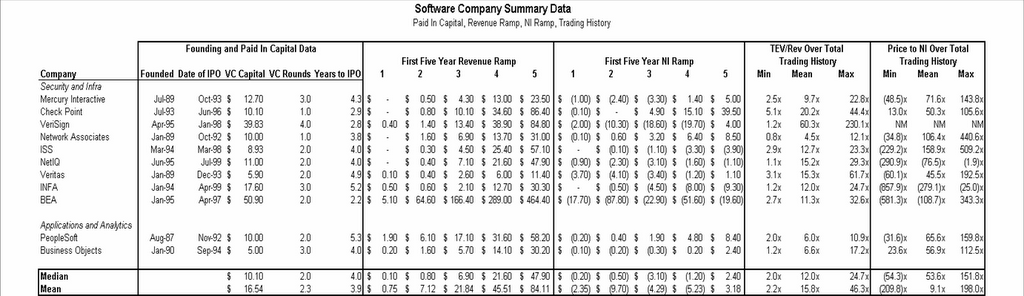
(Click on picture to see data)

What makes software such an attractive area to invest?

Capital efficiency married to the potential for fantastic outcomes.

While the companies above are the 1990s Hall of Fame, the data is still instructive for those of us building software companies and thinking about the time, capital required, and revenue ramp profile of when it goes right.

  • Median Capital Raised: $10.1m
  • Median 1st-4th Year Revenue Ramp: $.1m $.8m $6.9m $21.6m
  • Median Years to Exit: 4
  • Market Comps: Massive variance
  • Lesson:
    • Pricing discipline is critical as multiples at exit are impossible to forecast and may not be consistent with market multiples at time of funding
    • With market pricing impossible to forecast, capital efficiency is critical
  • Software model supports the creation of great companies on <$15m of capital

Wednesday, November 29, 2006

The VCAT

Guy Kawasaki's latest post - The Venture Capital Aptitude Test (VCAT) - is, as usual, thought provoking and worth reading.

The post, stimulated by repeated emails from MBAs to Guy seeking advice on how to get into the VC industry, makes the argument that great VCs require entrepreneurial experience and that a VC position should be the capstone, not the start of a business career.

When you're young, Guy argues, work 80 hours a week building, marketing, and selling products not sitting in meetings deciding whether or not to make an investment.

As a relatively young VC (35), the post hit a nerve. The post also forced me to revisit a set of questions that I struggled with when I first joined the industry: 1) is VC a vocation, in its own right, with discrete skill sets and capabilities or 2) is VC something people do after they have been successful doing something else?

Even if there is no clear answer to the question, is one path more closely correlated with investing success than another? Are great VCs graying entrepreneurs or are they experts in the VC domain with several decades of pattern recognition, tens of deals, and hundreds of diligence sessions behind them?

In 2001, following the sale of the start-up where I was CEO, I made the rounds of Sand Hill Road asking those very questions and worked hard to find a common answer. The jokes about the "dark side" aside, I remember feeling serious disquiet when I decided to join Pequot Ventures. In doing so, I felt that I was somehow selling out and walking away too early from the managerial and entrepreneurial track.

While the itch to build and sell a product has never left, I have grown more comfortable with the notion that there is no stock answer to the questions above. Examples of successful investors can be found from both tracks and as the old saying goes, "there are many roads to Rome."

I know great entrepreneurs who, while perhaps empathetic and experienced in managing start-up growth, are not very value-added in the board room. And I know of people who got into the business right out of business school who suffer from the arrogance and vapidity that Guy describes in his post.

One observation is that the VC industry, by its nature, is one where it takes many years to find out if one is any good. In fact, Guy himself refers to his personal challenge in this regard. If deals take 5 years to get liquid and if it takes one several years to get into the position to sponsor and lead investments, then it will be a minimum of 7 years before one can objectively comment on one's venture capital aptitude. Given the time it takes to evaluate talent, firms hire by proxy and look for leading indicators of that latent talent. These proxies lead to the stereotypes of the CS grad, start-up founder, EE. Prior success in related fields is used as a guesstimation and predictor of investment talent.

Certainly, by pursuing a start-up or large company management role, the ability to point to success and claim attribution or causality for success is much easier. From shorter cycle times to achieve one's goals and the accountability and responsibility that comes from owning a product or project, it is possible to more quickly grow in self-confidence and credibility. Start-up roles of note help provide firms comfort with evidence of the proxies and predictive variables note above. Given the seven year horizon and long gestation of venture aptitude, the VC business is an apprentice business that takes patience and that can be frustrating for people, me included, out to conquer the world.

Several years ago, while still tortured with these questions, I sat down with one of my favorite people and a very successful entrepreneur. I approached the meal with great trepidation as I was going to tell him that I loved being a VC and wanted to make it my career choice. After I got through telling him how much I loved the job, he shocked me. Rather than belittling my choice and dumping on the profession, he walked me through the following. He said, "there are too many lawyers, doctors, venture capitalists, sales people, professors - in fact almost every profession suffers from an oversupply of wannabes. The problem is that there are never enough good ones. Be a good one."

When I asked him to clarify the meaning of "good," he replied someone who works to serve the entrepreneur, to shorten the cycle time to achieving milestones, and someone who the CEO wants to call in the middle of the night with a burning question or problem. Since then, that has been my goal;to be good by working to serve rather than expecting to be served.

The reality is that firms hire in their own image - firms full of entrepreneurs will continue to look to mature business leaders to fill their ranks, while firms that are built on the back of hiring and training MBAs will continue to do so. At Hummer Winblad, we ascribe to the portfolio approach. We have both wonderful senior executives, the very model of Guy's "good VC," and career VCs - the combination of operating experience and the pattern recognition that comes from having been in the industry a long, long time helps eliminate blind spots and, I believe, makes for better collective decision making.

Finally, I think Guy is right to caution industry entrants and to ask that they join the industry for the right reasons - a love of technology, endless curiosity, a desire to serve and accelerate growth, and a passion for what you do every day.

Sunday, November 26, 2006

Milton Friedman: Free to Choose

Over Thanksgiving, I reread Free to Choose in honor of Milton Friedman. The book, first published in 1980, is a classic that lays out a systematic argument for free markets, the tyranny of controls, and the benefits of cooperation through voluntary exchange.

26 years ago, Friedman wrote of the perils of unfunded social security obligations, the sorry state of public education, and of the battle over the definition of equality; i.e, is the goal equality of opportunity or equality of outcome?

Today, his diagnoses of our societal ills remain more valid than ever. In an era marked by the growing power of the Federal government and corresponding erosion of personal freedoms, expanded benefits programs and bureaucracies, and the evergreen debates over the merits of free trade, it is instructive to read Friedman's admonition that increases in government power and control come at great cost to individual and economic freedoms.

Perhaps the most tragic insight is how often good intentions produce deplorable results when government is the middleman. He cites a Theory of Bureaucratic Displacement that helps us understand the juxtaposition between ever growing government budgets, ear marks, and appropriations and the state of public health, education, and welfare. The theory argues that, "in a bureaucratic system increases in expenditure will be matched by falls in production...Such systems will act rather like black holes in the economic universe, simultaneously sucking in resources, and shrinking in terms of emitted production." Education is an excellent example - resources and cost per student continue to go up, while the "production" of well-educated students continues to go down. Poor results lead to increased spending and a vicious cycle is spawned and capital destroyed.

There is no party today that bases its vision on Friedman's work. It is hard to get elected when one argues against the minimum wage and rent control, for school vouchers, against social security where the next generation funds the state's pension guarantees to the prior generation, for self-funded retirement programs, against welfare programs...While politicians opportunistically claim Friedman as their patron saint, it is clear that neither party is willing to follow his precepts for good government.

Laissez-faire arguments that government controls - where someone else spends someone else's money for someone else's benefit - limit freedom and prosperity appear cruel and indifferent to the suffering of hard working people. They are easily dismissed as anti-worker, pro-rich, and impractical. Perhaps more than anyone else in recent history, he helps provide the analysis and human touch that makes free market arguments tangible, while explaining the pernicious impact of government interference of voluntary exchange and collaboration.

Silicon Valley is perhaps the most clear example of the innovation, wealth, and job creation possible when individuals freely cooperate to promote their separate interests. All of us benefit by a system that encourages individuals to pursue their dreams rather than a system that prescribes what jobs we may hold, who we may hire, and what we may work on.

As you read the following, it is hard to imagine a more cogent analysis of our society's condition. Remember this was written in 1979.

Despite massive increases in public spending and the attendant bureaucracy...

"No one can dispute the two superficially contradictory phenomena: widespread dissatisfaction with the results of this explosoin in welfare activities; continued pressure for further expansion.

The objectives have all been noble; the results, disappointing. Social security expenditures have skyrocketed, and the system is in deep financial trouble...As government has paid a larger share of the nation's medical bills, both patients and physicians complain of rocketing costs and of the increasing impersonality of medicine. In education, student performance has dropped as federal intervention has expanded.

The repeated failure of well-intentioned prgrams is not an accident. It is not simply the result of mistakes of execution. The failure is deeply rooted in the use of bad means to achieve good objectives.

Despite the failure of these programs, the pressure to expand them grows. Failures are attributed to the miserliness of Congress in appropriating funds, and so are met with a cry for still bigger programs. Special interests that benefit from specific programs press for their expansion - foremost among them the massive bureaucracy spawned by the programs."

Thursday, November 16, 2006

TechNet Innovation Summit

Yesterday, I had the good fortune of attending TechNet's Innovation Summit at Stanford University. TechNet is a bi-partisan advocacy group that lobbies Federal and State governments on behalf of the technology industry.

The agenda, which included three panels hosted by PBS' Charlie Rose, focused on innovation, green energy, and the global knowledge economy. Panelists included Jerry Yang, John Doerr, Scott McNealy, Reed Hastings, Charlie Giancarlo, and Bill Gates. The day ended with a surprise cameo by Arnold Schwarzenegger.

I thoroughly enjoyed Rose's interviewing style and the thoughtful commentary from our industry's leaders. My key takeaways/observations follow:

  • innovation is like pornography - it is hard to define but easy to recognize.
  • Rose worked hard to ask the panelists how best to foster and encourage innovation. While the answers varied, a recurring theme centered on the importance of both youth and ignoring convention.
  • Irreverence, iconoclasm, idealism - three "i's" - were noted as magical ingredients, but the inability to systematically or coherently explain how to foster innovation is interesting to note. It is clear, however, that there is little obvious correlation between R&D spend and innovation. CSCO spends $4bn a year in R&D and yet the majority of new products stem from an active M&A program.
  • Two of Gates' comments struck me: 1) he compared MSFT's focus on low price high volume software (compared to the prevalent IBM model in 1980) to GOOG's focus on low price high volume advertising (compared to traditional Madison Avenue models). Both models commoditized huge industries and enabled new participants and beneficiaries to share in the now larger pie. 2) the greatest strategy sins are ones of omission, missing a market or opportunity. He believes in identifying and entering markets as early as possible as the opportunity to repeatedly play the game (v 1.0, 2.0, etc) allows for iterative innovation not possible if you are not previously commited to the market. Also, markets that take off follow s-curve growth rates and it is often impossible to catch up with the pioneers in front of you.
  • free labor markets, government funding of core science, and increased investment in math and science education are vital investments to maintain US innovation and prosperity
  • global warming is a global imperative and must be addressed to head off economic and social catastrophe
  • resources, and not capital, are they key constraints to providing energy to the 1/3 of the planet's population without ready access to energy. With energy consumption correlated with GDP growth, developing economies will drive huge increases in demand for carbon based energy sources.
  • Much like Malthus' views on running out of food supply (people grow exponentially while food supply grows arithmetically), panelists argued that while the world is awash in capital that could fund energy needs that there is a deficit of carbon matter that can power the world's future energy demands.
  • Accordingly, the argument goes, the only credible means to service energy demand will be through bio-fuels and other renewable energy sources. Malthus' thesis fell prey to non-linear innovations in agriculture science, and perhaps science will also wean our addiction to carbon fuels
  • Green energy cannot be a conscience driven purchase - ie premium-priced. Green can no longer evoke Patagonia but rather Wal-Mart - ie low-cost - if it is to meaningfully take share from carbon sources.
  • Stanford is a vital resource for Silicon Valley - many of the panelists and a good number of the innovations discussed trace their pedigree back to the school
Suggested actions, support:

Monday, November 06, 2006

Move Networks

When people read the words "Internet video," they quickly think of Youtube.

Today, Internet video is associated with short-form, relatively low quality video clips (90-200 seconds, somewhat grainy and often jittery).

Average view times, for longer content, remain below three minutes (ie people shut down their browsers well before the video ends) and despite the hype associated with Internet video very few of us are watching full episodes and long-form content on the web.

The vast major of Internet video today is Long Tail content, content of limited value to the general populace but of very high value to small clusters of viewers. CPMs are likewise challenged by the hugely distributed audiences associated with long tail content. Youtube continues to rely on AdSense to drive revenue and CPMs are a far cry from the $25 range associated with prime time television.

We are beginning to see, however, Short Tail Tail content moving across IP networks. Today, for example, one can visit Myspace.com/Fox and watch Fox's premium broadcast content on the web. The OC is currently being made available a week prior to broadcast on MySpace - an amazing example of how to harness the power of social networks, word of mouth marketing, and traditional media assets. Other shows being streamed include Prison Break, Standoff, Bones, Vanished, etc. Note: use IE to watch the shows. Firefox remains in beta.

Rupert Murdoch's vision of marrying 100m plus MySpace users to FoxTV programming is powerful, and I believe evidence of the future of Internet Video - long-form, high quality content that combines prime time broadcast CPMs with Internet per click, per stream analytics and tracking.

The company behind Fox's on-line video delivery? Move Networks.

Move, based in Utah, provides major content owners and network operators enabling infrastructure for the delivery of both live and archived long-form, high quality Internet video.

"Game-changing technology" is a cliched phrase, often over used and very seldom an apt description. Move, however, is a game changing company that in the months ahead will be bringing archived and live premium content (TV, movies, sporting events) to a browser near you - no buffering, no jitter, just high-quality content when and where you want to consume it.

Hummer Winblad recently joined Steamboat, Disney's venture arm, as an investor in Move - it is a company worth watching (pls pardon the pun)!!

Post-script:
A few readers sent me email arguing that long-tail content allows for better targeting and hence will generate more attractive CPMs relative to short-tail content. The logic here is that the content is the filter; ie that advertisers can key off our consumption of certain content as a signal of our intent and interest. The logic supposes that prime time content is too universal to allow for effective segmentation, targeting, and positioning.

The reason for broadcast's failing to deliver effective targeting lies in the nature of broadcast technology itself - a blast mechanism that is one-to-many with no visibility into consumption at the end-points - who you are, what you watch, how often you watch it, ie. your behavioral preferences.

With Move, however, one can marry the targeting that derives from Internet tracking and profiling to the widespread interest in premium content - for example, when we watch the World Cup on-line in 2010, you and I will see different ads based on our profiles and viewing histories.


With Move, we get the best of both worlds - users get on-line access to the world's best content and advertisers are enabled to provide per stream, per user targeting, tracking, and segmentation.