As the pundits debate next Sunday's Superbowl, my friend Dave Cotter's company, Mpire, developed a Superbowl Index based on eBay's listings of Seahawk and Steeler paraphernalia. On average, Seahawk items sell for ~$50 more.
The Index is a clever means of showcasing Mprie's Researcher product and is probably as accurate as any TV pundit when it comes to forecasting a winner. It looks like whoever wins, eBay will take a cut along the way:)
Sunday, January 29, 2006


Friday, January 20, 2006
1 (800) 411-METRO
Matt Marshall recently wrote an article on the $8bn directory services market and other emerging mobile information models. Matt profiles a recent addition to the HWVP portfolio, Infreeda.
Infreeda provides nation-wide, human operator, ad supported 411 calls. Very simply, dial 1 800 411 METRO the next time you are looking for a listing and stop paying high fees (~$1.75 per call) for information.
Let us know your feedback.
Infreeda provides nation-wide, human operator, ad supported 411 calls. Very simply, dial 1 800 411 METRO the next time you are looking for a listing and stop paying high fees (~$1.75 per call) for information.
Let us know your feedback.
Thursday, January 19, 2006
Instant Gratification
Last night, Hummer Winblad hosted a dinner at Stanford for GSB, CS, and EE students. Stanford students are remarkably entrepreneurial and the energy around new company formation is impressive.
Over dinner, several questions were raised with respect to design considerations for new enterprise software companies. In thinking through an answer, the following thoughts came to mind.
What is the time to value quotient? How long does it take for the customer to realize value from your product? Compare and contrast clicking on a URL to self-provision versus a two-month on-premise proof of concept.
What is the customization to value quotient? How much customization is required before the customer sees relevance and value?
How much manual labor is required to realize value? How many sales engineering and professional services hours are required to both explain the merits of the solution and have it running successfully in the customer's environment? The common element of MySQL or Salesforce.com appears to be that customers self-validate through low-risk experimentation without the need for vendor sales engineers.
What is the risk of experimentation? Does the customer need to pay for a proof of concept? Does the customer need to requisition IT resource (new servers, open up a firewall port, etc) to enable your product to showcase its benefit? As with the MySQL comment above, can the customer experiment and test the value proposition without material risk or expense?
What is the time to integration? Can the product provide standalone value that obviates the need for day one systems integration, a la SFA? To the extent integration is required, how standardized are the interfaces to relevant up and downstream systems that add value to the solution?
The consumer internet offers useful lessons and direction for the enterprise space. Customers self-provision, self-validate, self-integrate, and self-configure.
The dinner offered some great ideas and insights, and I look forward to seeing the great new companies that are currently being hatched on campus.
Over dinner, several questions were raised with respect to design considerations for new enterprise software companies. In thinking through an answer, the following thoughts came to mind.
What is the time to value quotient? How long does it take for the customer to realize value from your product? Compare and contrast clicking on a URL to self-provision versus a two-month on-premise proof of concept.
What is the customization to value quotient? How much customization is required before the customer sees relevance and value?
How much manual labor is required to realize value? How many sales engineering and professional services hours are required to both explain the merits of the solution and have it running successfully in the customer's environment? The common element of MySQL or Salesforce.com appears to be that customers self-validate through low-risk experimentation without the need for vendor sales engineers.
What is the risk of experimentation? Does the customer need to pay for a proof of concept? Does the customer need to requisition IT resource (new servers, open up a firewall port, etc) to enable your product to showcase its benefit? As with the MySQL comment above, can the customer experiment and test the value proposition without material risk or expense?
What is the time to integration? Can the product provide standalone value that obviates the need for day one systems integration, a la SFA? To the extent integration is required, how standardized are the interfaces to relevant up and downstream systems that add value to the solution?
The consumer internet offers useful lessons and direction for the enterprise space. Customers self-provision, self-validate, self-integrate, and self-configure.
The dinner offered some great ideas and insights, and I look forward to seeing the great new companies that are currently being hatched on campus.
Wednesday, January 18, 2006
Share of Revenue and Profits
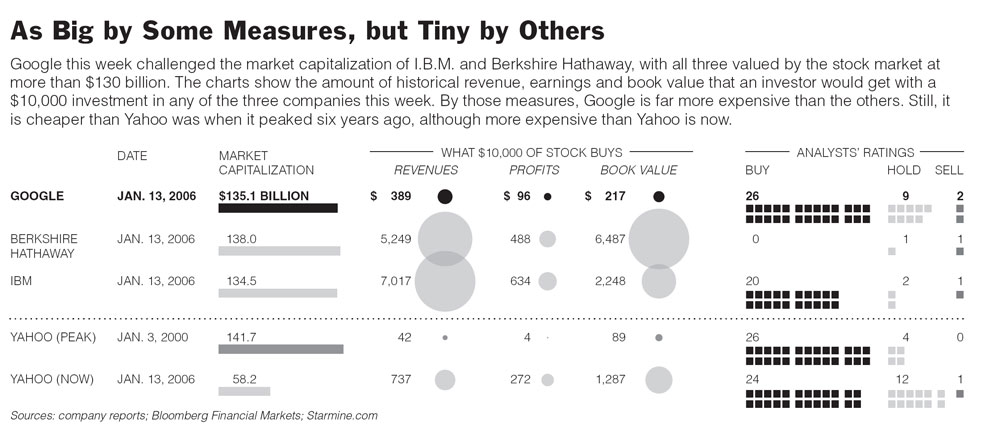
The NYT recently published an interesting article on the occasion of Google's market cap matching that of Warren Buffet's Berkshire Hathaway.
See the attached chart. The analysis looks at the relative claims of $10,000 worth of IBM, Google, Yhoo today, Yhoo peak valuation, and Berkshire Hathaway shares on respective revenues and net profits .
The analysis illustrates that a company's improvement in fundamentals may not be matched by a corresponding improvement in stock price. YHOO is down 66% from its peak while $10,000 of YHOO stock now has claim to 17.5x more revenue, 68x more net profit, and 14.5x more book value than at its peak valuation.
The separation from fundamentals and valuation, realistic forecasts and market cap, etc become particularly problematic when market sentiment changes. The questions of where is the floor and what is the intrinsic value are begged by the separation. With GOOG swinging $15 in a given day, it may pay to think about the analysis and YHOO's recent history.
Thursday, January 12, 2006
RSS Ad Stats

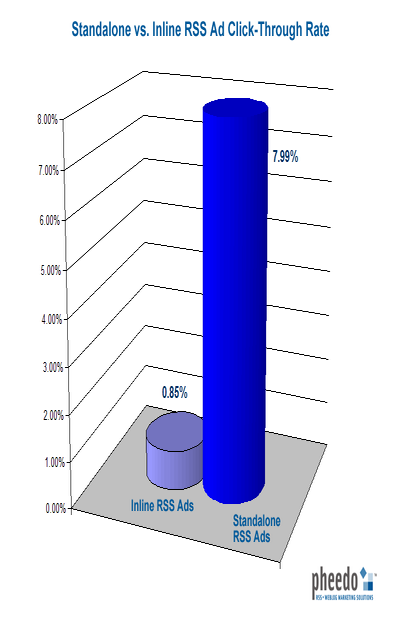
With RSS traffic and RSS reader adoption booming, ad impressions on traditional sites will inevitably go down. Web publishers will need to work out how to make money off of the RSS r/evolution via embedding ads in RSS.
For some very useful statistics on RSS advertising click-through-rates and RSS reader behavior, check out Pheedo's blog - Pheed Read #1 and # 2.
The feeds are instructive and suggest that RSS ads significantly outperform traditional web advertising wrt CTRs. Furthermore, given RSS subscriptions allow for more effective targeting and segmentation it is likely that the CPCs will be higher than with traditional on-line ads. Web publishers may find that driving RSS usage increases ad-related revenues despite a decline in "home site" web-site page views.
I would love to talk with people working actively in this area. Thanks to Pheedo for the data.

Wednesday, January 11, 2006
Living History - Sun Founders Panel
Tonight, the Computer History Museum in Mountain View hosted a fabulous event with the four founders of Sun - Vinod Kholsa, Scott McNealy, Andy Bechtolsheim, and Bill Joy. If you enjoy history and technology, I encourage you to come to future events and to support the only museum in the world dedicated to the collection and preservation of the software, documentation, hardware, images, and personal histories that represent the innovation and advances in IT.
The wonderful reality about the technology industry is that a significant number of IT industry pioneers and innovators are not only still with us (Jobs, Joy, Bechtolsheim, etc), but also remain vibrant participants in the economy they helped to create. Tonight really was living history with the people on stage recounting the founding of Sun in 1982 and the adoption of open systems, Unix, RISC, Java, network based computing, the constant ying and yang of fat vs thin clients, and the MSFT vs Sun world views.
Sun's sales in the first six years - $8.5m to $1bn- testify to its force as disrupter, and yet I have to tip my hat to the company and founder's staying power. Here we are 24 years later and 50% of the founders remain employees and Sun remains a force in the market place.
WRT disruption, it is instructive to note that open systems were lightly regarded by the investment community in 1982, which is very similar to Marc Benioff's experience raising money for SaaS-based CRM in the late 1990s. The common elements in both examples appear to be a price/performance ratio improvement and an alignment to the customers' interests that the competition's business model did not allow for. Yet the investment community, in both instances, reflected the incumbent's world view. It seems to be a truism that large companies in technology can innovate (Xerox Parc being the poster child) but that they remain vulnerable with respect to brittle cost structures, business models, and organizational dynamics that make it difficult to use the very technologies their research labs are innovating. Perhaps the best answer to "why can't a large company do what you do Mr Start-up," is to say they probably can but they can't afford to - history, that is living history, says that's true.
The wonderful reality about the technology industry is that a significant number of IT industry pioneers and innovators are not only still with us (Jobs, Joy, Bechtolsheim, etc), but also remain vibrant participants in the economy they helped to create. Tonight really was living history with the people on stage recounting the founding of Sun in 1982 and the adoption of open systems, Unix, RISC, Java, network based computing, the constant ying and yang of fat vs thin clients, and the MSFT vs Sun world views.
Sun's sales in the first six years - $8.5m to $1bn- testify to its force as disrupter, and yet I have to tip my hat to the company and founder's staying power. Here we are 24 years later and 50% of the founders remain employees and Sun remains a force in the market place.
WRT disruption, it is instructive to note that open systems were lightly regarded by the investment community in 1982, which is very similar to Marc Benioff's experience raising money for SaaS-based CRM in the late 1990s. The common elements in both examples appear to be a price/performance ratio improvement and an alignment to the customers' interests that the competition's business model did not allow for. Yet the investment community, in both instances, reflected the incumbent's world view. It seems to be a truism that large companies in technology can innovate (Xerox Parc being the poster child) but that they remain vulnerable with respect to brittle cost structures, business models, and organizational dynamics that make it difficult to use the very technologies their research labs are innovating. Perhaps the best answer to "why can't a large company do what you do Mr Start-up," is to say they probably can but they can't afford to - history, that is living history, says that's true.
Wednesday, January 04, 2006
Personal Equity
Steve Bird of Focus Ventures wrote an interesting paper on what drives venture capital returns.
The paper looks at two investment cycles: the PC era of 1983-1987 and the Internet boom of 1997-2001. In the former era, the top 50 firms represented 13% of the industry and captured 44% of the value created. In the latter era, the top 50 firms represented 4% of the industry and captured 66% of the value created.
The moral of the tale to LPs is that if you cannot get your money in a top firm then don't invest in the asset class.
Click above to get the PDF.
The paper looks at two investment cycles: the PC era of 1983-1987 and the Internet boom of 1997-2001. In the former era, the top 50 firms represented 13% of the industry and captured 44% of the value created. In the latter era, the top 50 firms represented 4% of the industry and captured 66% of the value created.
The moral of the tale to LPs is that if you cannot get your money in a top firm then don't invest in the asset class.
Click above to get the PDF.
Friday, December 30, 2005
Silicon Beat
Thanks to Matt over at Silicon Beat for recently profiling my blog. Silicon Beat is part of my daily routine and the site and reporting are consistenly good sources for the latest in the technology and start-up world.
Matt's reference to Hummer Winblad suggests that the firm has been quiet of late. It is worth noting that Hummer Winblad has been an active and successful software investor through three major technology cycles: PC, client/server, and the Internet era. The firm's track record of successful investments includes Arbor Software, Net Dynamics (sold to Sun), Adforce (sold to CMGI), Powersoft (merged with Sybase), Scopus (sold to SEBL), and Wind River.
In the past 18 months, the firm led investments in 14 companies including Akimbi, Palamida, Scalent Systems, Cittio, and ActiveGrid. Active portfolio companies include Omniture, Voltage Security, and Employease.
Thanks again to Matt for the post and to the entrepreneurs who read Silicon Beat, please be in touch:)
Matt's reference to Hummer Winblad suggests that the firm has been quiet of late. It is worth noting that Hummer Winblad has been an active and successful software investor through three major technology cycles: PC, client/server, and the Internet era. The firm's track record of successful investments includes Arbor Software, Net Dynamics (sold to Sun), Adforce (sold to CMGI), Powersoft (merged with Sybase), Scopus (sold to SEBL), and Wind River.
In the past 18 months, the firm led investments in 14 companies including Akimbi, Palamida, Scalent Systems, Cittio, and ActiveGrid. Active portfolio companies include Omniture, Voltage Security, and Employease.
Thanks again to Matt for the post and to the entrepreneurs who read Silicon Beat, please be in touch:)
2005 Redux
According to Feedburner's Item Stats, the following posts topped this blog's most read list. Happy New Year and here's to a wonderful 2006.
Running on Empty
Search: The Rise of Specialization
The Golden Age of IT Buying and What Does it Mean for Investors
H1-B Aliens and the Myth of Free Labor Markets
Sales Forecasting
Sales Management
IBM: Standards, Customer Alignment, and Ecosystem-based Competition
The Cost of Optimism
Pat Your Head and Rub Your Tummy
Running on Empty
Search: The Rise of Specialization
The Golden Age of IT Buying and What Does it Mean for Investors
H1-B Aliens and the Myth of Free Labor Markets
Sales Forecasting
Sales Management
IBM: Standards, Customer Alignment, and Ecosystem-based Competition
The Cost of Optimism
Pat Your Head and Rub Your Tummy
Friday, December 23, 2005
Absurd Athleticism
Watch this Russian video for some incredible footage. It is sad to see such talent amidst such poverty. Hopefully, the market is efficient and Hollywood talent scouts are on their way.
Wednesday, December 21, 2005
Cap Table Hygiene
Venture capitalists are very much tabla rasa investors. One frequently hears about deals with "no hair," "plain vanilla terms," and good hygiene. Conversely, deals that come with cap table challenges (too many investors, too much prior preference, or onerous terms granted to a prior round) are often dead on arrival.
Why? My view is that company formation and growth is hard enough - one has to deal with market risk, technology risk, team risk, downstream financing risk, etc; therefore deals that layer "bad organizational/legal hygiene" as an additional risk factor into the investment evaluation tend to fail to secure investment.
In thinking of starting a company, it is worth understanding the VC industry's attraction to greenfield situations and is well worth thinking through two specific capitalization challenges that often create downstream pitfalls.
- Too Many Founders
A typical Series A sees the following equity ownership distribution: VC syndicate 50%, option pool 20%, founders 30%. Each subsequent financing will see founders diluted by roughly 20% per financing, such that after three rounds the founder shares represent 30%*.8^2, or 19.2% of the company. The per founder math is very simple - founder shares/# of founders. It almost seems redundant to state that too many founders can greatly impact the downstream economics of the founders, however, I have seen very smart, experienced founding teams launch with 5-6 founders and come to realize later that the per founder ownership in the entity creates real incentive problems. The VCs will rarely take less than 40-50% of a Series A and the pool is almost always 20%. Therefore it is important to think through the distribution of the remaining shares to ensure that each member of the team is truly required to get the company off the ground. Teams of 2-3 founders seem to be the norm and cap table issues, questions about equity (wrt fairness), often arise if the team gets much bigger.
2. Too Many Common Holders
All things being equal, the number of common shareholders is inversely proportional to a VC firm's interest in funding a company. The brutal reality of company formation is that often one must take capital from as many angels as necessary. While a small number of qualified angels can add needed runway and perspective, too many angels creates shareholder issues that may impact downstream financings, acquisitions, and legal liability. In raising angel money, try to limit the number of investors required to hit the financing target. When shareholder consents are required - financings, acquisitions, etc - the logistics of rapidly getting approvals can be problematic. I have seen some buyers require full shareholder consents, even if not legally necessary, in order to limit downstream problems relating to minority shareholder lawsuits.
Reality often dictates the necessity of sub-optimal strategies, however, if you can think through how many founders and how many angels to have in your next company you can limit the negative impact of "bad hygiene" on a venture financing.
Friday, December 09, 2005
Hip Hop Web
While listening to Tupac in the car today, it struck me that web 2.0 and rap music have a great deal in common.
The democratizing effect of "two tables and a microphone" allowed people without instrumental training to create wonderful music. Similarly, today's web tools are enabling thousands of web users to create content and applications without deep knowledge of programming languages and technology. Mashups are the web equivalent to rap's sampling, code jams the analog to rap's freestyle battles, beta launches the equivalent to demo tapes, shout-outs the analog to track-backs, Apple's Garageband software similar to Typepad or Jotspot. Moreover, the blogosphere and rap are perhaps the most self-referential creative mediums known to man, whereby songs and posts build off one another in a call and response manner. Mashup's are experiments that create rich blends of underlying applications, as rap tunes are created via the synthesis of jazz, funk, and soul classics. Creativity and innovation is redefined from ground-up development (100% original material) to innovations on the margin. Finally, web 2.0 and rap are both driven by young innovators, often around project-based interaction rather than long-term relationships.
The steady advance in web tools is introducing on-line creativity, rather than simply on-line consumption, to millions of people. As with rap, I think the world is richer for it.
The democratizing effect of "two tables and a microphone" allowed people without instrumental training to create wonderful music. Similarly, today's web tools are enabling thousands of web users to create content and applications without deep knowledge of programming languages and technology. Mashups are the web equivalent to rap's sampling, code jams the analog to rap's freestyle battles, beta launches the equivalent to demo tapes, shout-outs the analog to track-backs, Apple's Garageband software similar to Typepad or Jotspot. Moreover, the blogosphere and rap are perhaps the most self-referential creative mediums known to man, whereby songs and posts build off one another in a call and response manner. Mashup's are experiments that create rich blends of underlying applications, as rap tunes are created via the synthesis of jazz, funk, and soul classics. Creativity and innovation is redefined from ground-up development (100% original material) to innovations on the margin. Finally, web 2.0 and rap are both driven by young innovators, often around project-based interaction rather than long-term relationships.
The steady advance in web tools is introducing on-line creativity, rather than simply on-line consumption, to millions of people. As with rap, I think the world is richer for it.
Monday, December 05, 2005
How to respond to Nigerian Spam Mail
The ingenuity and implicit humor found in Nigerian spam mail inspired a close friend of mine, Mike Flynn, to send this incredicle response.
This could be the funniest thing I have read in a long time . Well done Mike.
Re: Next of Kin
Dear Paul,
By a most uncanny coincidence, I am also soliciting a barrister, preferably a national of your country, who worked with Shell development. By a most unfortunate series of events, I was being held hostage in the trunk of the car that claimed the lives of your client. Fortunately I was blown clear of the wreckage and was able to make my way through the jungles of Nigeria to the Plains of Arjuna dragging a dozen large boxes that I was informed by the sister of the mailman who claimed to be the ilegitimate heir to the throne of Uganda, Mr. Yanindada N'Golo Botticelli Vespa, manservant to your client, contained bars of gold bullion!
When I made it to the Baltic sea I was able to obtain safe passage (after many months of hardship as a fish monger's wife) in a freighter to northern Llapland where I met a Nordic Shaman named Odin who told me you would be contacting me after 23 full moons to fulfill my economic desires.
Paul, I feel I can trust and confide in you and feel from your words that you are a man of God and the people who will help me in my time of need. If you can help me with my immediate need of exporting 300,000,000 pink plastic monkeys to Jakarta I will then be in a better position to provide assistance in routing US$106M to my accounts in Lichtenstein.
be the ball Danny,
truly,
M
Dear Sir/madam
I am Barrister paul debayo Solicitor. I am the Personal Attorney to Mr
Thomas Anindya, a national of your country, who used to work with
shell development company in Nigeria.On the 2nd of may 1999, my
client, his wife And their three children were involved in a car
accident along Sagbama Express Road. All occupants of the vehicle
unfortunately lost there lives. Since then I have made several
enquiries to your embassy to locate any of my clients extended
relatives, this has also proved unsuccessful.
After these several unsuccessful attempts, I decided to trace his
relatives over the Internet, to locate any member of his family but of
no avail, hence I contacted you. I have contacted you to assist in
repartrating the money that belong to my client before they get
confisicated or declared unserviceable by the bank where this huge
deposits were lodged.
Particularly, the Bank where the deceased had an account valued at
about $30million dollars has issued me a notice to provide the next of
kin or have the account confisicated within the next ten official
working days. since i have been unsuccesfull in locating the the
relatives for over 3 years now I seek your consent to present you as
the next of kin of the deceased since you are from the same country
and bear the same last name ,so that the proceeds of this account
valued at $30 million dollars can be paid to you and then you and me
can share the money. 55% to me and 40% to you,while 5% should be for
expenses or tax as your government may require, I have the certificate
of deposit that can be used to back up any claim we may make. All I
require is your honest cooperation to enable us see this dealt
through.
I guarantee that this will be executed under a legitimate arrangement
that will protect you from any breach of the law.Please get in touch
with me by my email to enable us discuss further.
I WILL OBTAIN AFFIDAVIT FROM COURT WHEN YOU RESPONS TO ME.
Best regards,
Esq:paul debayo
This could be the funniest thing I have read in a long time . Well done Mike.
Re: Next of Kin
Dear Paul,
By a most uncanny coincidence, I am also soliciting a barrister, preferably a national of your country, who worked with Shell development. By a most unfortunate series of events, I was being held hostage in the trunk of the car that claimed the lives of your client. Fortunately I was blown clear of the wreckage and was able to make my way through the jungles of Nigeria to the Plains of Arjuna dragging a dozen large boxes that I was informed by the sister of the mailman who claimed to be the ilegitimate heir to the throne of Uganda, Mr. Yanindada N'Golo Botticelli Vespa, manservant to your client, contained bars of gold bullion!
When I made it to the Baltic sea I was able to obtain safe passage (after many months of hardship as a fish monger's wife) in a freighter to northern Llapland where I met a Nordic Shaman named Odin who told me you would be contacting me after 23 full moons to fulfill my economic desires.
Paul, I feel I can trust and confide in you and feel from your words that you are a man of God and the people who will help me in my time of need. If you can help me with my immediate need of exporting 300,000,000 pink plastic monkeys to Jakarta I will then be in a better position to provide assistance in routing US$106M to my accounts in Lichtenstein.
be the ball Danny,
truly,
M
Dear Sir/madam
I am Barrister paul debayo Solicitor. I am the Personal Attorney to Mr
Thomas Anindya, a national of your country, who used to work with
shell development company in Nigeria.On the 2nd of may 1999, my
client, his wife And their three children were involved in a car
accident along Sagbama Express Road. All occupants of the vehicle
unfortunately lost there lives. Since then I have made several
enquiries to your embassy to locate any of my clients extended
relatives, this has also proved unsuccessful.
After these several unsuccessful attempts, I decided to trace his
relatives over the Internet, to locate any member of his family but of
no avail, hence I contacted you. I have contacted you to assist in
repartrating the money that belong to my client before they get
confisicated or declared unserviceable by the bank where this huge
deposits were lodged.
Particularly, the Bank where the deceased had an account valued at
about $30million dollars has issued me a notice to provide the next of
kin or have the account confisicated within the next ten official
working days. since i have been unsuccesfull in locating the the
relatives for over 3 years now I seek your consent to present you as
the next of kin of the deceased since you are from the same country
and bear the same last name ,so that the proceeds of this account
valued at $30 million dollars can be paid to you and then you and me
can share the money. 55% to me and 40% to you,while 5% should be for
expenses or tax as your government may require, I have the certificate
of deposit that can be used to back up any claim we may make. All I
require is your honest cooperation to enable us see this dealt
through.
I guarantee that this will be executed under a legitimate arrangement
that will protect you from any breach of the law.Please get in touch
with me by my email to enable us discuss further.
I WILL OBTAIN AFFIDAVIT FROM COURT WHEN YOU RESPONS TO ME.
Best regards,
Esq:paul debayo
Thursday, December 01, 2005
New Web Site
Hummer Winblad launched our new web site yesterday.
The site provides a great overview of the firm, timeline of investments since founding in 1989, and our process.
For those of you who know the firm well know that John's dog is a key member of the team.
See if you can find an overview on our honorary senior canine leader.
The site provides a great overview of the firm, timeline of investments since founding in 1989, and our process.
For those of you who know the firm well know that John's dog is a key member of the team.
See if you can find an overview on our honorary senior canine leader.
Saturday, November 26, 2005
H1-B Aliens and the Myth of Free Labor Markets
A wonderful constant in this valley of innovation, is the amazing contribution of immigrants to our economy.
In my daily meetings with founding teams and start-ups, there is not a single company that does not have an emigre as a key member. The contribution of Indian, Chinese, Russian, and other nationals to our economy is beyond question and a vital source of our success. From professors, to engineers, senior managers, company founders, and venture capitalists, our current success and prosperity is very positively influenced by our ability to attract the best and brightest to work and study in our country.
Unfortunately, America, while often a champion of free trade, is not a practioner of free labor markets. While technology talent is perhaps the most important input in Silicon Valley's decades of innovation, the US government artificially caps and limits the number of ambitious immigrants to our economy. This year, the H1-B Alien visa program is limited to 65,000. Moreover, since 9/11 the US government has clamped down on graduate student visas; current visa application security checks take 67 days and the total process takes over 3 months . The pernicious effect red-tape is that gifted students are less likely to bother applying, thereby greatly weakening our future prosperity and welfare.
A recent GOA study found that:
- "Lengthy waits to obtain a visa might lead Chinese students and scholars to pursue studies or research in countries where it is easier to obtain a visa. A consular chief in Chennai, India, agreed, saying that lengthy waits are also causing Indian students to decide to study in countries where it is easier to get a visa and, therefore, the United States could lose out on intellectual knowledge these visa applicants bring to our country"
- "Many officials with whom we spoke cited specific examples where scientific research and collaboration was delayed or prevented due to delays in obtaining a visa. NASA officials at post also noted that up to 20% of their time is spent dealing with visa issues when they should be focusing on program issues."
- "According to several surveys, scientific research was postponed, jobs were left unstaffed, and conferences and meetings were missed as a result of the delays."
True globalization requires the seamless flow of ideas, products, and talent. While the world is moving in the right direction, the future of the Valley requires that we make it easy for the world's best to study, work, and contribute to our economy.
Tuesday, November 15, 2005
Running on Empty
Several years ago, Pete Peterson, the founder of Blackstone and an ex-cabinet secretary, wrote an important and sobering book titled Running on Empty.
The book indicts both Republicans and Democrats for ignoring two troubling twin deficits - the the trade deficit and the budget deficit - which, he believes, may ultimately bankrupt the country. The hard-hitting book highlights the off-balance sheet, unfunded entitlement program liabilities that will fall due in the coming decades. With trillions of dollars in Medicaid, social security, and drug benefits promised to current and future retirees, he warns of some very hard choices that face the nation. For example, he estimates if Congress was forced to fund promised entitlement programs, we would face, "an immediate and permanent 60 percent hike in the federal income tax, or a 50 percent cut in Social Security and Medicare benefits."
Recently, news of corporate pension plans failing reminded me of Peterson's important book. For example, Delphi's unfunded pension liabilities present a scary harbinger of what is to come in corporate and government pensions. Delphi, the world's largest auto parts maker, faces an $11bn shortfall in its obligation to retirees. Delphi management, unable to negotiate with the unions, may file for bankruptcy, which would transfer the pension liability to the Pension Benefit Guaranty Corp, a government agency that insures pension plans. Unfortunately, the PBGC is itself underfunded, with assets of $56bn and liabilities of $79.2bn. Total corporate pension plan unfunded liabilities are estimated to be $450bn, well beyond the financial resources of the PBGC. Ultimately, tax payers will be liable for the failings of management to properly fund future obligations.
Roger Lowenstein wrote a wonderful NY Times Magazine article, The End of Pensions, which provides scary and powerful insight into the failing of the defined benefit program and the massive state and local pension obligations that dwarf the corporate dilemma.
Why am I writing about this?
Economic growth is a function of investment. As entitlement spending drives deficits, we will need to finance them with either massive tax increases or massive borrowing to cover our shortfalls. As we borrow more, we will see a higher percentage of our tax base go to interest payments and the lions share of our local, state, and federal budgets go to entitlement spending that reward historical work rather than into investment programs that drive future growth. Both parties appear incapable of addressing this fundamental problem, and I hope that the writings of Peterson, Lowenstein, and others wake the electorate up to the scary prospects of a failing corporate and government pensions and the mortgaging of our future to fund entitlement programs.
The book indicts both Republicans and Democrats for ignoring two troubling twin deficits - the the trade deficit and the budget deficit - which, he believes, may ultimately bankrupt the country. The hard-hitting book highlights the off-balance sheet, unfunded entitlement program liabilities that will fall due in the coming decades. With trillions of dollars in Medicaid, social security, and drug benefits promised to current and future retirees, he warns of some very hard choices that face the nation. For example, he estimates if Congress was forced to fund promised entitlement programs, we would face, "an immediate and permanent 60 percent hike in the federal income tax, or a 50 percent cut in Social Security and Medicare benefits."
Recently, news of corporate pension plans failing reminded me of Peterson's important book. For example, Delphi's unfunded pension liabilities present a scary harbinger of what is to come in corporate and government pensions. Delphi, the world's largest auto parts maker, faces an $11bn shortfall in its obligation to retirees. Delphi management, unable to negotiate with the unions, may file for bankruptcy, which would transfer the pension liability to the Pension Benefit Guaranty Corp, a government agency that insures pension plans. Unfortunately, the PBGC is itself underfunded, with assets of $56bn and liabilities of $79.2bn. Total corporate pension plan unfunded liabilities are estimated to be $450bn, well beyond the financial resources of the PBGC. Ultimately, tax payers will be liable for the failings of management to properly fund future obligations.
Roger Lowenstein wrote a wonderful NY Times Magazine article, The End of Pensions, which provides scary and powerful insight into the failing of the defined benefit program and the massive state and local pension obligations that dwarf the corporate dilemma.
Why am I writing about this?
Economic growth is a function of investment. As entitlement spending drives deficits, we will need to finance them with either massive tax increases or massive borrowing to cover our shortfalls. As we borrow more, we will see a higher percentage of our tax base go to interest payments and the lions share of our local, state, and federal budgets go to entitlement spending that reward historical work rather than into investment programs that drive future growth. Both parties appear incapable of addressing this fundamental problem, and I hope that the writings of Peterson, Lowenstein, and others wake the electorate up to the scary prospects of a failing corporate and government pensions and the mortgaging of our future to fund entitlement programs.
Tuesday, October 11, 2005
WSJ Article: How to Ship Better Software
Robert Guth of the WSJ recently wrote a fascinating article with respect to Microsoft's legendary challenges shipping Longhorn, WinFS, and quality software products. The article, titled Code Red, Battling Google, Microsoft Changes How it Builds Software, is an insider's review of Windows problems and the team assigned to make the product more modular, extendable, and easier to test. If you can, read it.
Not long ago, Detroit took 5-7 years to take a car from blueprint to the dealer's lot. Innovation fell prey to the inefficiencies of the Big 3's product development processes and customers abandoned US cars in favor of Asian manufacturers who responded more quickly to consumer tastes and sold higher quality products. Guth's article positions MSFT as the GM to GOOG's Toyota and underscores MSFT's inability to be first to market with innovative (desk top search, ad words, tabbed browsing, maps, etc), (endless patches and security warnings) quality products. Windows proved to be too large a boat anchor to allow MSFT to predictably ship products ahead of competitors.
The article gives credit to Jim Allchin, Window's top executive, for an effort to refactor Windows and, more importantly, the tools, culture, and processes of the Windows development organization. Allchin and Amitabh Srivastava set out to improve quality via new tools that automated unit testing, rejected checked-in code that failed quality checks, improved build processes, system tests and coverage, and a culture traditionally more focused on feature additions than architecturally integrity and quality software.
As a former BOD member of Klocwork, I know first hand that the enterprise and ISV market suffer from poor development processes, a lack of automated source code analysis tools, and a culture of missed ship dates and brute-force solutions. The market is waking up to the need to fix problems at "day zero" and to maintain architectural integrity as products mature. Failure to do so results in products that make innovation very challenging and impossible to maintain.
While MSFT is a poster-child for buggy products, the industry as a whole can benefit with a new generation of tools that improve software quality and reduce the cycle time for new releases that meet customer needs.
Hummer Winblad is an active investor in development tools solutions, with investments in companies such as Akimbi, Palamida, and others still in stealth.
If you know of other companies of note and interest attacking this problem, please send them my/our way.
Not long ago, Detroit took 5-7 years to take a car from blueprint to the dealer's lot. Innovation fell prey to the inefficiencies of the Big 3's product development processes and customers abandoned US cars in favor of Asian manufacturers who responded more quickly to consumer tastes and sold higher quality products. Guth's article positions MSFT as the GM to GOOG's Toyota and underscores MSFT's inability to be first to market with innovative (desk top search, ad words, tabbed browsing, maps, etc), (endless patches and security warnings) quality products. Windows proved to be too large a boat anchor to allow MSFT to predictably ship products ahead of competitors.
The article gives credit to Jim Allchin, Window's top executive, for an effort to refactor Windows and, more importantly, the tools, culture, and processes of the Windows development organization. Allchin and Amitabh Srivastava set out to improve quality via new tools that automated unit testing, rejected checked-in code that failed quality checks, improved build processes, system tests and coverage, and a culture traditionally more focused on feature additions than architecturally integrity and quality software.
As a former BOD member of Klocwork, I know first hand that the enterprise and ISV market suffer from poor development processes, a lack of automated source code analysis tools, and a culture of missed ship dates and brute-force solutions. The market is waking up to the need to fix problems at "day zero" and to maintain architectural integrity as products mature. Failure to do so results in products that make innovation very challenging and impossible to maintain.
While MSFT is a poster-child for buggy products, the industry as a whole can benefit with a new generation of tools that improve software quality and reduce the cycle time for new releases that meet customer needs.
Hummer Winblad is an active investor in development tools solutions, with investments in companies such as Akimbi, Palamida, and others still in stealth.
If you know of other companies of note and interest attacking this problem, please send them my/our way.
Friday, September 30, 2005
Hummer Winblad Venture Partners
Per my prior post on early-stage havens, I am pleased to write that I am putting my hypothesis to work and joining Hummer Winblad Venture Partners.
Starting October 3rd, 2005, I will be part of HWVP and looking for exciting, early-stage software deals.
My contact info will be:
Hummer Winblad Venture Partners
One Lombard Street, Suite 300
San Francisco, CA 94111
w) 415 979 9600
e) wprice@humwin.com
I look forward to working with great entrepreneurs and the experienced HWVP team. Please feel free to send early-stage software deals my way!
Starting October 3rd, 2005, I will be part of HWVP and looking for exciting, early-stage software deals.
My contact info will be:
Hummer Winblad Venture Partners
One Lombard Street, Suite 300
San Francisco, CA 94111
w) 415 979 9600
e) wprice@humwin.com
I look forward to working with great entrepreneurs and the experienced HWVP team. Please feel free to send early-stage software deals my way!
Tuesday, September 13, 2005
Early Stage Haven?
Recent numbers suggest that early stage investing may yet prove to be a bastion of IRR and extraordinary returns. Why? Recent data provides interesting insights into industry dynamics.
In 1H05, VC firms raised roughly $11bn in IT Venture Capital. Over the same period, IT VCs invested roughly $5.5bn, for a ratio of IT$ invested YTD/IT$ raised YTD of .5. Not a sustainable number.
If IT VCs stopped raising money today (which will never happen), it would take ~12 quarters to invest the $32bn of IT VC$ available for new investment at the Q2 run rate of $2.747bn.
As we all know, the surplus capital appears to be a secular rather than a cyclical shift in the fundamentals of the venture industry.
A key question is, where is the capital going? Apparently, not in the early stage. According to VentureOne, the percentage of VC IT $ going into early stage is falling precipitously:
- 2000 Early Stage $/Total $ = 34%
- 2003 Early Stage $/Total $ = 20%
- 2004 Early Stage $/Total $ = 20%
- 1H2005 Early Stage $/Total $ =16%
With a -53% change in the amount of money flowing into early stage investments btwn 2000 and 1H05, it appears that the surplus will continue to flow into later stage deals. In later stage investing, winning is almost always a function of share price. Price discipline is eroded as firms bid deals up to deploy capital and "win."
With fewer dollars chasing early stage deals and meaningful non-share price based differentiators - deal flow, company evaluation in absence of customers/revenue, syndication, post-deal value add, etc - it may be that while extraordinary returns for the industry as a whole look challenging, early stage investing may prove to be a bastion of IRR and extraordinary returns.
I believe that smaller funds, specialized focus areas, and early stage investing are the way to go.
Thoughts?
Friday, September 02, 2005
Scale Free Profitability
Morgan Stanley's high-tech investment banking team present a wonderful chart that examines the effect of scale on software profitability. The chart powerfully illustrates that scale is increasingly necessary to achieve competitive operating leverage in the software industry.
For example, the distribution of LTM operating margin by revenue size is as follows:
For example, the distribution of LTM operating margin by revenue size is as follows:
- $75-300m in revenue = 7% operating margins
- $300-500m in revenue = 11% operating margins
- $500m-$1bn = 12% operating margins
- $1bn-$5bn = 18% operating margins
- >$5bn = 33% operating margins
The scale effect, as noted by Larry Ellison and Barron's, is driving rapid consolidation of the industry as vendors seeks to consolidate capacity, drive volumes, and get to minimum efficient scale. Consolidation, while good for exits in the near term, has troubling long-term implications wrt the market's expectations for future small cap software company growth, profitability, and viability.
Start-up companies and VCs, by definition, cannot rely on scale to help us achieve profitability. Rather, start-up companies must innovate their business models and strategies in order to reach attractive profitability metrics independent of scale.
As important as technical innovation, successful start-ups must innovate how we do business and prosecute R&D, marketing, sales, and operations.
If we simply innovate technically and rely on traditional business practices, we will suffer from the fate illustrated in the table above.
How we rip costs out of the software model while delivering value will be critical.
I would enjoy hearing from start-ups and investors on novel, optimized business practices that are helping to realize scale-free profitability. While open source software, offshore development, and channel based selling are well-known strategies, any fundamentally novel approaches would be great to share.
Subscribe to:
Posts (Atom)