Wednesday, July 26, 2006

Open Source - What is the Model?

I flew to Portland really looking forward to learning more about open source business model and execution best practices. OSCON’s Executive Briefing included panelists from Red Hat, MySQL, Digium, and other leading open source companies. I looked forward to discussing optimal open source licenses, download to sale conversion ratios, best practices with respect to support, community development, and sales models… Unfortunately, the day largely centered on very high-level discussions about the relevance of Web 2.0 to open source and failed to satisfy the widespread interest in diving into meatier issues.

Like many conferences, the highlights were not panel-based conversations but rather the opportunity to meet and speak with the leaders in the field – CEOs and executives from a broad cross section of open source companies. At lunch, over coffee, and at dinner, we were able to get into the nuts and bolts of open source business models and compare notes with various teams with respect to license strategies, how to build support organizations, what download to sales conversion ratios one can expect, and how/if to bifurcate the product between free and commercial.

Despite conventional wisdom that open source models allow for pull-based selling, where telesales teams reach out to pre-qualified customers who have downloaded and tested the product and ping the company to inquire about orders, leveraged development, where community developers do the lions share of the work, support processes where developers should do both development and support etc, I left struck by the lack of consensus on the optimal operating model. Conversations with various teams certainly begged the question if download driven models are more fiction than fact.

It appeared that conversion ratios on downloads were very low (1 in 10,000), that many teams were discovering the need to hire direct sales forces that made outbound calls rather than simply taking ordersJ, and that providing scalable 24x7 support that met enterprise customer scrutiny would demand more than asking developers to code 50% of the time and then get on the phone to fix a customer bug or deployment issue.

Some executives observed that they expect that at scale open source companies may look not too different from traditional software companies with respect to sales and marketing and development expenses. The argument was made that rather than a permanent shift in models (with respect to expense ratios –marketing and sales/revenue), open source really served as an on-ramp strategy that greatly reduced the capital required to reach customers and material revenue rate rates. Capital efficiency is still a great benefit but I sensed a lack of confidence that a permanent shift in operating leverage would be possible.

Another common view was that dual-license models are the optimal approach. The dual-license model – like MySQL – is premised on a single product that is common independent of license (GPL or commercial). Other approaches involve offering two products – a stripped down open source version and a commercial version with full bells and whistles. Many executives I spoke with view the latter as inconsistent with the open source value proposition and prefer a reciprocal relationship whereby users either pay with contributions back into the project (GPL) or with money (enterprise).

While the conference in many ways failed to address core business model issues it did provide a common forum for start-ups to discuss the evolving state of the open source industry and operational best practices.

Finally, despite the evolving nature of open source models one thing is clear – incumbent vendors are failing their customers with extremely expensive, difficult to deploy, and often legacy technologies. The pricing umbrella available to companies in sector after sector – system management, integration, database, app server, business intelligence – remains truly amazing. Customers are seeing 80-90% cost savings, plus access to great technology. The benefits to the enterprise of moving to open source are legion and while on the margin some questions of strategy remain unanswered, one leaves OSCON more convinced than ever that the alignment of customer interest and value/cost ratio that open source allows will continue to roil the software markets for years to come.

Tuesday, July 25, 2006

Tim O'Reilly's Big Ideas

Tim O'Reilly opened OSCON 2006 with a list of big ideas. A core theme of the conference is how to think through the future meaning of open source and how the concepts of open source apply to web applications.

While many of Tim's ideas are well understood, they are interesting to think through and apply to the changing nature of opensource - which as a concept is moving away from solely source code to also include hosted applications and/or user-driven phenomena such as Flickr, Youtube, etc. that involve invoking publicly defined APIs independent of access to source.


The core ideas follow.

  • architecture of participation
    • design systems that are designed for user contribution
    • well-defined APIs
  • asymmetric competition whereby community contributions leverage the company/project
    • for example, craigslist, internet rank = 7, employees = 22
    • versus yahoo internet rank = 1, employees 9,000
    • youtube is another great example of massive page view growth uncorrelated to headcount growth
  • change in meaning of openness
    • as applications are increasingly delivered as a service versus installed applications some of the licensing issues become moot
    • with internet applications the concept of openness moves away from GPL-like licenses to discussions regarding the openness of APIs and degree to which data is portable
    • what should developers expect wrt apis, api support for certain versions, etc
    • should there be a GPL-like licenses for APIs?
  • operations as advantage
    • as applications move to the network, competitive advantage will be increasingly center on APIs, SLAs, and datacenter operations
    • Amazon's S3 is an example of the rise of services as a product offering
    • Craigslist, for example, manages to a key metric which is page views per kilowatt hour
  • open data
    • is data portable?
    • who owns data stored in flickr, Amazon, etc?
    • will the industry support microformats to standardize data representation and make data portable
    • Tim highlighted movemydata.org - which is making the case to ensure access to user data
    • Tim sees data as the Intel-inside equivalent of Internet applications. Given the tremendous value of data, issues relating to user access, ability of users to move data from one service to another, etc will become important to think through

As I mentioned in a prior post, Innovation Happens Elsewhere, the axiom of distributed innovation is premised on the fact that one can never employ, pay, or manage all the smart people in the world. Nor can one monopolize innovative ideas. Accordingly, companies need to be architected to leverage the innovation of others and find means of allowing third parties to see benefit and value in using your APIs, content, data centers, etc to add mutually beneficial value.


Monday, July 24, 2006

OSCON

I will be at OSCON in Portland starting tonight through Wednesday.

Matt Asay is leading a great day tomorrow, and I look forward to a good discussion regarding business models, licensing strategies, and best practices for building open source companies. Some of Matt's thoughts on secrets of successful open source companies can be found here.

If you will be at the show, please ping me. I will write more on the conference later this week.

Wednesday, July 19, 2006

Krillion

In a prior post, I wrote about the rise of vertical search engines and business models. The search engine market continues to grow with query volumes up 29% y-o-y, from 4.967 bn queries to day to 6.407bn queries. Google, Yahoo, and MSN own 86% of the search market, with Google at 44.7%, Yahoo at 28.5%, and MSN at 12.8%, respectively.


The search engine business model is also well understood: Revenue = Users * Queries/User * Ads/Query * Clicks/Ads * Revenue/Click

The race is on to aggregate queries, increase ad/query coverage, increase relevancy and hence clicks, and drive revenue per click opportunities. The focus on vertical search allows for greater query volumes and new opportunities for monetization. For example, local search will create a broader universe of possible searches (Palo Alto Best Buy) and local ads (coupon or pay per call) will allow for incremental revenue opportunities. Hummer Winblad is excited to have recently led an investment in Krillion.

Krillion will be launching a brand new service that makes it easy to find key products in the best stores in your local neighborhood. Krillion brings together millions of unbiased and comprehensive listings sources in one easy-to-use website. More details will be announced when the company launches. The company boasts a great team, with senior leadership coming from Yahoo!, AOL, Ariba and other leading companies.

The opportunity to increase the revenue/query ratio is driving innovation and opportunity. Krillion offers retailers, advertisers, and search engines a great vehicle for leveraging the continued growth and verticalization of search.


Thursday, July 13, 2006

Age and Entrepreneurship

A Silicon Valley axiom equates entrepreneurship with youth - think of Jobs, Dell, Gates, Yang, and many other founders who built industry-changing companies in their twenties. I once heard a Valley veteran remark that if you were either A) over thirty or B) had children the odds of you starting a company were close to nill.

While working 24x7, living on Red Bull, and a low personal burn rate may all be traits of young founders, is it true that entrepreneurship is inversely proportional to age?

I once asked a 30 year veteran of entrepreneurship at GSB, Chuck Holloway, that very question. He answered unequivocally no. He maintained that there are two natural age peaks correlated to entrepreneurship - late twenties and mid-forties.

Today, I read in Wired magazine an article that argued that creativity comes in two distinct types - quick and dramatic and careful and quiet. David Galenson, an economist at the University of Chicago, analyzed the creative output of leading artists. He plotted the relationship between an artist's age and the value of their paintings. He quickly realized the artists clustered into two distinct groups - conceptualists, who did their breakthrough work early in life and then declined and experimentalists - who developed slowly, experimented and iterated, and peaked later in life. In the former camp are artists such as Mozart (age 30), Andy Warhol (33), Picasso (26), F. Scott Fitzgerald (29), and in the latter camp are figures such as Twain (50), Cezzanne (64), and Beethoven (54).

Conceputalists rewrite the rule book and in their extreme creativity revolutionize their area of focus and specialty. Experimentalists innovate more incrementally and while not as radical do infact generate great creativity over much longer periods of time. It is fascinating to apply the two mental constructs to the high-tech industry.

I look forward to reading more of Galenson's work and perhaps he will turn his analytical attentions away from artists and to business entrepreneurs. For those of you with kids and over thirty, it may not be too late after all!

Sunday, July 02, 2006

Board Meeting Management

Start-up boards typically meet once a month. The market, product, competition, customers, team, etc are moving and changing quickly and frequent board meetings to discuss resource allocation, trade-offs, strategy, financial position, etc are critical.

Too often, however, I find board meetings are a status update. The frenetic pace of start-up life often leaves a CEO incapable of doing more than simply report state - cash position, sales pipeline, product development, customers.... The cliche about the forest and trees is apt to describe the board meeting where problems are simply listed independent of an incremental layer of analysis and insight that provides pro forma scenario analysis with respect to the tradeoffs at hand and a declarative management team strawman.

Great board meetings not only provide a succint update on the condition of the business but lay out in clear detail the challenges at hand and the optimal remedies. Scenario analysis help the board understand the trade-offs being considered (ie hiring more reps to serve demand or other decisions that involve accelerating/delaying spending given current opportunities) and their impact on pro forma cash, revenue, and expenses. Importantly, by demonstrating to the board the CEO and team are aware of the challenges, modeled various remedies, and have a strawman on the table for the best path forward the board is left with a sense of the thoughtful, competent process the team has in place for choosing the best path forward. Confidence soars.

Independent of a strawman and answers to the financial implications of the decisions that need to be made, the board may lose confidence in the team's ability to thoughtfully manage the company and, I have seen too often, the board feels it needs to micro-manage and fill the vacuum left by managers who fail to see the forest for the trees and put forward trailing facts rather than prospective strategy for consideration.

Thursday, June 29, 2006

Venture Capital Performance


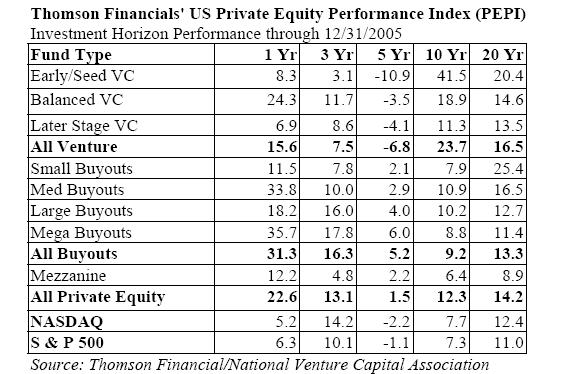
The NVCA and Thomson Financial recently released private equity performance data.

The chart provides a twenty year comparison between the returns to specific private equity strategies, as well as to the NASDAQ and S&P 500.

The private equity returns are net of management fees and carry. 71% of the private equity gains reflect realized returns, while the balance of the total return is calculated by taking the current net asset values of the funds as reported to limited partners.

In the last ten years, limited partners have received distributions totaling $202bn, or an average of $20.3 bn per year, while over the same period limiteds made $829bn in commitments, or an average of $83bn per year.

While the 20 year early stage vs S&P 500 risk premium is only 9.4%, over a 20 year period this represents a 6x difference in total dollars returned.

I am banking on the fact that the ability of top firms to maintain access to non-public information, ideas, entrepreneurs, and information asymmetries will support the continued historical investment performance of early stage venture capital despite the 2x increase in number of VC firms, 1.9x increase in number of VC professionals, 2.5x increase in the amount of VC raised, and 3.2x increase in the average capital under management over the last ten years.

Early stage VC is a tough, tough business. I believe that the best firms demonstrate that a commitment to supporting the entrepreneur, while working to create an unfair advantage with respect to information and access to opportunity supports extraordinary performance relative to the industry at large. It will fascinating to watch if the rolling 20 year returns to early stage venture remain in the 20+% range.

Wednesday, June 28, 2006

Top Ten VC Blog List

Thanks to Andrew Fife for putting together his list of favorite VC blogs. Importantly, I appreciate his kind words about my blog and posts.

All the authors listed offer great insights and perspectives on the start-up and vc worlds. A hallmark of our era is the wonderful transparency and direct access that blogs afford to the ideas and experiences of members of our industry. Great to read and fun to learn from.

Omniture

Congratulations to Josh James, John Pestana, and the Omniture management team on yesterday's IPO.

Also, congratulations to Hummer Winblad's Mark Gorenberg, who led Hummer Winblad's investment in Omniture.

Sunday, June 25, 2006

PostApp

This week, Hummer Winblad portfolio company PostApp announced funding and the private beta of its WidgetBox service at SuperNova 2006. The press release can be found here.

TechCrunch wrote an excellent overview, as did Silicon Beat.

The funds will be used to pioneer a new type of marketplace for web-based widgets, called Widgetbox™, that enables the placement of many types of applications, functionality and content into blogs, personal homepages, social networking sites, and auction pages.

A web widget is a piece of web service-based interactive content that can be dynamically embedded into a web page. For example, a web widget can be a auction listing, contextual search box, a game, a score box displaying a set of statistics, a weather box, an advertising box or any other functionality to be embedded on a web page such as a blog, personal homepage, social networking profile, or auction page.

Web widgets, sometimes called gadgets or modules, are increasingly used by web publishers to enhance their web pages, and web service developers are now frequently making their technologies available as web widgets. Many different technologies can be used to develop widgets: HTML, JavaScript, AJAX, Flash, Java Applets, and any web application platform: J2EE, LAMP, Perl, Ruby, etc.

PostApp is creating a marketplace that connects web widget developers with bloggers and other personal publishers. Widget developers include online services seeking widespread widget distribution such as Yahoo! and eBay, as well as small independent widget developers.

PostApp offers innovative technology to ease the pain of widget management including the Widgetizer Engine™, a powerful but simple tool that lets you turn anything on the web into a widget, as well as tools that make it easier for bloggers to control their widgets quickly and intuitively.

Interested developers and users can sign up for the private beta here.


Akimbi

Congratulations to the board, management team, and employees of Akimbi on their successful sale to EMC. Mitchell Kertzman and Hummer Winblad co-led the Series A investment in Akimbi and the acquisition is a testament to the vision and hard work of the entrepreneurs - James Philips and Wilson Huang - and the team.

Akimbi extends the virtualization metaphor into the test and development marketplace.

Akimbi's Virtual Lab Automation System provides development and test infrastructure that automates and virtualizes the rapid setup and teardown of complex multi-machine software configurations, shaving man-months off of software development projects and saving development orgs from having to physically provision test configurations.

Congratulations to all.

Wednesday, June 14, 2006

Morgan Stanley 2006 CTO Summit

Last night, I attended Morgan Stanley’s Sixth CTO Summit. As I described in a prior post, Morgan Stanley’s CTO conference is a very well run and managed event that brings the firm’s top 40 technologists to the valley to meet and interact with venture capitalists and start-ups.

Since the first summit six years ago, Morgan Stanley spent $12.5bn on IT. Importantly for attendees at the CTO Summit, that spend includes millions with 30 start-ups, or 11% of the total companies that were sourced by Morgan Stanley at the summit. Morgan Stanley is expert at deploying technology from both ends of the bar bell – large vendors and the best and brightest innovators. Morgan Stanley first met, at the CTO Summit, and later bought technology from VMWare, Transitive, iRise, Avamar, and others.

I enjoy attending the summit and am often struck by Morgan Stanley’s ability to concurrently scale the technology environment with very little increase in total spending. For example, since 2001:
• Trade volumes are up 7.5x
• Bandwidth is up 20x
• Business data is up 4.75x
• Servers/computers are up 3.5x
• Business connections are up 8x
• The IT group now manages 68,000 desktops, 16,000 servers, 4.5 PB of storage, 10,000 mobile devices…

And yet, the CAGR of IT spend is ~2%. Remarkable. The IT department is allowing Morgan Stanley’s core business to grow and scale without a related increase in IT costs that would reduce the marginal profitability of such growth. In some sense, IT is a fundamental source of operating leverage. A core element of this accomplishment is the use of innovative new technologies.

Key, well-known, sources of savings are:
• the move from SMP to blade servers,
• RISC to x86,
• Unix to Linux,
• virtualization,
• automation,
• 1 GigE to 10 GigE,
• and an increase in the ratio of severs/switch port.

Part of the summit involves Morgan Stanley delineating sources of ongoing cost and a request for technologies to blow out bottlenecks.

Transitive and iRise were recognized as two companies that help meet that mission. Transitive, which allows any software application binary to run on any processor and operating system, helps Morgan Stanley move applications off of expensive legacy hardware. iRise, which is a visual requirements gathering and prototyping solution, helps reduce the cost of failing to deliver applications that meet customer expectations.

With respect to SaaS, Morgan Stanley (Jeff Birnbaum) made several interesting comments. They segment SaaS into three models: web based delivery of applications, Citrix-like terminal emulation with server-side processing, and Softricity-enabled and client-side processing and delivery of rich client applications that require no client installs.

Morgan Stanley views web-based SaaS as, pejoratively, the 3270 equivalent, which demands large back-end server farms and limited user experience. They see a continuing demand for rich client applications, beyond what AJAX delivers, and see Microsoft’s acquisition of Softricity as the most significant new technology of the last 12 months. Softricity streams applications for client-side processing without requiring the .exe to be installed and managed on the desktop. Softricity allows Morgan Stanley to avoid the need to deploy and manage .exes on 60k desktops, while providing traditional rich client application user-experience. It will be interesting to follow what MSFT does with the technology – perhaps Softricity will provide MSFT an articulate, user centric response to the rise of web-based SaaS.

Tuesday, June 06, 2006

eBay Devcon 2006

This Saturday and Sunday, I plan to attend eBay Devcon 2006. I will be representing Hummer Winblad on two SDForum-managed panels.

The first centers on raising venture capital and the second on building a great team. If you plan to be in Vegas, please let me know.

Funding and Pitching Your Business (Track 101)
Speakers: Laura Merling, Executive Director, SDForum
Jim Lussier, General Partner, Norwest Venture Partners
Will Price, Principal, Hummer Winblad Venture Partners
Jim Slavet, General Partner, Greylock
Nick Sturiale, General Partner, Sevin Rosen Funds
Formulating your business plan and developing a compelling presentation for potential investors are two of the most important things you will ever do for your company. In this session, you get to be a fly on the wall as real start-ups make real pitches to a panel of real VCs. Following three 5-minute presentations, an open Q&A session gives you the invaluable opportunity to ask the panel questions about the fundamentals of funding a startup, including developing a winning elevator pitch, what VCs are specifically looking for, and how to avoid red flags that can overshadow even the most impressive business plan.

Building a Top-Tier Team in the Early Stages (Track 106)
Speakers: Laura Merling, Executive Director, SDForum
Jim Lussier, General Partner, Norwest Venture Partners
Will Price, Principal, Hummer Winblad Venture Partners
Nick Sturiale, General Partner, Sevin Rosen Funds
One of the most effective ways for venture capital partners to add value to their portfolio companies is to introduce them to talented executives. This panel will give you insight into the recruiting process within a venture capital firm, including how they identify and hire CEOs and then work with them to develop top-tier management teams. You'll also learn how potential candidates can best network with venture capitalists to gain the upper hand in a competitive job market.

Monday, June 05, 2006

Structured Interviewing

A few weeks ago, I wrote a post on applied interviewing. Mark Tsimelzon, founder and President of Coral8, replied that Coral8 is a strong advocate of structured interviewing and has had tremendous success hiring the best and brightest by a well-defined, consistently applied hiring methodology. Mark kindly offered to serve as this blog's first guest writer and the post below is a wonderful "how to" structured interviewing guide. Thanks to Mark!

A Practical Guide to Structured Interviewing ============================================

All entrepreneurs agree that building a strong team is extremely important for their startup's success, but many first-time founders are not sure how to achieve it, and are baffled by the interviewing process. The number of questions and choices is indeed confusing: where to get the resumes, whom to invite to an interview, whether to conduct interview over the phone or in person, what to ask, how to evaluate the answers, etc.

Luckily, the structured interviewing approach Will wrote about recently can help. Below are some details of how we apply structured interviewing at Coral8 ( a Silicon Valley startup building a platform for real-time analysis of large volumes of data). While what follows applies mainly to engineers (software, QA, support, professional services), the same would apply to many other job functions and positions.

Like any complex process, the interviewing process is best structured and analyzed as a sequence of phases. At Coral8, we have four phases: email interview, phone interview, the first in-person interview (with 1-2 person), the second in-person interview (3-4 others). Whether you have the same stages or not is not important. What's important is having a clear understanding of a) why you are having each phase b) what you are trying to accomplish, and c) how you are going to evaluate the results. It helps if all the interviewers share this understanding, and keep the process as consistent across candidates as possible.

Let's consider the phases separately.

Email interview
---------------

Most startups complain that just finding a good candidates is the hardest part of the process. Post a job description at any jobs web site, and you'll receive hundreds of resumes, most of them from people who are not even remotely qualified. Hire a recruiter, and he'll be sending dozens of resumes your way, again often from poorly qualified candidates. Just opening and reading those resumes is often overwhelming.

The problem may seem impossible to solve, yet a simple solution exists, and here at
Coral8 we are still puzzled as to why so few companies use it. Here is what you do: You never, ever, publish a position description without an accompanying problem that someone MUST solve before you even open their resume. The problem
should: a) have a solution that can be easily reviewed b) take the right candidate about 10 minutes to complete c) test a skill that is core to the job
d) be somewhat interesting e) allow a super-star candidate to show off their
knowledge and skill. Since most of our positions require programming in some
language, our problems often require writing a simple program or function. The language and the complexity is adjusted for each position.

For example, when we interview C++ engineers, we want to make sure they understand polymorphism and virtual functions. It's disturbing how many people who call themselves C++ programmers do not. So here is a problem we sometimes
use: Illustrate the use of the keyword "virtual" by writing a short C++ program which contains this keyword and prints "Hello, world". If the keyword "virtual"
is removed, the modified program should print "Good bye, world".

Some may say that the problem is too simple, and it certainly is. But having a problem like this in your ad does wonders. First, it greatly raises the signal-to-noise ratio. Few Visual Basic programmers will bother to send their resumes if you require a solution to a C++ problem. If they do, or when the solution is wrong, you can quickly ignore the submission. The resumes you'll get are usually from people who are really motivated, and not just sending resumes to all the positions. If somebody gives you a correct solution, you immediately know that you have a strong candidate.

Some folks may think that having a problem discourages some good candidates from applying for a job. Who knows, maybe this is true for some candidates. In our experience, however, we find just the opposite. Some of the very best employees we've hired told us that they applied for a position with Coral8, back then a stealth-mode startup, precisely because they were intrigued and challenged by our posted problems.

What if you do not publish your job openings, but instead use recruiters? Easy!
Give the problem to the recruiter, and tell him that you will not accept any resumes without the solution to this problem. Some recruiters will tell you they don't want to do the extra work. Somehow these are often the recruiters who want to charge you 25-30% of the candidate's annual salary, and you just pass on them. A startup can and should negotiate a much better deal anyway, and, more important, a good recruiter loves the fact that you have this problem!
Why? They know that you get a lot of resumes, from many sources. They want to give you the candidates who are the most qualified, and they have to qualify them somehow anyway. And what better way is there to qualify the candidates than to use your own problem?

So this is what we call an "email interview". In most cases, unless we have a high-quality referral, we refuse to even look at the resume unless we see a solution to our problem. Life is too short to look at hundreds of resumes a week.

Phone interview
---------------

Phone interviewing is a much more traditional and better understood process, so I won't spend as much time on it. What we found important is to have a list of questions for each position, and to try to follow this list every time. It makes the process much better structured, and over time you learn which questions are harder than you thought, and which ones are easier. So it helps you calibrate your expectations better.

Since we only schedule phone interviews with the people who pass the email interview, we know they have at least some basic understanding of one area. So the phone interview is used to get a slightly better understanding of the breadth and the depth of the candidate's skills. We spend about 30 minutes with a candidate, and use a part of that time telling the candidate about the company and the position. After 30 minutes, it is usually clear if you want to invite the candidate to a face-to-face interview.

1st face-to-face interview
---------------------------

All right, the candidate comes in to see you, what do you do? As Will mentioned, too many interviewers go with "Tell me about yourself?" and "Tell me about your past projects?" kind of questions. These questions are ok, but spending more than 10-15 minutes on them is counter-productive. The last question is often useless, unless you happened to know a lot about specific areas the candidate worked in. If you do not, it's hard to evaluate how challenging the tasks really were, and whether the decisions he made were correct. Instead, what you should evaluate in these situations is the candidate's presentation skills. Whether you are an expert in his area or not, any good candidate should be able to clearly explain to you what he did, what the overall project was, what the trade-offs were, etc.

But most of the time should be spent with the candidates answering a carefully constructed set of questions. This may be a religious issue, but we at Coral8 strongly believe that the questions should be clearly related to the job, and not some puzzles that test nothing but the ability to solve puzzles.

Now, if you are interviewing programmers, then please, please, please, administer some programming exercises. There is an amazing number of programmers on the market with fancy resumes, fancy titles, and fancy degrees from fancy schools, who nevertheless cannot program well. You do not want to hire people like that. Any resistance to programming during the interview (e.g, "I don't program well during interviews") should be an immediate red flag.

Of course, when you ask somebody to code during the interview, be reasonable.
Many people do not remember the language syntax or the names of library functions. That's entirely ok. We either let people use some reference guide or Google, or just tell them that they should not worry syntax. To us, what matters most is algorithms, so this is what we pay attention to. You may worry more about something else, but whatever it is, make sure you carefully construct your questions to test for that, rather than just asking whatever you feel like at the moment.

2nd face-to-face interview
--------------------------

Now, the candidate passed your interview, and you invited him to come again to "meet the team." Sounds innocent, but this is one of the more challenging parts of the process. You've got to recognize that people have widely different interviewing skills, and sometimes even great engineers make poor interviewers.
Work with them. Agree, as a team, on which questions to ask, and who will ask them. Sit in on some interviews yourself, to make sure you are satisfied with the interview dynamics. It's often best if people interview in pairs: it takes less candidate's time and lets the interviewers to learn from each other.

The 2nd face-to-face interview is also a good time to further investigate some
personality issues. For example, the team may agree that during the interview,
one team member will try to push the candidate a bit, disagree with him strongly on some issues, and see how the candidate handles it. You don't want to go too far, but it's a useful test. Nothing kills productivity in a startup like engineers who do not know how to disagree with each other professionally.

All right, everybody has talked to the candidate, now what? This is the place where it's especially important to have a well-defined process. It's best to have a formal scale, on which everybody will grade the candidate. The scale we have at Coral8 was popularized by Siskel and Ebert: thumbs up, thumbs down, and we also have many gradations in between. It's not important what you have, the scale 1-10 works just as well.

It also helps to have a threshold. Let's say your threshold is 7. It means that you do not want to hire anybody with the average score below 7. If you have only one serious candidate for the position, you just need to decide whether he scored above your threshold or not. If you have multiple candidates, you need to compare them to each other, using their combined scores.

How you combine the scores given by different team members is an art, not a science. You may start with simple averaging. Or you may want to say that anybody with one or two votes below the threshold is automatically disqualified.
You may also keep in mind that one person's 9 may well be another person's 6.
The ultimate decision is yours, but what's important is that you as a team talk about the candidate, and discuss what people like and dislike about the person.
During this discussion, you'll learn a lot about the candidate, and you'll learn even more about your team!

Conclusion
----------

There are many parts of the hiring process that we have not covered yet: formal reference check, informal reference check, offer negotiation, etc. The important point, however, may have nothing to do with hiring per se. To many people, the words "startup" and "process" are mutually contradictory. Processes are for Fortune 500 companies, right? Not so fast. Like it or not, there are many processes going on in any startup. You may recognize, structure, and optimize them. Or you may hope that they just work by themselves. The interviewing process is a good example of a process that will produce some results either way: after all, no startups die because they cannot hire any people at all. But there are certainly ways to make this process much more effective, efficient, and enjoyable for all participants.

Wednesday, May 24, 2006

Managing Growth

Today, I had the good fortune of sitting in on a lecture by Verne Harnish on how to increase the value of fast-growth companies. Verne is the author of Mastering the Rockefeller Habits and CEO of Gazelles Inc. My host, a major Internet company, brought Verne in to provide senior and mid-level management a framework and set of best practices for managing growth and creating value. The subject matter is dear to my heart and a critical area of study for any start-up manager.

Verne's book is based on the management style of John D Rockefeller. Rockefeller's management style centered on three key areas: priorities (define the 1-5 most important organizational objectives), data (identify and manage to the key metrics and leading indicators), and rhythm (run a well-organized set of daily, weekly, monthly, and quarterly meetings that keep everyone aligned and accountable). The core premise is that success is the sum total of all decisions being made in an organization. Leaders/managers influence decisions, and hence success, and need a framework regarding how best to do so.

Verne laid out his 4-3-2-1 framework for how great managers can optimize decisions.

Managers have four decision levers:
  • people (happiness, turnover, applicants/job opening, quality applications/total applicants)
  • strategy (revenue/growth)
  • execution (profit/time)
  • cash
The four key decision areas are complemented by three key disciplines:
  • priorities
  • metrics/data
  • meeting rhythm
The three disciplines relate to two key drivers
  • reputation
  • productivity
Finally, each manager needs a life coach who will push, challenge, and hold them accountable as you grow as a leader. The key point is that if Tiger Woods, Roger Federer, and Michael Dell have life coaches, why do you think you don't need one? Good point.

Often start-ups feel that data-driven management is an oxymoron, that meetings are a waste of time, and that communication by email is the most effective way to get things done in a crazy, fast-paced world.

Verne's rebuttal to that world-view is that relentless repetition and routine frees the company to shine and grow confident that energy and effort are aligned with the end game. He advocates meeting and managing to a few key priorities, daily "talk time" where the team can spend 10-15 minutes reviewing pressing issues, daily data and indicators, and bottlenecks that require resolution creates incredible energy, collaboration, and productivity. He recounted multiple examples of companies that make a daily meeting an essential rhythm of corporate life and benefit in doing so.

As an investor and ex-CEO of a start-up, I relate very well to Verne's approach. Companies need to select a framework and language of dialogue that centers the team on common goals, common metrics, and creates a forum for cross-function collaboration, problem resolution, and productivity. While this is common sense, too often common sense is lost to inertia and productivity grinds to a halt as misalignment and misdirection sap energy, cash, and momentum. Whether Verne's framework or another, picking a methodology to detail priorities, metrics, and company alignment and communication can make implicitly intelligent ideas explicit mechanisms of management and key tenents of company culture.

With respect to growth, he argued that the faster the rhythm (group meetings and metric reviews), the faster you will grow. Seems counter-intuitive that meeting time accelerates productivity - but if a short, stand-up meeting eliminates bottlenecks, realigns priorities and strategy, and enhances cross-team synergy then it is somewhat obvious productivity will be enhanced. This is very similar to the role of the Scrum master in agile development.

His site provides templates for strategic plans, daily and weekly meetings, and other useful materail.

Finally, he left the group with two sets of looming questions.

The first set is what is the business question we need to answer? What is the key problem/question whose answer will free us to grow at 2x the competition, 2x the cashflow, 3-5x the profitability, and 10x the market cap? He also suggests picking a key personal question that will similarly accelerate personal growth and development.

The second question is to determine what to stop doing. What wastes time, is inefficient, gets in the way of true productivity - answer the question and get rid of it.

Thank you to my host and to Verne for a great day and lots of food for thought.

Friday, May 19, 2006

Applied Interviewing

Interviewing candidates is an art and a challenging one. Hiring the best and brightest, establishing competency, qualifying cultural fit, and making interviewing productive are critical to the success of early stage companies. In order to avoid superficial discourse and backing-in to a process that rewards conversational skills rather than material functional skills, it is helpful to train people in structured, applied interviewing.

Too often, people walk into interviews armed with little more than a resume and ask, “so tell me about yourself.” There is an awkward dynamic where the candidate is eager to convey their strengths and the interviewer wants to qualify the “fit” of the applicant. And yet, far too often, the output of the interview is , “I liked them,” or,
“I don’t think they are a fit.”

Given the massive importance of hiring the right people, screening for the right skills, and making the best use of the time consuming interview process it really pays think about how best to evaluate talent. Structured, applied interviewing moves the interview away from conversational skills and the serial recounting of someone’s background to a focus on the specific skills that are relevant to the hire in question.

For each department, I encourage start-up teams to jointly develop a set of questions, case studies, and applied examples of the skills in question. Then train each interviewer in how to best ask the questions and use the structured material. Group evaluations can then center on a common framework and a targeted output. For example, for engineers the interview could center of logic and coding tests, for VP sales on forecasting methodologies, CRM systems of choice, pipeline and sales force management…In my case here at Hummer Winblad, the team asked me to present my thoughts on the future of the software industry, in a one hour presentation, to the full partnership. My ability to present, articulate a thesis, and provide a framework for analysis were made transparent and the final evaluation allowed for skills and cultural fit to be taken into account.

After interview-day dinners can help with the cultural fit questions, however, for the scheduled interviews I suggest avoiding the conversational approach for a vetted, structured approach that helps make the interviewing process more productive in terms of both time and results.

People, after all, are the most input into any growing business.

Thursday, May 18, 2006

SVASE - VC Breakfast

Next Thursday, I will be involved in a SVASE VC breakfast event. The event is Thursday, May 25th at 8am at 50 Fremont St in San Francisco.

Per the SVASE site:

"The VC Breakfast club provides an intimate setting and meeting place for one VC and up to ten entrepreneurs who meet for breakfast every week. The participating VC listens to each entrepreneur's extended elevator pitch and provides immediate feedback - enabling fast, effective, accessible mentoring and relationship development."

I look forward to meeting some great entrepreneurs.

Wednesday, May 17, 2006

Cash Breakeven Analysis


In the spirit of sharing best practices in start-up management, I write to share some interesting analysis on cash breakeven forecasting that I saw at a recent BOD meeting. The BOD deck included a simple yet powerful slide that helps understand the size of the "cash gap" derived from analyzing the make-up of monthly cash expenses, current monthly recurring cash revenue base, and average monthly sales price. Simply graph total montly cash expenses by category vs existing recurring monthly revenue - illustrate the size of the gap and note how many incremental sales * contribution margin it will take to close the gap.

An example is below:

Tuesday, May 09, 2006

Follow the User


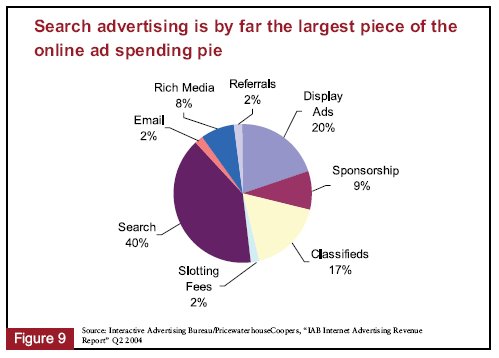
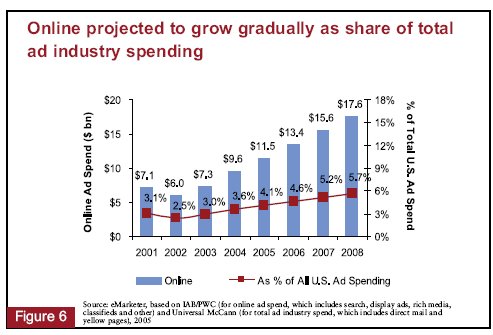
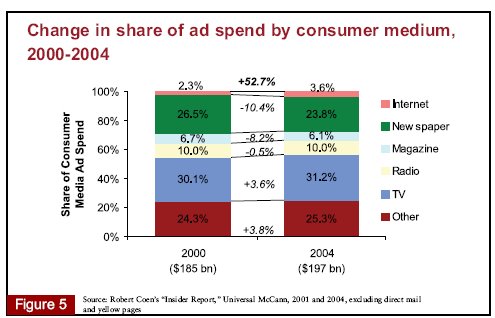
In 2006, American industry will spend $290 bn on advertising. How much will be spent on-line as a percentage of the total? 4.6%, or $13.4bn.

It is quite remarkable that despite the pay-for-performance advantages and closed-loop nature of on-line spend versus off-line spend that the number is so low. Newspaper spend is 6.6x that of on-line spend - why? How long can this last?

In many ways, on-line ad spending is changing our relationship to our service providers - more and more content and application functionality is ad-supported - email, storage, video, news, calendaring, IM, 411 calls, etc - and the companies that recognize the move to providing users high-quality product while providing advertisers high-quality demographics and targeting mechanisms are clearly winning.

Google's model: revenue = users x queries/user x ads/query x clicks/ads x revenue/click is powerful. Queries provide targeting information (what is someone looking for, watching, blogging about), clicks provide insight and accountability (how many consumers find this campaign relevant and useful), and revenue/click helps advertisers understand cost of customer acquisition and helps site that provide meaningful user populations, user segmentation and targeting monetize their users.

Questions to Ask

Quick post sharing some of my favorite questions to ask entrepreneurs thinking through enterprise business plans and strategies....the questions help me think through the merits of enterprise software start-up strategies given today's IT environment.

What is the time to value quotient? How long does it take for the customer to realize value from your product? Compare and contrast clicking on a URL to self-provision versus a two-month on-premise proof of concept.

What is the customization to value quotient? How much customization is required before the customer sees relevance and value?

How much manual labor is required to realize value? How many sales engineering and professional services hours are required to both explain the merits of the solution and have it running successfully in the customer's environment? The common element of MySQL or Salesforce.com appears to be that customers self-validate through low-risk experimentation without the need for vendor sales engineers.

What is the risk of experimentation? Does the customer need to pay for a proof of concept? Does the customer need to requisition IT resource (new servers, open up a firewall port, etc) to enable your product to showcase its benefit? As with the MySQL comment above, can the customer experiment and test the value proposition without material risk or expense?

What is the time to integration? Can the product provide standalone value that obviates the need for day one systems integration, a la SFA? To the extent integration is required, how standardized are the interfaces to relevant up and downstream systems that add value to the solution?

The consumer internet offers useful lessons and direction for the enterprise space. Customers self-provision, self-validate, self-integrate, and self-configure.