Quick post sharing some of my favorite questions to ask entrepreneurs thinking through enterprise business plans and strategies....the questions help me think through the merits of enterprise software start-up strategies given today's IT environment.
What is the time to value quotient? How long does it take for the customer to realize value from your product? Compare and contrast clicking on a URL to self-provision versus a two-month on-premise proof of concept.
What is the customization to value quotient? How much customization is required before the customer sees relevance and value?
How much manual labor is required to realize value? How many sales engineering and professional services hours are required to both explain the merits of the solution and have it running successfully in the customer's environment? The common element of MySQL or Salesforce.com appears to be that customers self-validate through low-risk experimentation without the need for vendor sales engineers.
What is the risk of experimentation? Does the customer need to pay for a proof of concept? Does the customer need to requisition IT resource (new servers, open up a firewall port, etc) to enable your product to showcase its benefit? As with the MySQL comment above, can the customer experiment and test the value proposition without material risk or expense?
What is the time to integration? Can the product provide standalone value that obviates the need for day one systems integration, a la SFA? To the extent integration is required, how standardized are the interfaces to relevant up and downstream systems that add value to the solution?
The consumer internet offers useful lessons and direction for the enterprise space. Customers self-provision, self-validate, self-integrate, and self-configure.
Tuesday, May 09, 2006


Friday, April 28, 2006
Business Plan Dependencies
In designing a business plan, it pays to ask, "what are the business plans' dependencies on variables beyond the company's control?" Why? Because the probability of success is inversely proportional to the number of exogenous variables.
Let's assume the business is dependent on five market factors materializing and each independent variable has a 50% chance of occurring - the odds of failure are then 1-(.5^5), or 96.875%. Not good. The odds of start-up success are already daunting; making the odds even more daunting by attempting to execute a plan overly dependent on external variables is a recipe for frustration.
What do I mean? Well, if a business plan requires
Let's assume the business is dependent on five market factors materializing and each independent variable has a 50% chance of occurring - the odds of failure are then 1-(.5^5), or 96.875%. Not good. The odds of start-up success are already daunting; making the odds even more daunting by attempting to execute a plan overly dependent on external variables is a recipe for frustration.
What do I mean? Well, if a business plan requires
- distribution deals to reach the end-market (ex. wireless carriers)
- deployment of new networks, infrastructure, and network devices (ex. wimax, rfid readers)
- new device proliferation (ex. Windows Mobile only)
- new technology (broadband over powerline)
- etc...
Thursday, April 27, 2006
America's Competitiveness
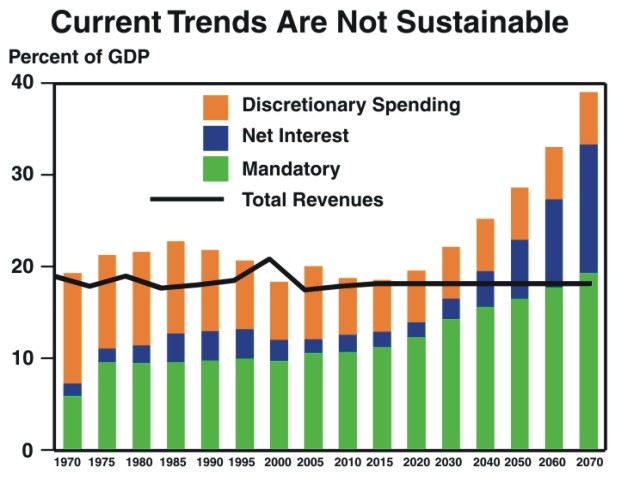
Today, the NVCA announced Magnet USA, a program designed to strengthen America's competitive position in the global economy. I am all for programs designed to stimulate and encourage innovation. Innovation creates jobs, wealth, and increased social utility. However, America's long term security and capacity to support innovation is under tremendous pressure.
Bill Gross' recent column compares the future fate of America to the current state of GM. Gross attributes GM's malaise to uncompetitive labor costs and the burden of pension and health care liabilities. He argues that we are glimpsing America's future in the GM's current struggle to remain solvent, reduce its fixed costs, and reduce future pension and healthcare obligations via employee buyouts. It is a worthwhile and scary read.
Is this overly negative thinking? I went to Whitehouse.gov and read through the OMB's assessment of America's future to find out. Unhappily, I found the following:
"While the near-term outlook for shrinking deficits is encouraging, the long-term picture presents a major challenge due to the expected growth in spending for major entitlement programs. In only two years, the leading edge of the baby boom generation will become eligible for early retirement under Social Security. In five years, these retirees will be eligible for Medicare. The budgetary effects of these milestones will be muted at first. But if we do not take action soon to reform both Social Security and Medicare, the coming demographic bulge will drive Federal spending to unprecedented levels and threaten the NationÂ’s future prosperity.
No plausible amount of cuts to discretionary programs or tax increases can help us avert this major fiscal challenge. As the accompanying chart shows, assuming mandatory spending continues on its current trajectory and the tax burden is held at historical levels, by 2040 Federal spending will accelerate to a level at which mandatory outlays and debt service would consume all Federal revenue. By 2070, if we do not reform entitlement programs to slow their growth, the rate of taxation on the overall economy would need to be more than doubled, placing a crushing burden on the economy that is required to produce the revenues to support the Government programs in the first place."
Wow. According to the OMB, by 2040 all our tax revenue will go to entitlement spending and debt service. How we will invest in the future - research, education, infrastructure - if we are seeing an ever smaller amount of US government revenues available for discretionary spending?
The technology market feels good right now - new companies, models, and innovation is strong. What frightens me is when the OMB and major bond holders forecast a financial meltdown and the eventual devaluation of the US currency, rising interest rates, and a social contract (entitlement spending) that will literally break the bank.
As the VC industry discusses globalization and the merits of offshore investing, a key part of the conversation may be the fundamental, long term macro trends that are shaping the face of future opportunity and innovation. Certainly, the OMB paints a bearish view of America and a compelling reason to start thinking about offshore investing and non-US dollar holdings.
I recently heard someone argue that capital is a coward - it seeks refuge in safe-havens. Unless, we in America are able to make difficult decisions and reduce the fixed costs in the governmemt budget, as GM is laboring to do today, capital will eventually flow out the US and to more attractive safe harbors. Hopefully, unlike energy policy/problems, these entitlement burdens will become part of the political discourse while we still have time to make painful choices to avert painful outcomes.
Tuesday, April 18, 2006
Concept to Company Update - Great Event
Tonight, VLAB and Hummer Winblad hosted a wonderful panel at Stanford Business School titled Concept to Company: Strategies for Swimming with the Sharks.
This year's Concept-to-Company event focused on the business formation of Cittio, a network management software company founded in 2001 and funded by Hummer Winblad last year. Ann Winblad moderated the panel, Jamie Lerner, Cittio's CEO served as the keynote speaker, and the panelists included Sandeep Johri, Oblix's founding CEO and currently HP Software's VP Strategy and Business Planning, Deborah Magid, IBM Software's Director of Strategy, and Elisabeth Rainge, IDC's Network Management analyst.
The evening's conversation centered on how start-ups best can enter mature markets dominated by incumbents. Network management is a $5+bn software market owned by IBM, HP, BMC, and CA. Jamie set out to answer how best to archetype an offering innovation, sales and delivery model, and marketing message that resonates with buyers in a market long controlled by larger vendors.
Jamie's advice centered on when to raise VC money, how to pick your VC partner, how to pitch VCs, how to sell against giants, and how to handle incumbents' FUD.
When To Raise VC Money
Jamie believes in bootstrapping companies. While I believe this is not a requirement, Jamie believes start-ups are best served by eliminating key market, customer, and product risks prior to soliciting venture firms. Jamie calls his strategy the "just add water approach;" walk in to meetings having validated a big market, shipped a solid product, sold paying customers, operated a well managed business, and hired a good team. He believes entrepreneurs should validate the following five hypotheses:
How to Pitch VCs
Jamie suggested the following structure for good pitches:
This year's Concept-to-Company event focused on the business formation of Cittio, a network management software company founded in 2001 and funded by Hummer Winblad last year. Ann Winblad moderated the panel, Jamie Lerner, Cittio's CEO served as the keynote speaker, and the panelists included Sandeep Johri, Oblix's founding CEO and currently HP Software's VP Strategy and Business Planning, Deborah Magid, IBM Software's Director of Strategy, and Elisabeth Rainge, IDC's Network Management analyst.
The evening's conversation centered on how start-ups best can enter mature markets dominated by incumbents. Network management is a $5+bn software market owned by IBM, HP, BMC, and CA. Jamie set out to answer how best to archetype an offering innovation, sales and delivery model, and marketing message that resonates with buyers in a market long controlled by larger vendors.
Jamie's advice centered on when to raise VC money, how to pick your VC partner, how to pitch VCs, how to sell against giants, and how to handle incumbents' FUD.
When To Raise VC Money
Jamie believes in bootstrapping companies. While I believe this is not a requirement, Jamie believes start-ups are best served by eliminating key market, customer, and product risks prior to soliciting venture firms. Jamie calls his strategy the "just add water approach;" walk in to meetings having validated a big market, shipped a solid product, sold paying customers, operated a well managed business, and hired a good team. He believes entrepreneurs should validate the following five hypotheses:
- Demand - select a large, established market to operate in and prove the innovation
- Product - develop a complete and working product
- Customers - referenceable accounts, good logos, and revenues
- Profitability - prove efficiency, discipline, and frugality
- Team - key players in place to grow
How to Pitch VCs
Jamie suggested the following structure for good pitches:
- 10 slides
- be crisp, clear, and articulate about the market need, offering innovation, and sales and delivery model
- 5 year GAAP pro formas