I write to point out a great new blog, written by Jeff Richards, a serial entrepreneur and currently a VP with VeriSign.
Jeff sold his last company, R4 Global Solutions, to VeriSign in March 2005 and is active blogger and commentator on start-ups, technology, and the market in general.
For new start-ups CEOs, check out his post, "Advice to a Start-up CEO."
Monday, November 06, 2006


Wednesday, November 01, 2006
New Start-up CEO Blog
In an earlier post, I wrote about the rise of vertical search.
Since then, Hummer Winblad led an investment in Krillion, a local search company founded by a great team of Internet veterans.
Joel Toledano, CEO of Krillion, is also the author of a great new blog, Toles Take, which covers the Internet space and lessons learned in building a VC-funded start-up.
The blog covers, among other things, Joel's Rules for Start-ups, with Rule 1 and Rule 2 up on the site and worth reading.
Welcome the blogosphere Joel.
Since then, Hummer Winblad led an investment in Krillion, a local search company founded by a great team of Internet veterans.
Joel Toledano, CEO of Krillion, is also the author of a great new blog, Toles Take, which covers the Internet space and lessons learned in building a VC-funded start-up.
The blog covers, among other things, Joel's Rules for Start-ups, with Rule 1 and Rule 2 up on the site and worth reading.
Welcome the blogosphere Joel.
Tuesday, October 31, 2006
Eating Less: The Elixir of Life
Juan Ponce de Leon traveled to the new world in search of the fountain of youth - today, the NY Times Science Section reveals the secret to extended life: caloric restriction.
In a study involving rhesus monkeys, one group of monkeys received ~50% fewer calories than another group - 445 vs 885 per day. The results are startling and "cast doubt on the long-held scientific and cultural beliefs regarding the inevitability of the body's decline."
The well-fed animals suffer from obvious signs of age, relatively more frequent incidents of diabetes and cancer, and a higher mortality rate. For humans, caloric restriction would involve reducing, on average, daily consumption of calories from 3,000 to 2,000.
Scientists are working on mechanisms other than all of us becoming ascetics to provide similar results. The story discusses an interesting experiment with earthworms whereby a mutation of the gene daf-2 led to a 6x increase in life span. The gene appears to "trick" cells into thinking that nutrients (insulin) are not available and in turn prolongs the live of each worm cell.
Increasing insulin and calorie consumption appears to accelerate cell death and reduce life span - I suppose the next time we drive by In-N-Out Burger, we will need to decide if that double-double is worth it after all!:)
In a study involving rhesus monkeys, one group of monkeys received ~50% fewer calories than another group - 445 vs 885 per day. The results are startling and "cast doubt on the long-held scientific and cultural beliefs regarding the inevitability of the body's decline."
The well-fed animals suffer from obvious signs of age, relatively more frequent incidents of diabetes and cancer, and a higher mortality rate. For humans, caloric restriction would involve reducing, on average, daily consumption of calories from 3,000 to 2,000.
Scientists are working on mechanisms other than all of us becoming ascetics to provide similar results. The story discusses an interesting experiment with earthworms whereby a mutation of the gene daf-2 led to a 6x increase in life span. The gene appears to "trick" cells into thinking that nutrients (insulin) are not available and in turn prolongs the live of each worm cell.
Increasing insulin and calorie consumption appears to accelerate cell death and reduce life span - I suppose the next time we drive by In-N-Out Burger, we will need to decide if that double-double is worth it after all!:)
Building an Open Source Business
Dave Rosenberg, CEO of Mulesource, recently published an informative article on Sandhill.com regarding his experiences in starting an open source company - from looking for funding, to legal and IP issues, to community development, and pricing, Dave's article is good food for thought.
He describes MuleSource as a second-generation open source company - that is an apt description as RHAT, JBoss, MySQL and others have paved the way with respect to business models, enterprise acceptance of open source, sales strategies, and experienced open source employees are accelerating the rise of recently funded companies.
He describes MuleSource as a second-generation open source company - that is an apt description as RHAT, JBoss, MySQL and others have paved the way with respect to business models, enterprise acceptance of open source, sales strategies, and experienced open source employees are accelerating the rise of recently funded companies.
Thursday, October 26, 2006
Trial and Error
Start-ups are, if anything, exercises in iteration. Hypotheses are formed, tested, adapted, retested, and a given company's center of gravity, culture, and path are forged in the fire of trial and error.
As an early stage venture investor, it is interesting to think about the minimum number of iterations required before a company is sufficiently baked that one's capital will be used to refine, rather than to reinvent, a given business.
Refinement and course correction are fundamental to start-ups, reinvention, however, is more related to inefficient capital consumption than it is to value creation.
I often state that genius is a function of context. The best ideas and the most valuable innovations germinate from real world observations of customer need.
Said another way, projections are dangerous, while rejections are instructive.
Start-ups, without any a priori knowledge of the customer need/problem, often project need and develop solutions in isolation and without the bearing of market reality - similar to Plato's Allegory of the Cave. It is always best to ensure that inputs are a function of reality (light of the sun) rather than projection (shadows on the wall).
My personal view is that the minimum number of iterations may be hard to quantify, however, I have observed that the best time to meet a company is ~T+6months. 6 months of commitment, iteration, and market reality seems to be the optimal balance between opportunity and trial and error.
The maturity of the plan, product spec, pitch, value prop, team's commitment, etc is exponential across time - the job of the early stage VC is to work out how much time and how many iterations and if a given company presents the optimal mix of both factors.
As an early stage venture investor, it is interesting to think about the minimum number of iterations required before a company is sufficiently baked that one's capital will be used to refine, rather than to reinvent, a given business.
Refinement and course correction are fundamental to start-ups, reinvention, however, is more related to inefficient capital consumption than it is to value creation.
I often state that genius is a function of context. The best ideas and the most valuable innovations germinate from real world observations of customer need.
Said another way, projections are dangerous, while rejections are instructive.
Start-ups, without any a priori knowledge of the customer need/problem, often project need and develop solutions in isolation and without the bearing of market reality - similar to Plato's Allegory of the Cave. It is always best to ensure that inputs are a function of reality (light of the sun) rather than projection (shadows on the wall).
My personal view is that the minimum number of iterations may be hard to quantify, however, I have observed that the best time to meet a company is ~T+6months. 6 months of commitment, iteration, and market reality seems to be the optimal balance between opportunity and trial and error.
The maturity of the plan, product spec, pitch, value prop, team's commitment, etc is exponential across time - the job of the early stage VC is to work out how much time and how many iterations and if a given company presents the optimal mix of both factors.
Wednesday, October 25, 2006
Decision Making and Uncertainty
Investing and management are in many ways exercises in decision making.
Where to invest? Where to focus? What are the risks? What is upside, the downside, and what to do and, just as importantly, what not to do?
Thoughtful investors and managers work hard to analyze the pros and cons of a given decision, however, no matter how diligent the analysis the final decision will be a judgment call that involves a large degree of uncertainty.
If imperfect knowledge is a given and yet decisions must be make, what to do?
Bob Rubin is well known as a legendary arbitrage trader, co-CEO of Goldman Sachs, and Secretary of the Treasury. His wonderful autobiography In an Uncertain World provides important insight and lessons into how to best make decisions under uncertainty. The governing principle of his book is that nothing is provably certain.
He writes,
Where to invest? Where to focus? What are the risks? What is upside, the downside, and what to do and, just as importantly, what not to do?
Thoughtful investors and managers work hard to analyze the pros and cons of a given decision, however, no matter how diligent the analysis the final decision will be a judgment call that involves a large degree of uncertainty.
If imperfect knowledge is a given and yet decisions must be make, what to do?
Bob Rubin is well known as a legendary arbitrage trader, co-CEO of Goldman Sachs, and Secretary of the Treasury. His wonderful autobiography In an Uncertain World provides important insight and lessons into how to best make decisions under uncertainty. The governing principle of his book is that nothing is provably certain.
He writes,
"In arbitrage - as in policy making - you also have to be able to pull the trigger, even when your information is imperfect and your questions cannot all be answered. You have to make a decision: Should I make this investment or not? You begin with probing questions and end having to accept that some them will be imperfectly answered - or not answered at all. And you have to have the stomach for risk."
Rubin does not believe that given the certainty of uncertainty that decision making should be from the gut or based on intuition. Rather he argues that decision making is fundamentally about calculated risks. He stresses a focus on defining a set of possible outcomes, quantifying the probabilities and payoffs associated with each outcome, and then quantifying the expected value payoffs for each outcome identified.
As an arb trader and policy maker, Rubin focused on identifying the potential upside and downside risk, the net of which is the expected value. For example, at GS he looked to take risks that would generate a return of no less than 20% on the firm's capital.
Similarly to Naseem Taleb's book Fooled by Randomness, Rubin stresses that good decisions that appropriately weighed the pros and cons can and will have bad outcomes. Also, it is clear that bad decisions can have good outcomes and that we can be fooled into believing that given the successful outcome that causality is clear - ie that we made a great decision.
Taleb's book centers on the "hidden role of chance in life and in the markets." As an investor, it is particularly apropos as one tries to identify systematic methods of creating value via investing. Investors and investees like to believe that the investment world is deterministic with clearly understood cause and effect. Understanding causal drivers of value helps to create repeatable models for investment that scale both across time and individuals in the firm. Nassim challenges us to be very careful in overascribing reason and logic to an outcome. Too often, investment outcomes are the result of randomness rather than science, ie being lucky rather than good.
He illustrates his point by comparing the world of investors to a large sample of coin-flippers. If you start with a large enough sample, someone will manage to flip heads for many months in a row. While others drop out, the surviving "flipper" will take on magical qualities and others will study his background, methods, and secrets for achieving such success. Then, of course, he will flip tails one day and "blow up."
Nassim's book instills a deep sense of humility in the reader and a recognition that time and chance are often at the root of success. I strongly recommend reading his book.
Both Rubin and Nassim provide valuable insights into how best to operate under uncertainty. There is much to learn from both books.
Successful people and firms focus on building frameworks that allow for systematic decision making and judge people ultimately on the quality of the analysis and the assumptions used to derive at a decision rather than simply on the outcome itself. We all live with uncertainty - how we make decisions day after day given that fact will separate the winners, the losers, and those simply who got lucky!
Rubin does not believe that given the certainty of uncertainty that decision making should be from the gut or based on intuition. Rather he argues that decision making is fundamentally about calculated risks. He stresses a focus on defining a set of possible outcomes, quantifying the probabilities and payoffs associated with each outcome, and then quantifying the expected value payoffs for each outcome identified.
As an arb trader and policy maker, Rubin focused on identifying the potential upside and downside risk, the net of which is the expected value. For example, at GS he looked to take risks that would generate a return of no less than 20% on the firm's capital.
Similarly to Naseem Taleb's book Fooled by Randomness, Rubin stresses that good decisions that appropriately weighed the pros and cons can and will have bad outcomes. Also, it is clear that bad decisions can have good outcomes and that we can be fooled into believing that given the successful outcome that causality is clear - ie that we made a great decision.
Taleb's book centers on the "hidden role of chance in life and in the markets." As an investor, it is particularly apropos as one tries to identify systematic methods of creating value via investing. Investors and investees like to believe that the investment world is deterministic with clearly understood cause and effect. Understanding causal drivers of value helps to create repeatable models for investment that scale both across time and individuals in the firm. Nassim challenges us to be very careful in overascribing reason and logic to an outcome. Too often, investment outcomes are the result of randomness rather than science, ie being lucky rather than good.
He illustrates his point by comparing the world of investors to a large sample of coin-flippers. If you start with a large enough sample, someone will manage to flip heads for many months in a row. While others drop out, the surviving "flipper" will take on magical qualities and others will study his background, methods, and secrets for achieving such success. Then, of course, he will flip tails one day and "blow up."
Nassim's book instills a deep sense of humility in the reader and a recognition that time and chance are often at the root of success. I strongly recommend reading his book.
Both Rubin and Nassim provide valuable insights into how best to operate under uncertainty. There is much to learn from both books.
Successful people and firms focus on building frameworks that allow for systematic decision making and judge people ultimately on the quality of the analysis and the assumptions used to derive at a decision rather than simply on the outcome itself. We all live with uncertainty - how we make decisions day after day given that fact will separate the winners, the losers, and those simply who got lucky!
Thursday, October 12, 2006
Infopia and Salesforce.com
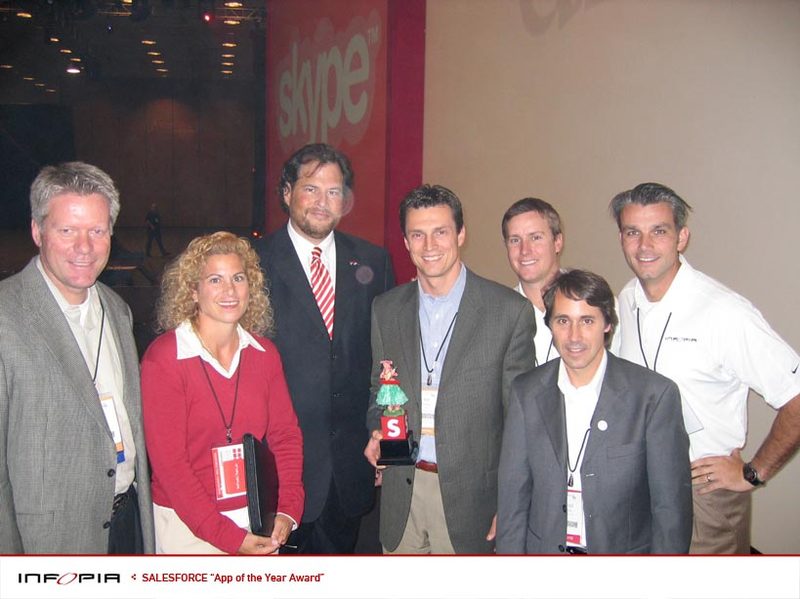
Congratulations to Infopia, a Hummer Winblad company, for winning the inaugural Salesforce.com's Appy Award Breakthrough App of the Year!
Infopia provides multi-channel online selling solutions. Infopia's Marketplace Manager solution empowers sellers to reach all possible sources of liquidity and transactions via a single merchandising, inventory, shipping, and complete order to cash system. The integration with Salesforce extends CRM records to include a customer's transactions not only on the retail site, but importantly across all marketplaces, such as eBay. This single view of the customer is a critical extension to CRM and reflects the growing importance of marketplace transactions for retailers.
Congratulations to the team on another big win!
Monday, October 09, 2006
Poison the Well
Throughout history, retreating armies have poisoned wells, burned crops, and otherwise left the victors with barren lands. Which brings me to Sevin Rosen.
Not simply content to quietly shut down after nine funds and several decades of very succesful and significant investments, the firm announced the industry broken and incapable of creating value for its limited partners. In articles in the NYTimes and interviews on CNBC, Steve Dow is making his case for an industry in decline doomed to poor investment returns.
I must say that I find it remarkable that a set of investors whose professional existence is predicated on funding disruption and innovation are publicly advocating that an end-state in the venture capital industry has been reached; that no viable models exist, no innovations exist, no disruptions exist that will allow people to rewrite the venture rule book and add value.
There are no end-states, but rather constantly changing constraints that demand adaptation to ensure survival in the brave new world.
In June 2005, Howard Anderson, a co-founder of Battery Ventures, wrote an article titled Goodbye to Venture Capital in which he lamented how too much money and companies combined with stagnant tech spending had slayed the golden goose. It has, frankly, become cliche to discuss structural challenges and to see nothing but poor risk adjusted returns on the horizon.
Strategies, however, reflect the context facing any given business. The context today is quite clear - and commented on by me here - surplus capital, relatively poor IPO market, and too many venture firms/people.
In the face of stark constraints, the challenge is to define an intellectually credible strategy for creating value that incorporates today's realities rather than ignores them. At Hummer Winblad, we focus on capital efficient software companies priced to reflect the reality that the median IT exit is sub $100m. In the ROIC ratio, the denominator is fixed by the investor and entrepreneur. If the market is fixing the numerator (iemedian exit<$100m), then the maximum amount of money invested must take the exit as a given and be as low as possible.
Business models, use of proceeds, total capital required to reach profitability, and the weighted-average post-money valuation must all reflect the new reality. Steve Dow argues that, "Maybe we have to look only at deals that are going to take a limited amont of capital." I would argue that is logically consistent with simple math: exit/investment = return on invested capital.
Adam Smith famously stated that specialization is a function of market size. Venture capital is a massive market with significant specialization. There is no, accordingly, single model of venture investing and therefore no way to comment on the model failing. Certain firms and certain strategies that do not reflect the empirical constraints of the industry and adapt and innovate will certainly underperform.
My read is that firms will need to go earlier to avoid the ugly exit realities, or they will go abroad to leverage growth markets. Mid to late stage US investing will be a real challenge. The US will see smaller funds that are economically viable in the current market.
Life is disruptive and all business people - operators and investors - need to constantly question their strategies and demand an intellectually credible answer to how to best compete given the exogenous variables at work in any given industry.
VC is no different and it is too large and specialized an industry to extrapolate industry malaise from the hardships of a few funds. While I have great respect for Sevin Rosen's track record, I am not quite sure why going on CNBC to discuss the "broken" industry is a good idea.
Not simply content to quietly shut down after nine funds and several decades of very succesful and significant investments, the firm announced the industry broken and incapable of creating value for its limited partners. In articles in the NYTimes and interviews on CNBC, Steve Dow is making his case for an industry in decline doomed to poor investment returns.
I must say that I find it remarkable that a set of investors whose professional existence is predicated on funding disruption and innovation are publicly advocating that an end-state in the venture capital industry has been reached; that no viable models exist, no innovations exist, no disruptions exist that will allow people to rewrite the venture rule book and add value.
There are no end-states, but rather constantly changing constraints that demand adaptation to ensure survival in the brave new world.
In June 2005, Howard Anderson, a co-founder of Battery Ventures, wrote an article titled Goodbye to Venture Capital in which he lamented how too much money and companies combined with stagnant tech spending had slayed the golden goose. It has, frankly, become cliche to discuss structural challenges and to see nothing but poor risk adjusted returns on the horizon.
Strategies, however, reflect the context facing any given business. The context today is quite clear - and commented on by me here - surplus capital, relatively poor IPO market, and too many venture firms/people.
In the face of stark constraints, the challenge is to define an intellectually credible strategy for creating value that incorporates today's realities rather than ignores them. At Hummer Winblad, we focus on capital efficient software companies priced to reflect the reality that the median IT exit is sub $100m. In the ROIC ratio, the denominator is fixed by the investor and entrepreneur. If the market is fixing the numerator (iemedian exit<$100m), then the maximum amount of money invested must take the exit as a given and be as low as possible.
Business models, use of proceeds, total capital required to reach profitability, and the weighted-average post-money valuation must all reflect the new reality. Steve Dow argues that, "Maybe we have to look only at deals that are going to take a limited amont of capital." I would argue that is logically consistent with simple math: exit/investment = return on invested capital.
Adam Smith famously stated that specialization is a function of market size. Venture capital is a massive market with significant specialization. There is no, accordingly, single model of venture investing and therefore no way to comment on the model failing. Certain firms and certain strategies that do not reflect the empirical constraints of the industry and adapt and innovate will certainly underperform.
My read is that firms will need to go earlier to avoid the ugly exit realities, or they will go abroad to leverage growth markets. Mid to late stage US investing will be a real challenge. The US will see smaller funds that are economically viable in the current market.
Life is disruptive and all business people - operators and investors - need to constantly question their strategies and demand an intellectually credible answer to how to best compete given the exogenous variables at work in any given industry.
VC is no different and it is too large and specialized an industry to extrapolate industry malaise from the hardships of a few funds. While I have great respect for Sevin Rosen's track record, I am not quite sure why going on CNBC to discuss the "broken" industry is a good idea.
Thursday, October 05, 2006
Mulesource/CSFB
Jason Maynard, the lead software analyst for CSFB, published today a research brief on the significance and potential of Mulesource. His key comments follow: a powerful endorsement of the company and opportunity.
The Mule is Kicking
The Mule is Kicking
· Earlier this week MuleSource, a startup enterprise service bus provider, made its public launch as "the open source choice for integration and SOA." MuleSource raised over $4 million in venture capital funding from Hummer Winblad Venture Partners and Morgenthaler Ventures. MuleSource is headed by CEO Dave Rosenberg and CTO Ross Mason.
· We think this is an interesting company to watch since the ESB is the foundational layer for SOA and MuleSource has perhaps the most mature and widely adopted open source ESB. To date, Mule has more than 200k downloads, a community of over 500 developers, and is in production with over 100 organizations including several in the Fortune 50. In addition, the overall market being addressed by MuleSource is relatively big ($8.5B in software license and $132B in services according to Gartner), which should provide good opportunity for the company to grow.
· The early deployments of Mule have been for SOA and integration at the edge of the network. A few of the more advanced customers have progressed quickly and are now running the product as an enterprise backbone including a few transaction-heavy processing environments in the financial services market. The company hasn’t publicly disclosed any of its customers but we have heard good feedback about the product from many users. Mule’s business model is to offer subscription support contracts in a similar manner to other open source providers.
· Mule is designed to be open and agnostic with nearly all leading application servers, business process management tools, registry offerings, and standard security frameworks. One argument for open source SOA is that it can help solve some of the mundane and one-off architectural challenges for integrating niche applications and systems. The company has been pleased with the value-add from the community around developing new integration adapters. So far nearly 30% of the community is active in offering bug fixes and domain expertise around integration modules.
· One interesting trend to watch is the uptake of the SMuT stack (Spring, Mule, Tomcat) as an alternative to traditional application servers. Their positioning around the edge could siphon some business from the application server market and pop up as a potential alternative to other SOA offerings from JBoss (Red Hat), BEA’s Aqualogic, and TIBCO’s Matrix offerings. Mule is not positioned directly against incumbent messaging providers like TIBCO or IBM since it will take some time and proof points to validate their capabilities. Mule is still very in its lifecycle but should grow quickly given strong usage and product adoption. We don’t think this will disrupt business for the established players in the next year or so but it is an interesting seed that could alter the space in the longer term.
Monday, October 02, 2006
Mulesource
The inevitable march of open source software up the stack continues with Hummer Winblad and Morgenthaler's investment in MuleSource, reported here by Cnet's Stephen Shankland.
MuleSource develops and supports Mule, the leading open source Enterprise Service Bus (ESB) and Integration Platform. At funding, the Series A company is blessed with an active developer community (200,000 downloads), Fortune 50 enterprise deployments, and the enviable value proposition of superior, standards-based products available at a fraction of the cost of commercial source alternatives.
Mule is a Java-based platform that enables enterprise developers to perform a wide variety of integration tasks, from bringing new applications into production, to modernizing legacy applications and platforms, to enabling SOA (Service-Oriented Architecture). Mule's programming model enables faster integration results than proprietary solutions, at a fraction of the cost. And unlike proprietary approaches that frustrate users with complex, closed frameworks, specialized skill sets and architectural lock-in, Mule’s modular design enables enterprise developers to take integration into their own hands.
Enterprise IT organizations must grow IT capacity in a non-linear relationship to revenue and transaction volume growth. The move to SOA and composite applications requires that IT organizations make systems and applications available to an ever widening array of consuming systems and applications. Integration, traditionally a source of high-costs, must provide operating leverage -ie support the capacity of increased integration without a linear increase in the cost of integrating the nth system.
RDHT, MySQL, and others offer a mechanism of adding capacity at greatly reduced costs - keeping IT budgets flat to 1-2% up while adding 30-50% incremental capacity.
MuleSource is fundamentally aligned with IT's mandate to be a source of operating leverage for the business and it will be a great company to watch.
Also, the CEO Dave Rosenberg is an active blogger and co-writes InfoWorld's open source blog. Check it out.
Friday, September 29, 2006
Scalent

IT professionals face the dichotomy between server sprawl and low asset utilization.
Between production, failover, disaster recovery, test, and development, many enterprises face 100% year over year server growth. For every server in production, another four or more are in place to support the deployment and development of a given application.
At the same time, server utilization remains anemic, often less than 15%. What drives such waste and inefficiency? Why the continued sprawl if existing resources remain available for consumption?
The problem lies in the inability to easily repurpose servers from one application to another. Repurposing is shackled by three constraints: 1) software constraints, 2) LAN constraints, and 3) SAN constraints.
Operating systems and applications are hard to change independent of powering down the server, servers are bound by their LAN IP addresses and require reconfiguring and often recabling to be available to other network resources, and servers, via HBAs, are hard-bound to certain LUN segments on the storage network.
Accordingly, it is often quicker, easier, and cheaper to simply add a net new server in the data center then it is to repurpose a server from one application use case to another.
Thankfully, Scalent, a Hummer Winblad portfolio company, provides a solution that frees servers from the three shackles noted above and allows IT to instantly repurpose existing assets - servers, LAN connectivity, and storage access - for alternate use.
Scalent virtualizes all the assets required to deploy a business system and by providing a virtualized abstraction eliminates the physical constraints to changing server A from running application B to application A on the fly.
Repurposing servers eliminates the driver behind server sprawl and allows IT organizations to dramatically increase utilization, and hence return on assets.
Scalent recently received an outstanding and in depth review from InfoWorld's Paul Venezia. The report outlines a set of detailed deployment use cases and provides strong validation of the approach and implementation.
Paul writes," Not many products truly deliver what they promise. Scalent, however, comes as close to keeping its pledge as anything I've seen. Scalent is attempting - and succeeding - at reaching the pinnacle of datacenter management: a truly adaptive infrastructure."
Well said.
How Pure is Your Model
Rightnow Technologies is a leading provider of customer experience management solutions. Based in Bozeman, MT, the company boasts a $500m market cap, $100m in run-rate revenue, and a price to sales ratio of roughly 5x. The company provides software to its customers via multiple delivery models - on premise, on-demand single-tenant, and on-demand multi-tenant.
Salesforce, on the other hand, is a pure, read on-demand multi-tenant, SaaS play and enjoys a $4BN market cap, $472m in run rate revenue, and a 8.5x price/sales ratio.
As entrepreneurs architect start-up software companies, it is worth asking the following question: how much of Salesforce's 70% multiple premium is a function of the purity of their software delivery and pricing model?
When questioned why he supports so many delivery options, Rightnow's CEO, Greg Gianforte, answers that he sells the customers what they want. If they want on premise, fine. If they want their own instance of the application on-demand, fine. If the want multi-tenant on demand, fine.
While there is no question that being customer driven is a sound business trait, the complication arises when saying "yes" to customer demands introduces systematic weaknesses into your operating model. These weaknesses tend to frustrate the ability to realize economies in development, pricing, development, and sales force training.
Many of the bootstrapped start-ups that I meet with face this exact challenge - how can you say no to a customer when you need to make payroll? Why not agree to sell customer B what they want, even if it is inconsistent with what we sold customer A?
Where is the fine line between being customer driven and being a custom development shop building one-off products?
The economics of multi-tenant software are well understood:
At Hummer Winblad we are sympathetic to companies who perform "unnatural acts," ie deviations from their model, to win business. Teams, however, must be very careful that in pleasing customers they don't alienate investors who question the wisdom and sustainability of impure operating models.
All revenue is not created equally, and I posit that "good" revenue that reinforces efficiencies and the scalability trumps absolutely higher revenue. For start-ups, purity is a virtue worth aspiring to.
Salesforce, on the other hand, is a pure, read on-demand multi-tenant, SaaS play and enjoys a $4BN market cap, $472m in run rate revenue, and a 8.5x price/sales ratio.
As entrepreneurs architect start-up software companies, it is worth asking the following question: how much of Salesforce's 70% multiple premium is a function of the purity of their software delivery and pricing model?
When questioned why he supports so many delivery options, Rightnow's CEO, Greg Gianforte, answers that he sells the customers what they want. If they want on premise, fine. If they want their own instance of the application on-demand, fine. If the want multi-tenant on demand, fine.
While there is no question that being customer driven is a sound business trait, the complication arises when saying "yes" to customer demands introduces systematic weaknesses into your operating model. These weaknesses tend to frustrate the ability to realize economies in development, pricing, development, and sales force training.
Many of the bootstrapped start-ups that I meet with face this exact challenge - how can you say no to a customer when you need to make payroll? Why not agree to sell customer B what they want, even if it is inconsistent with what we sold customer A?
Where is the fine line between being customer driven and being a custom development shop building one-off products?
The economics of multi-tenant software are well understood:
- lower research and development costs (eliminate the need to support multiple code bases, custom patches and the need to port the software across multiple hardware and O/S stacks)
- lower support costs (eliminate on-premise one-off configuration complexities that complicate root cause analysis, eliminate need to support old versions of the product)
- lower sales costs (standard pricing and delivery options vs complex pricing lists)
At Hummer Winblad we are sympathetic to companies who perform "unnatural acts," ie deviations from their model, to win business. Teams, however, must be very careful that in pleasing customers they don't alienate investors who question the wisdom and sustainability of impure operating models.
All revenue is not created equally, and I posit that "good" revenue that reinforces efficiencies and the scalability trumps absolutely higher revenue. For start-ups, purity is a virtue worth aspiring to.
Monday, September 25, 2006
Widgetbox Launches
UPDATE: Click here to watch their very successful pitch at DEMO.
Widgetbox, on on-line directory of web widgets for blogs and other webpages, launches this week at Demo.
As an open web widget marketplace, Widgetbox serves the needs of both web widget developers and web personal publishers, including bloggers, web site and profile developers, participants in web auctions and others.
Widget developers using Widgetbox include the very small, independent developers and the very large such as Yahoo!, AOL, and eBay. At launch, Widgetbox is proud to announce partnerships with 38 of the web's leading companies, including Typepad, Meebo, and AOL Pictures. At launch, the directory includes over 290 widgets, a number that grows by the day due to a very popular developers' program.
Central to the power and simplicity of Widgetbox is the Widget Syndication Platform. This technology enables:
- Live Widgets: Widgets are always live within blogs and web pages; they can be re-configured instantly and without touching HTML code.
- Smart Blogs: Widgets can be “tag aware”, meaning a web publisher can make widgets react to the content of their web site. For example, an image widget might display images related to the content of the most recent blog post.
- Widget Panels: Drag and drop placement makes it easy to install and manage widgets within Widgetbox. See the Technorati widget on my blog as an example.
I believe that web widgets represent the lowest common denominator for the adoption and usage of web services. Widgets leverage the millions of dollars invested in web services, the power of syndication - ie the consumption of functionality "off domain," and the ease of use of Flickr.
Like AdSense, it is critical that web companies allow users to consume web services at locations of the consumers' choosing. Widgetbox is a powerful innovation in making that consumption easy and powerful - a rare combination.
For those of you who blog or maintain a web page, I encourage you to sign up and begin to enrich your users’ experience with relevant widgets that add to the mission of your site.
Wednesday, September 13, 2006
Thoughts on Venture 2.0
Peter Rip posted an interesting analysis of an emerging alternative asset model – the platform strategy, whereby a single firm offers LPs exposure to a full range of public and private equity asset classes – early, mid, late, PIPE, LBO, public, etc.
While it is an undeniable fact that platform strategies are on the rise – Carlyle, Pequot Capital, Farallon, etc – I am not a believer in the approach.
Why?
1) conglomerates are a discredited concept
a. history suggests that conglomerates do not in fact allocate capital more efficiently than capital markets
b. platform strategies leverage the very same arguments that conglomerates once did to justify their existence
c. investors perform better when they create return/risk appropriate portfolios than when they outsource portfolio construction to a conglomerate
2) platform strategies create an adverse selection problem
a. the best LPs will want pure play exposure to asset class segments and risk profiles
b. LPs who see value in abdicating portfolio selection are probably not the best nor brightest
3) Platform strategies create GP/LP alignment problems
a. While the accumulation of assets and the leverage of LP relationships across strategies clearly lines the pockets of the firm’s principals, it is unclear that larger, diversified funds lead to better risk/adjusted returns
b. Strategy drift in chase of larger platforms may negate the value in sustained focus and pure play execution in an area of one’s true competence
4) Incentives and management
a. How do you pay people for collaboration across strategies – how do you create systematic flow of information?
b. How do investors, typically not by nature great managers, manage the complexity of multiple markets, geographies, risk profiles, competencies…
5) Who has a bigger d*ck problems
a. Some strategies scale more than others
b. How do you avoid smaller strategies partners being marginalized by the larger strategy partners – see Apax early stage experience
6) Focus and decision making
a. Sourcing deals, syndication partners, service provider partners, terms, competition, etc all change as you move along the risk spectrum
b. The lack of common ground makes investing in ecosystem partners, deciding where and why to invest, and having your “partners” add value to your decision making process a real challenge
My own view is that the best LPs will prefer boutiques and will seek to build return maximizing portfolios across pure-play exposures to risk - this clearly is inverse to investors building platform companies predicated on LPs outsourcing their risk allocation to groups that will build that basket for them.
Tuesday, September 12, 2006
Baynote
This year marketers will spend $5 bn on search marketing. Companies are waking up to the power of search engine optimization and paid search marketing as an effective mechanism for customer acquisition and driving traffic.
Optimizing click through rate is a critical goal and the end result is traffic that lands at your domain. Then what?
How many of you have searched on a company site for the main product, a product data sheet, an officer of the company, contact information and been able to find nothing? Let's take an example, sorry to pick on Cisco...Go to their web site and type in "wifi access point" into the search box. Hit enter and you will find this is the number one result.
Now Cisco spent $500m acquiring Linksys and I am fairly sure they would rather have customers get to a page about wifi products!!
Luckily, Baynote has an answer for you. Baynote recently received Inc 500's 2006 "Best of the Web for Smarter Searching" award.
Congratulations to Jack Jia and the Baynote team and John Hummer for a great launch to date and for the award.
Optimizing click through rate is a critical goal and the end result is traffic that lands at your domain. Then what?
How many of you have searched on a company site for the main product, a product data sheet, an officer of the company, contact information and been able to find nothing? Let's take an example, sorry to pick on Cisco...Go to their web site and type in "wifi access point" into the search box. Hit enter and you will find this is the number one result.
Now Cisco spent $500m acquiring Linksys and I am fairly sure they would rather have customers get to a page about wifi products!!
Luckily, Baynote has an answer for you. Baynote recently received Inc 500's 2006 "Best of the Web for Smarter Searching" award.
Baynote was selected based on its on-demand Content Guidance offering and the company'’s success rate in helping website visitors reach their objectives by distilling visitor search and navigational behaviors into the Wisdom of Community. Using this Wisdom, Baynote dynamically adapts website search and website navigation for each user, vastly improving the conversion potential and usefulness of any business website.
Baynote customers on average realize more than a 20x increase in search-driven conversions of web visitors, turning viable prospects into leads on their websites. In addition, site navigation is streamlined significantly, with a reduction from 6 to 1 in the average number of clicks needed to find information and complete transactions.
Now, if the market is going to spend $5bn driving traffic to their domains, why not spend incremental dollars to ensure that customers find what they are looking for!!Congratulations to Jack Jia and the Baynote team and John Hummer for a great launch to date and for the award.
Monday, September 11, 2006
Widgetbox Competition
While you may never win the US Open or American Idol...Widgetbox's Widget Contest may be your ticket to glory:)
Widgetbox, a Hummer Winblad portfolio company, is the leader in creating a Web widget marketplace that provides widgets for use with blogs, social networks, auctions and web pages. Om Malik wrote a wonderful article on the web widget phenomenon and the company, which can be read on CNN here.
The company recently announced a widget contest, with the goal of identifying the most creative and useful web widgets. The prizes and ground rules follow:
Widgetbox, a Hummer Winblad portfolio company, is the leader in creating a Web widget marketplace that provides widgets for use with blogs, social networks, auctions and web pages. Om Malik wrote a wonderful article on the web widget phenomenon and the company, which can be read on CNN here.
The company recently announced a widget contest, with the goal of identifying the most creative and useful web widgets. The prizes and ground rules follow:
Grand Prize
The winning widget will be shown in the Widgetbox presentation at the DEMOfall conference the week of September 25. This presentation will be seen by journalists, VCs and many of the movers and shakers of the blogosphere.
The Four Runners Up
Each of the four runners up gets a week as the top Featured Widget on the Widgetbox front door, a Lego Mindstorms NXT kit, and a 100% genuine Widgetbox T-shirt. If you win, we'll ask you for your shipping address.
Deadline
- All entries must be received by the end of the day on Wednesday, Sept. 20.
- You can continue to make changes to your widgets after you submit them.
- The winners will be privately notified via email on Friday, Sept 22. A public announcement will be made at DEMO.
Judging Criteria
Things that will influence the judges:
- Innovativeness. What we'd really love to see is a "we didn't know that was possible!" moment.
- Web 2.0-ness. Mashiness, thick clientosity, usability, beauty.
- Usefulness. For example, a screensaver widget probably won't make the cut.
- Widgetboxiness. Whether it shows off Widgetbox features such as Tag Awareness.
Eligibility
- Contestants must be 18 years or older.
- It is open internationally. Contestants do NOT have to be a US citizen.
- It is open to all widgets, even those that have already been registered on Widgetbox.
- Contestants may submit multiple widgets.
How To Enter
Send an email to support@widgetbox.com with the name of your widget. If you'd like to point out features of your widget in the email, go ahead.
We'll email you a confirmation that your submission has been received.
Who Are The Judges?
Every member of the Widgetbox staff will weigh in. We're going to have a big Judgment Day party, with pizza and veggie samosas, and stay as long as it takes.
Thursday, September 07, 2006
Consumer Health and Prospects for VC

Do you ever feel a disconnect between the images on TV from Iraq and the daily reality of life here in the Valley, of the price of crude and the latest funding announcement, of the energy and optimism of the time with the stories of unfunded pensions and skyrocketing household debt?
With out sounding alarmist, what does the possibility of a real estate/consumer-debt driven recession mean for the sustainability of that disconnect? I recently sat down with a smart hedge fund investor who reeled off a series of disquieting statistics that suggested that the end of a debt-driven asset bubble was nigh.
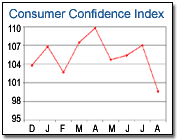
He argued that consumer spending is the engine driving America's economic engine and that the engine is beginning to sputter. For example, economists believe that consumer spending accounts for two-thirds of current economic growth. The market hangs on the monthly consumer confidence index as a predictor of future economic activity.
The VC industry is also banking on the consumer with Internet, device, and semiconductor investment theses predicated on robust consumer spending activity. In my four years in the VC business, I watched the industry move completely away and then back towards the consumer. The question this post addresses is what are the implications of early warning signs of a slowdown in consumer spending activity, a fall in housing prices, and a growing crisis in consumer confidence? Also, if a slowdown does happen, it may pay to ask if the technology in one's portfolio is pro versus counter cyclical.
Market experts are beginning to question the sustainability of economic growth dependent on a consumer facing record high gas prices, household debt, and rising interest rates. The CCI fell from 107 to 99.6 from July to August, or by 7%. The market is beginning to punish companies exposed to consumer confidence and spending ability - Toll Brothers, a home builder, is down 46% from its 52 week high, Downey Financial, a mortgage lender, is down 15%, and Tiffany and Co is down 28%.
What is driving the stock market's concern about consumer-facing businesses. In a nutshell...consumer fatigue.
- From 2001-2004 median household debt grew 34%
- the household debt service ratio hit a record high in Q106 of 18% (ie. $18 of every $100 after-tax dollars goes to service debt), up 15% from Q199
- In 2005, real disposable incomes of private households in the United States increased $93.8 billion, or 1.2%, while their debts grew $1,208.6 billion, or 11.7%.
- Total consumer spending on goods, services and new housing accounted for 92% of real GDP growth
- average household debt grew to $90,000
- a large portion of consumer debt is set to reset in the coming few years
- 22% of the $8.7 trillion US mortgages are ARM based, with 40% of all new mortgages in 2005 being ARM based
- home sales are falling, inventories are rising, and prices are falling below appraised value
The truth of the matter is that I am not at all sure how to think about the data above. It seems clear that a cyclical shift in the economy is underway with consumer spending no longer a dependable engine of economic growth. Counter-cyclical stocks, Costco and WMT, will probably benefit from a shift in spending away from high-end stores.
Similarly, in IT and on the web it is conceivable that technologies that drive efficiency, reduce costs, and deliver WMT-type benefits to consumers (be they enterprise or consumer) will do well. Companies that target discretionary spending (ie vacation travel, consumer electronics, consumer finance) will most likely suffer.
On the web, we all are benefiting from an allocation of spend from offline to online. Will a recession accelerate that allocation - ie even if the total pie of dollars shrinks, will the hard ROI of internet marketing lead to an increase in absolute dollars spent on-line?
Will a recession accelerate the adoption of open source IT solutions, lower TCO and deployment technologies such as SaaS, and virtualization technologies that increase asset utilization?
Ie, will the recent sector bets of our industry, largely shaped by the last downturn in spending, prove to be prescient and counter-cyclical in that economic distress increases the value proposition of solutions that drive out excess margin and increase productivity?
Or will a slowdown not only reduce the total pie of available dollars but also retrench spending towards incumbent vendors and established business processes (think more not less of newspaper advertising and IBM).
If VC returns and start-up prospects are truly uncorrelated to the equity markets then these questions may be moot? However, if our companies and our exits are a function of the health of the US economy then it is worth thinking how prospective investments as well as portfolio companies will fare if the consumer spigot shuts down and the 2/3 engine of our economy feels the pinch of debt loads that crowd out discretionary spending.
To use two public examples...my personal opinion is that GOOG and VMWare (proxies for start-up related activity) will prove to be counter-cyclical. GOOG delivers auditable value and makes marketing a more scientific lever to create value and ROI. VMWare delivers more flexible IT environments, whereby utilization rises, cap ex is reduced, op ex is reduced, and return on assets goes up.
Despite the ominous storm clouds on the horizon, I believe that the best lessons of the last downturn were to focus on companies that deliver value for lower costs.
It will be interesting to watch how counter-cyclical these technologies prove to be and if an economic slowdown accelerates the rate of deployment and allocation of dollars. If we are wrong, it may be a rough couple of years.
Rich Price
My brother, Rich Price, is a very gifted singer-song writer. Tonight, he is playing in SF at Cafe du Nord. For those of you in the city who are fans of David Gray, the Counting Crows, or Martin Sexton...please come out and enjoy the show.
Also, his new record, All These Roads, is now available.
Enjoy and hopefully see you tonight. If you cannot make it, check out his myspace page and/or the new record.
Also, his new record, All These Roads, is now available.
Enjoy and hopefully see you tonight. If you cannot make it, check out his myspace page and/or the new record.
Wednesday, August 30, 2006
Stanford Technology Ventures Program
Stanford's Technology Ventures Program (STVP) released a collection of online entrepreneurship education resources, which can be found here.
The Stanford Technology Ventures Program (STVP) is the entrepreneurship center at Stanford University within the School of Engineering. STVP is dedicated to accelerating high-technology entrepreneurship research and education for engineers and scientists worldwide.
The site offers free videos and other resources for aspiring entrepreneurs.
The Stanford Technology Ventures Program (STVP) is the entrepreneurship center at Stanford University within the School of Engineering. STVP is dedicated to accelerating high-technology entrepreneurship research and education for engineers and scientists worldwide.
The site offers free videos and other resources for aspiring entrepreneurs.
Saturday, August 26, 2006
Carbon Footprint
Update:
Andrew Fife sent me a link to TerraPass, a cool service that allows you to offset your car's carbon emissions for less than $80 a year. Very cool idea.
The VC industry recently added a new sector of investment: clean energy. New funds are being raised and new opportunities explored in generating clean energy. As individuals, moreover, Americans are beginning to explore their contributions to carbon dioxide emissions.
I expect that within a few years one's carbon footprint will become common knowledge and carbon diets, attempts to lower carbon emissions, will become sources of pride and conversation.
This month's Sierra Club magazine features a great article, My Low-Carbon Diet, that explores carbon footprints and the ways in which modern lifestyles generate carbon. The site also features a link to a carbon-calculator, hosted at on the web site for Al Gore's movie - An Inconvenient Truth.
The article includes a carbon index with the following statistics:
Take the carbon calculator test. Thanks to the Sierra Club for a great article.
Andrew Fife sent me a link to TerraPass, a cool service that allows you to offset your car's carbon emissions for less than $80 a year. Very cool idea.
The VC industry recently added a new sector of investment: clean energy. New funds are being raised and new opportunities explored in generating clean energy. As individuals, moreover, Americans are beginning to explore their contributions to carbon dioxide emissions.
I expect that within a few years one's carbon footprint will become common knowledge and carbon diets, attempts to lower carbon emissions, will become sources of pride and conversation.
This month's Sierra Club magazine features a great article, My Low-Carbon Diet, that explores carbon footprints and the ways in which modern lifestyles generate carbon. The site also features a link to a carbon-calculator, hosted at on the web site for Al Gore's movie - An Inconvenient Truth.
The article includes a carbon index with the following statistics:
- Average daily US carbon dioxide emissions per person: 122 pounds
- Average worldwide: 24 pounds
- Amount that could be emitted without raising carbon dioxide levels in the atmosphere: 9 pounds
- Average pounds of carbon dioxide emitted each day by:
- driving in the US, per person: 2.2 pounds
- flying in the US, per person: 3.3 pounds
- cooling the 76 % of US households with AC: 3.9 pounds
- a typical refrigerator: 3.6 pounds
- the best current 21-cubic foot fridge: 1.6 pounds
- an electric clothes dryer: 3.9 pounds
- average per kilotwatthour: 1.5 pounds
- coal-fired kwh: 2.0 pounds
- hydro kwh: 0.5 pounds
Take the carbon calculator test. Thanks to the Sierra Club for a great article.
Friday, August 25, 2006
The High Cost of Optimism
The Standish Group, which analyzes IT projects, reported that in 2004 only 29% of IT projects succeeded, down from 34% in 2002. Cost over-runs from original budgets averaged 56%, and projects on average took 84% more time than originally anticipated.
Put another way, 71% of projects did not succeed, 44% came in on budget, and only 16% came in on time. Wow!
Today's papers are rife with horror stories of projects failing - from the FBI's abandoned $170m internal IT project, to EDS' failing Navy contract, to incredible cost overruns and delays in the Pentagon's weapons development programs.
What does all this mean for venture capital and for executive teams?
Why do such smart people, across so many industries, fail to adequately account for two crucial variables in planning - cost and time?
Think about the LBO business. Most deals are auctions, and the winning bid is often simply the highest bid. In some sense, the only way to win is to forecast the rosiest outlook and forecasts.
Along those lines, I once sat through a McKinsey pitch on private equity firm performance in which McKinsey found that the winning bidder/firm overestimated the target company's first year EBITDA 66% of the time. By overestimating profit performance, the winner bidder justified a very aggressive bid.
This is not good for investors, nor for companies who set overly aggressive goal, fail to realize them, and then have to retrench, rationalize, and regroup.
Another cliche in venture is that execution separates great start-ups from losers. These numbers illustrate why that is the case. If you are great at the initiation phase - idea articulation and business plan creation - and suffer the ability to execute and control the project...then not good.
Helping young companies develop the best practices associated not just with coming up with great ideas or products, but also on executing on a budgeted plan that ensures the company comes in on time and on budget with the deliverables in hand will be of immense value.
Thursday, August 24, 2006
Company Culture and Politics
Business school alums often come back to campus and tell students that Organizational behavior proved to be the most valuable course(s) they took. When I studied at Kellogg, I never understood why.
I often meet with people who ruefully state, "my company is too political;" "there is no transparency where I work, things happen, people come and go, and no one knows why;" "I don't understand how decisions get made, things seem so random."
Politics, as we all know, is not something that just happens in Washington DC. All companies, be they start-ups or GM, are political. Politics are informal, unofficial, and sometimes behind-the-scenes efforts to sell ideas, influence an organization, increase power, and achieve other targeted objectives. Politics have a truly pejorative connotation and being accused of being a political animal is most often meant to be an insult.
Since I left business school in 1999, however, I have come to appreciate the fact that to ignore the realities of organizational life and decision making is certain to reduce your effectiveness and influence at work. I believe people often join start-ups to escape the crushing politics of large companies. The reality is that organizational polictics are a constant, while start-ups may be lower on the political spectrum/continuum than larger companies, they remain organizations populated by people. I recently read a book that provided a model with respect to understanding the organizational political continuum. The book argues there are two contrasting styles and hence models of people and companies.
The first model is idea-centric. Idea-centric people and companies are driven by the power of an idea. They view power as residing in facts, logic, analysis, and innovation. These companies are often flat, meritocracies where the best ideas win and the way to win is to make the most cogent, objectively correct arguments. These people believe in substance, in doing the right (logically speaking) thing, open agendas and transparency, and the belief that ideas speak for themselves. Ie, if the ideas are well stated, why wouldn't someone agree? I fall into this camp and often believe that if I make a logically consistent argument (ie axiomatic) then it should be clear what to do.
The second model is person-centric. Person-centric people and companies are driven by the power of hierarchy. The merit of an idea is not driven by the cogency of the logic but by the power, position, and political support for the speaker. In this world, ideas definitely do not speak for themselves, but rather image and the perception of support (who supports this, what does the VP/CEO, etc think about it). In these companies, people often don't do what's right but rather what works. Decisions, given they are not based on logic, are far from transparent and meetings are fait accomplis rather than opportunities for genuine discussion and feedback. Relationships drive support, not ideas and merit appears to lose out to coalitions and sponsorship. Loyalty, alliances, and working the system outweigh doing whats right and trusting the system to pick the "best" outcome.
In my experience, companies land somewhere along a continuum of the two models. The challenge for all of us is to understand the type of company we work in and what style we will need to adopt to be successful, or rather to quit and leave. Often the most frustrated people are idea-centric people working in people-centric companies who simply don't realize it and cannot understand why their brilliant ideas find no support or traction.
We owe it to ourselves to be self-aware. I believe this is the message the alums were bringing to students - don't be naive, calibrate your company's culture and style, and recognize that merit alone, unfortunately, is often not enough to get things done. The key is to always maintain integrity, avoid ugly ethical compromises, while working within the political constraints of your employer.
I often meet with people who ruefully state, "my company is too political;" "there is no transparency where I work, things happen, people come and go, and no one knows why;" "I don't understand how decisions get made, things seem so random."
Politics, as we all know, is not something that just happens in Washington DC. All companies, be they start-ups or GM, are political. Politics are informal, unofficial, and sometimes behind-the-scenes efforts to sell ideas, influence an organization, increase power, and achieve other targeted objectives. Politics have a truly pejorative connotation and being accused of being a political animal is most often meant to be an insult.
Since I left business school in 1999, however, I have come to appreciate the fact that to ignore the realities of organizational life and decision making is certain to reduce your effectiveness and influence at work. I believe people often join start-ups to escape the crushing politics of large companies. The reality is that organizational polictics are a constant, while start-ups may be lower on the political spectrum/continuum than larger companies, they remain organizations populated by people. I recently read a book that provided a model with respect to understanding the organizational political continuum. The book argues there are two contrasting styles and hence models of people and companies.
The first model is idea-centric. Idea-centric people and companies are driven by the power of an idea. They view power as residing in facts, logic, analysis, and innovation. These companies are often flat, meritocracies where the best ideas win and the way to win is to make the most cogent, objectively correct arguments. These people believe in substance, in doing the right (logically speaking) thing, open agendas and transparency, and the belief that ideas speak for themselves. Ie, if the ideas are well stated, why wouldn't someone agree? I fall into this camp and often believe that if I make a logically consistent argument (ie axiomatic) then it should be clear what to do.
The second model is person-centric. Person-centric people and companies are driven by the power of hierarchy. The merit of an idea is not driven by the cogency of the logic but by the power, position, and political support for the speaker. In this world, ideas definitely do not speak for themselves, but rather image and the perception of support (who supports this, what does the VP/CEO, etc think about it). In these companies, people often don't do what's right but rather what works. Decisions, given they are not based on logic, are far from transparent and meetings are fait accomplis rather than opportunities for genuine discussion and feedback. Relationships drive support, not ideas and merit appears to lose out to coalitions and sponsorship. Loyalty, alliances, and working the system outweigh doing whats right and trusting the system to pick the "best" outcome.
In my experience, companies land somewhere along a continuum of the two models. The challenge for all of us is to understand the type of company we work in and what style we will need to adopt to be successful, or rather to quit and leave. Often the most frustrated people are idea-centric people working in people-centric companies who simply don't realize it and cannot understand why their brilliant ideas find no support or traction.
We owe it to ourselves to be self-aware. I believe this is the message the alums were bringing to students - don't be naive, calibrate your company's culture and style, and recognize that merit alone, unfortunately, is often not enough to get things done. The key is to always maintain integrity, avoid ugly ethical compromises, while working within the political constraints of your employer.
Wednesday, August 23, 2006
Pat Your Head and Rub Your Tummy
Young start-ups need two things to survive: customer orders and funding.
The challenge, however, is that customers and venture investors often decide to "buy" based on very different messages.
To succeed with customers, start-ups need to articulate clear, focused value propositions. Often the nature of early stage product development is such that the product is of limited functionality and can best be sold by "narrowing the focus to broaden the appeal;" clear use cases, incremental value wrt products already in production, easy to install, and quick to show value.
Focus is often the key to early sales traction.
Investors on the other hand can often have a pejorative view of focus - VCs question nichey looking business plans ("is this a feature or a company?") and the proverbial "what is the TAM" and "can this thing scale" are often orthogonal to the product marketing challenges of selling version 1.0 products to skeptical customers.
In my experience as a VC and ex-startup CEO, young companies need to remember to develop and tell two stories. The first targets customers and explains specific, tangible, and focused value made possible via the currently available product. The second story targets the VCs and addresses the real concern with respect to scale, TAM, and a road map that supports the emergence of the company from a niche-product to a real company.
This challenge of orthogonal messages and the need to develop them simultaneously is similar to the age-old, "pat your head and rub your tummy" trick.
Some companies tell great customer stories and never get funding. Others are great at raising money, yet never seem to be able to sell the customer. It is the rare, and significant, early-stage company that can tell a story of relevancy that resonates with the buyer, while also painting a longer-term vision to VCs wrt how to build a large company that will make VCs a healthy return.
The challenge, however, is that customers and venture investors often decide to "buy" based on very different messages.
To succeed with customers, start-ups need to articulate clear, focused value propositions. Often the nature of early stage product development is such that the product is of limited functionality and can best be sold by "narrowing the focus to broaden the appeal;" clear use cases, incremental value wrt products already in production, easy to install, and quick to show value.
Focus is often the key to early sales traction.
Investors on the other hand can often have a pejorative view of focus - VCs question nichey looking business plans ("is this a feature or a company?") and the proverbial "what is the TAM" and "can this thing scale" are often orthogonal to the product marketing challenges of selling version 1.0 products to skeptical customers.
In my experience as a VC and ex-startup CEO, young companies need to remember to develop and tell two stories. The first targets customers and explains specific, tangible, and focused value made possible via the currently available product. The second story targets the VCs and addresses the real concern with respect to scale, TAM, and a road map that supports the emergence of the company from a niche-product to a real company.
This challenge of orthogonal messages and the need to develop them simultaneously is similar to the age-old, "pat your head and rub your tummy" trick.
Some companies tell great customer stories and never get funding. Others are great at raising money, yet never seem to be able to sell the customer. It is the rare, and significant, early-stage company that can tell a story of relevancy that resonates with the buyer, while also painting a longer-term vision to VCs wrt how to build a large company that will make VCs a healthy return.
Tuesday, August 22, 2006
Happy Birthday Disk Drive
Today's WSJ's Technology section ran a fascinating overview of the disk drive. The disk drive was invented fifty years ago by IBM. The first drive, called the RAMAC (random access method of accounting and control) weighed in at one ton, the disks were 24 inches in diameter, and had 5 megabytes of storage capacity.
According to the article, the capacity limit related more to the marketing department's view that no one could use more than 5 MBs than to a purely technical limit. In the last 50 years, the capacity, measured by bits per square inch, has gone from 2,000 to 135 million bits. This improvement represents an incredible 70 million times improvement.
Annual capacity increases run at 30-40% per year and the expert interviewed, Currie Mance (VP with HDS), expects storage to move from 10 GBs/one-inch drive to 100 GBs/one-inch drive over the next seven years.
While much is made of Moore's law, the related improvement in disk drive capacity is simply amazing and a true enabler of the explosion of digital media and content that is fueling the current web phenomena.
According to the article, the capacity limit related more to the marketing department's view that no one could use more than 5 MBs than to a purely technical limit. In the last 50 years, the capacity, measured by bits per square inch, has gone from 2,000 to 135 million bits. This improvement represents an incredible 70 million times improvement.
Annual capacity increases run at 30-40% per year and the expert interviewed, Currie Mance (VP with HDS), expects storage to move from 10 GBs/one-inch drive to 100 GBs/one-inch drive over the next seven years.
While much is made of Moore's law, the related improvement in disk drive capacity is simply amazing and a true enabler of the explosion of digital media and content that is fueling the current web phenomena.
Monday, August 21, 2006
Employease Sold to ADP
In November 2005, JMP Securities released a great report titled Flipping the Switch about the benefits and power of Software-as-a-Service.
The report detailed the customer benefits - independence from IT, more timely software upgrades, financial risk mitigation, lower IT costs, high service levels, and funding from operating rather than capital budgets; as well as the vendor benefits - lower R&D costs, lower support costs, visibility into customer activities, and inherent piracy controls.
While Salesforce.com is a well-deserved pioneer of the model, seven years ago Hummer Winblad invested in Employease, a SaaS provider of human resource management software. Last week, ADP acquired the company and the event serves as real validation of the management's teams foresight in building a true multi-tenant application based on a recurring revenue model. At the time of exit, the company had over 1,500 customers and tremendous visibility into future growth and revenue. ADP, a major reseller and partner, lived with the company for some time as a partner and acquired the business as part of the company's Employer Services Division.
Congratulations to Phil Fauver (CEO), the management team, and to John Hummer for the foresight to help pioneer a new business and delivery model seven years before the analyst report was published!
The report detailed the customer benefits - independence from IT, more timely software upgrades, financial risk mitigation, lower IT costs, high service levels, and funding from operating rather than capital budgets; as well as the vendor benefits - lower R&D costs, lower support costs, visibility into customer activities, and inherent piracy controls.
While Salesforce.com is a well-deserved pioneer of the model, seven years ago Hummer Winblad invested in Employease, a SaaS provider of human resource management software. Last week, ADP acquired the company and the event serves as real validation of the management's teams foresight in building a true multi-tenant application based on a recurring revenue model. At the time of exit, the company had over 1,500 customers and tremendous visibility into future growth and revenue. ADP, a major reseller and partner, lived with the company for some time as a partner and acquired the business as part of the company's Employer Services Division.
Congratulations to Phil Fauver (CEO), the management team, and to John Hummer for the foresight to help pioneer a new business and delivery model seven years before the analyst report was published!
Wednesday, August 09, 2006
Fit versus Proven Performance
Update: Brad Feld sent me a link to Will Herman's blog that provides great detail and insight to the thoughts below.
Today, I sat through a classic early stage start-up discussion. The company, an unannounced early stage software company, is in the process of bringing on the first key hires post-funding.
Work is piling up, the opportunity awaits, time is of the essence...but, there remains an underlying tension with respect to the profile and capabilities of the first key hires.
Two profiles emerged in the discussion
- a proven performer with deep domain expertise and a track record of achievement in the given function versus
-a high-caliber athlete with incredible drive and passion that can be shaped into a high-achiever but without the defacto track record and resume.
Whom to hire - the proven performer or the eager, malleable beaver?
During the debate, one of the Hummer Winblad partners reminded the group of a mental framework Jack Welch employed at GE to help structure and clarify the issues.
He used a two-by-two diagram that plots cultural fit on the x-axis and proven performance on the y-axis. There then fall out four types of people:
Jack Welch concluded that type D trumps type A all day long. Type A hires are disruptive, wreck culture, and the short-term productivity gains do not justify the long term damage to the company's psyche. Type D hires, with the correct investment in mentoring, training, and coaching become, over time, the jewels of the company.
The risk for a start-up is do you have the time, competence, and resources to develop talent?
We will look for Type C employees all day long, however, reality and time pressures often dictate a choice between fit/potential and performance. Management wisdom suggests that fit and culture can become competitive weapons in building great companies.
Do the CEO and board of early stage companies benefit from hiring unbridled passion/malleable natures over mercenaries who get sh*t done but queer culture?
I certainly know whom I would rather work with.
Today, I sat through a classic early stage start-up discussion. The company, an unannounced early stage software company, is in the process of bringing on the first key hires post-funding.
Work is piling up, the opportunity awaits, time is of the essence...but, there remains an underlying tension with respect to the profile and capabilities of the first key hires.
Two profiles emerged in the discussion
- a proven performer with deep domain expertise and a track record of achievement in the given function versus
-a high-caliber athlete with incredible drive and passion that can be shaped into a high-achiever but without the defacto track record and resume.
Whom to hire - the proven performer or the eager, malleable beaver?
During the debate, one of the Hummer Winblad partners reminded the group of a mental framework Jack Welch employed at GE to help structure and clarify the issues.
He used a two-by-two diagram that plots cultural fit on the x-axis and proven performance on the y-axis. There then fall out four types of people:
- proven performers who are lousy fits = type A
- unproven performers who are lousy fits = type B
- proven performers who are great fits = type C
- unproven performers who are great fits = type D
Jack Welch concluded that type D trumps type A all day long. Type A hires are disruptive, wreck culture, and the short-term productivity gains do not justify the long term damage to the company's psyche. Type D hires, with the correct investment in mentoring, training, and coaching become, over time, the jewels of the company.
The risk for a start-up is do you have the time, competence, and resources to develop talent?
We will look for Type C employees all day long, however, reality and time pressures often dictate a choice between fit/potential and performance. Management wisdom suggests that fit and culture can become competitive weapons in building great companies.
Do the CEO and board of early stage companies benefit from hiring unbridled passion/malleable natures over mercenaries who get sh*t done but queer culture?
I certainly know whom I would rather work with.
Saturday, August 05, 2006
Hubpages Launches
Hubpages, Hummer Winblad's latest portfolio company, launched today. I profiled the company in a prior post and TechCrunch kindly wrote on the company and service today.
Enjoy the site and good luck beating my Hubscore.
Enjoy the site and good luck beating my Hubscore.
Feedburner
Feedburner is beta testing Feedburner Networks. A Feedburner Network is a collection of blogs clustered around a particular topic.
Brad Feld details the new service on his blog and he has set up a Feedburner Network on the Venture Capital industry that you can subscribe to by clicking here.
I am pleased to be a member of the Network and congratulate Feedburner on creating a useful new service around "channels" of content.
Brad Feld details the new service on his blog and he has set up a Feedburner Network on the Venture Capital industry that you can subscribe to by clicking here.
I am pleased to be a member of the Network and congratulate Feedburner on creating a useful new service around "channels" of content.
PostApp's WidgetBox Service
Rafe Needleman of Cnet wrote a wonderful overview of PostApp's WidgetBox service. The public beta will start in a few weeks and I encourage all of you to sign up.
Read Rafe's blog post to learn why PostApp will play a key role in the future of web publishing.
Read Rafe's blog post to learn why PostApp will play a key role in the future of web publishing.
Thursday, August 03, 2006
WSJ Article: Era of Diminishing VC Returns
Today's Wall Street Journal carries an article by Rebecca Buckman titled Silicon Valley's Backers Grapple with Era of Diminished Returns. The article catalogs a series of previously well documented and systematic challenges facing the industry:
As with all systemic shocks, the VC industry is adapting and learning to live within the new systemic, rather than cylical, realities of the industry. Clearly, the move to international markets (India and China), new sectors (clean energy), and niche based funds (very early), reflect an implicit realization that the battlefield of opportunity is changing and change will be required for firms to continue to justify their existence and create value.
Brad Feld's blog introduced me to an article by Howard Anderson called Good-bye to Venture Capital. The article, written by a founder of Battery Ventures, makes a familiar, yet powerful argument that the venture industry is over-funded, structurally transformed, and doomed to generate returns far lower than what limited partners expect from the asset class and the associated risk profile. As you will read, the article indicts the industry for suffering from too many investors, too much money, and paints a dire picture of the future.
As a recent entrant to the industry, I found the article is powerful food for thought. Is the industry doomed to low double-digit returns? Are there too many of us chasing too few deals funding too many companies selling to customers with finite budgets, abundance of choice, and limited differentiation between vendors? If so, Howard is spot on, returns will fall, capital will leave the industry, and the fees will be significantly lower thereby reducing the number of professional investors in the space.
As an aside, I don't believe that the VC industry is alone is suffering from too much money. The hedge fund industry is simply exploding wrt funds under management, the number of firms, and the number of people entering the space. Capital, itself, appears to be in abundance across the alternative asset management space.
Howard makes one powerful point that resonates with any reader of Fooled by Randomness. Funds invested in the 1994-19998 time frame did extremely well. The cliche rising tides float all boats comes to mind. At a recent offsite, Eric Schoenberg (HBS prof) reminded us that returns are driven by two key components, systematic returns and idiosyncratic returns (see CAPM model). Systematic returns are market returns. Idiosyncratic returns, however, are where professional investors earn their stripes - they are returns in excess of the market.
To be a decent investor, one must at least deliver systematic returns. To be a great investor, one must deliver idiosyncractic returns. In the bubble, random investments looked genius. The systematic returns (returns for the asset category at large) were simply amazing, thereby creating great weath and perhaps reputations for genius that were more due to circumstance and timing than investing prowess.
The questions for us to ponder is what will be the future systemic returns to the venture capital asset class, and has the inflow of money and people into the venture capital industry made it impossible to generate idiosynctratic returns. Are funds' returns systematic (an index of the market) or extroardinary? Will there be a Vanguard-like vc fund that is a low-fee provider of index funds for the private markets!? What is the basis for extraordinary performance over the market index? Is the succes of vc investors and funds due to serendipity or to process?
These are key questions for investors (both general and limited partners). Can one deliver quality returns in an industry full of capital and people chasing "good" ideas?
One key difference between the public equity markets and the venture capital markets is the degree to which information is transparent. The public markets are by regulation open and transparent with data available to all.
The private markets are marked by imperfect information, proprietary insights, and information asymetries. Certain private investors simply enjoy access to information, ideas, and talent that are not generally available to others. For exmaple, certain leading firms leverage the footprint of their portfolio (talent, ideas, reach) to drive insights that lead to investments that others are not in a position to make. An obvious example, is Sequoia Capital's investment in Yahoo! and Google. With a BOD seat at YHOO, Mike Moritz enjoyed acccess to information relative to GOOG's search technology simply not available to others weighing the decision to invest in GOOG, presuming they even had the chance.
The question for venture capitalists may be as simple as, "what do I know that others don't?" With the corallary, yet vital question begging, "will I be smart enough and sufficiently certain of myself to act on such information?" For as Keynes famously once said, "Worldly wisdom teaches that it is better for reputation to fail conventionally than to succeed unconventionally."
If one knows nothing proprietary, has no unique relationships, access to ideas, and information, then life may be very challenging.
- too many firms (860 US VC firms)
- too much money ($25bn of 2005 LP commitments)
- anemic returns relative to S&P 500 (YTD 3/31/06 returns of 11.7%)
- lack of home run deals (4 of 31 Q2 exits saw 10x+ ROI)
- endowments cutting back VC allocation
- industry leaders, like Paul Ferri, commenting, "I thought by now investors would have figured out that our industry is not an economically viable business model."
As with all systemic shocks, the VC industry is adapting and learning to live within the new systemic, rather than cylical, realities of the industry. Clearly, the move to international markets (India and China), new sectors (clean energy), and niche based funds (very early), reflect an implicit realization that the battlefield of opportunity is changing and change will be required for firms to continue to justify their existence and create value.
Brad Feld's blog introduced me to an article by Howard Anderson called Good-bye to Venture Capital. The article, written by a founder of Battery Ventures, makes a familiar, yet powerful argument that the venture industry is over-funded, structurally transformed, and doomed to generate returns far lower than what limited partners expect from the asset class and the associated risk profile. As you will read, the article indicts the industry for suffering from too many investors, too much money, and paints a dire picture of the future.
As a recent entrant to the industry, I found the article is powerful food for thought. Is the industry doomed to low double-digit returns? Are there too many of us chasing too few deals funding too many companies selling to customers with finite budgets, abundance of choice, and limited differentiation between vendors? If so, Howard is spot on, returns will fall, capital will leave the industry, and the fees will be significantly lower thereby reducing the number of professional investors in the space.
As an aside, I don't believe that the VC industry is alone is suffering from too much money. The hedge fund industry is simply exploding wrt funds under management, the number of firms, and the number of people entering the space. Capital, itself, appears to be in abundance across the alternative asset management space.
Howard makes one powerful point that resonates with any reader of Fooled by Randomness. Funds invested in the 1994-19998 time frame did extremely well. The cliche rising tides float all boats comes to mind. At a recent offsite, Eric Schoenberg (HBS prof) reminded us that returns are driven by two key components, systematic returns and idiosyncratic returns (see CAPM model). Systematic returns are market returns. Idiosyncratic returns, however, are where professional investors earn their stripes - they are returns in excess of the market.
To be a decent investor, one must at least deliver systematic returns. To be a great investor, one must deliver idiosyncractic returns. In the bubble, random investments looked genius. The systematic returns (returns for the asset category at large) were simply amazing, thereby creating great weath and perhaps reputations for genius that were more due to circumstance and timing than investing prowess.
The questions for us to ponder is what will be the future systemic returns to the venture capital asset class, and has the inflow of money and people into the venture capital industry made it impossible to generate idiosynctratic returns. Are funds' returns systematic (an index of the market) or extroardinary? Will there be a Vanguard-like vc fund that is a low-fee provider of index funds for the private markets!? What is the basis for extraordinary performance over the market index? Is the succes of vc investors and funds due to serendipity or to process?
These are key questions for investors (both general and limited partners). Can one deliver quality returns in an industry full of capital and people chasing "good" ideas?
One key difference between the public equity markets and the venture capital markets is the degree to which information is transparent. The public markets are by regulation open and transparent with data available to all.
The private markets are marked by imperfect information, proprietary insights, and information asymetries. Certain private investors simply enjoy access to information, ideas, and talent that are not generally available to others. For exmaple, certain leading firms leverage the footprint of their portfolio (talent, ideas, reach) to drive insights that lead to investments that others are not in a position to make. An obvious example, is Sequoia Capital's investment in Yahoo! and Google. With a BOD seat at YHOO, Mike Moritz enjoyed acccess to information relative to GOOG's search technology simply not available to others weighing the decision to invest in GOOG, presuming they even had the chance.
The question for venture capitalists may be as simple as, "what do I know that others don't?" With the corallary, yet vital question begging, "will I be smart enough and sufficiently certain of myself to act on such information?" For as Keynes famously once said, "Worldly wisdom teaches that it is better for reputation to fail conventionally than to succeed unconventionally."
If one knows nothing proprietary, has no unique relationships, access to ideas, and information, then life may be very challenging.
Monday, July 31, 2006
Hubpages
The San Francisco Chronicle ran a great story in Sunday's paper on start-ups that live together in order to maximize productivity, cost savings, and culture building. The article profiles our most recent investment, Hubpages. Hubpages plans to open their site up for public beta in the coming week. Please check it out.
In short, Hubpages helps experts bring their knowledge online to share it with people searching the internet for information.
Wednesday, July 26, 2006
Open Source - What is the Model?
I flew to
Like many conferences, the highlights were not panel-based conversations but rather the opportunity to meet and speak with the leaders in the field – CEOs and executives from a broad cross section of open source companies. At lunch, over coffee, and at dinner, we were able to get into the nuts and bolts of open source business models and compare notes with various teams with respect to license strategies, how to build support organizations, what download to sales conversion ratios one can expect, and how/if to bifurcate the product between free and commercial.
Despite conventional wisdom that open source models allow for pull-based selling, where telesales teams reach out to pre-qualified customers who have downloaded and tested the product and ping the company to inquire about orders, leveraged development, where community developers do the lions share of the work, support processes where developers should do both development and support etc, I left struck by the lack of consensus on the optimal operating model. Conversations with various teams certainly begged the question if download driven models are more fiction than fact.
It appeared that conversion ratios on downloads were very low (1 in 10,000), that many teams were discovering the need to hire direct sales forces that made outbound calls rather than simply taking ordersJ, and that providing scalable 24x7 support that met enterprise customer scrutiny would demand more than asking developers to code 50% of the time and then get on the phone to fix a customer bug or deployment issue.
Some executives observed that they expect that at scale open source companies may look not too different from traditional software companies with respect to sales and marketing and development expenses. The argument was made that rather than a permanent shift in models (with respect to expense ratios –marketing and sales/revenue), open source really served as an on-ramp strategy that greatly reduced the capital required to reach customers and material revenue rate rates. Capital efficiency is still a great benefit but I sensed a lack of confidence that a permanent shift in operating leverage would be possible.
Another common view was that dual-license models are the optimal approach. The dual-license model – like MySQL – is premised on a single product that is common independent of license (GPL or commercial). Other approaches involve offering two products – a stripped down open source version and a commercial version with full bells and whistles. Many executives I spoke with view the latter as inconsistent with the open source value proposition and prefer a reciprocal relationship whereby users either pay with contributions back into the project (GPL) or with money (enterprise).
While the conference in many ways failed to address core business model issues it did provide a common forum for start-ups to discuss the evolving state of the open source industry and operational best practices.
Finally, despite the evolving nature of open source models one thing is clear – incumbent vendors are failing their customers with extremely expensive, difficult to deploy, and often legacy technologies. The pricing umbrella available to companies in sector after sector – system management, integration, database, app server, business intelligence – remains truly amazing. Customers are seeing 80-90% cost savings, plus access to great technology. The benefits to the enterprise of moving to open source are legion and while on the margin some questions of strategy remain unanswered, one leaves OSCON more convinced than ever that the alignment of customer interest and value/cost ratio that open source allows will continue to roil the software markets for years to come.
Subscribe to:
Posts (Atom)