Wednesday, May 17, 2006

Cash Breakeven Analysis


In the spirit of sharing best practices in start-up management, I write to share some interesting analysis on cash breakeven forecasting that I saw at a recent BOD meeting. The BOD deck included a simple yet powerful slide that helps understand the size of the "cash gap" derived from analyzing the make-up of monthly cash expenses, current monthly recurring cash revenue base, and average monthly sales price. Simply graph total montly cash expenses by category vs existing recurring monthly revenue - illustrate the size of the gap and note how many incremental sales * contribution margin it will take to close the gap.

An example is below:

Tuesday, May 09, 2006

Follow the User


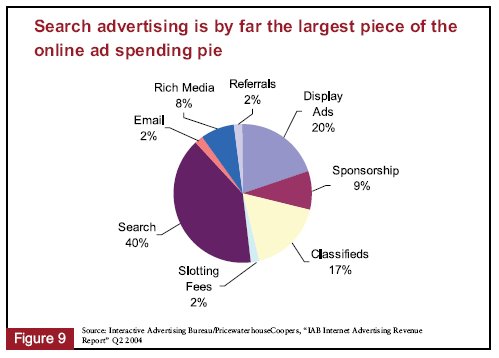
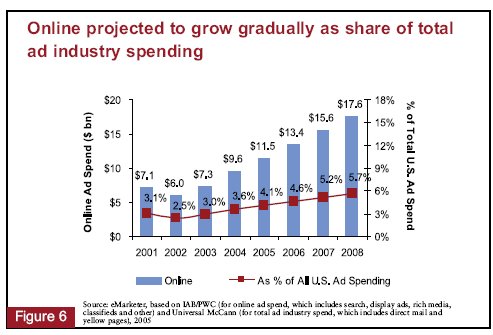
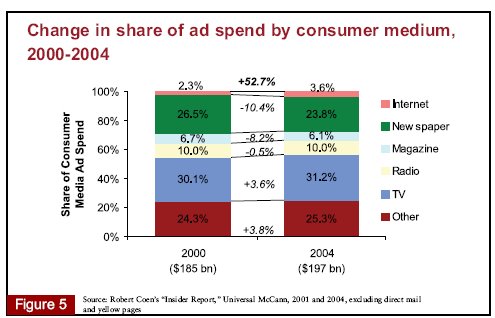
In 2006, American industry will spend $290 bn on advertising. How much will be spent on-line as a percentage of the total? 4.6%, or $13.4bn.

It is quite remarkable that despite the pay-for-performance advantages and closed-loop nature of on-line spend versus off-line spend that the number is so low. Newspaper spend is 6.6x that of on-line spend - why? How long can this last?

In many ways, on-line ad spending is changing our relationship to our service providers - more and more content and application functionality is ad-supported - email, storage, video, news, calendaring, IM, 411 calls, etc - and the companies that recognize the move to providing users high-quality product while providing advertisers high-quality demographics and targeting mechanisms are clearly winning.

Google's model: revenue = users x queries/user x ads/query x clicks/ads x revenue/click is powerful. Queries provide targeting information (what is someone looking for, watching, blogging about), clicks provide insight and accountability (how many consumers find this campaign relevant and useful), and revenue/click helps advertisers understand cost of customer acquisition and helps site that provide meaningful user populations, user segmentation and targeting monetize their users.

Questions to Ask

Quick post sharing some of my favorite questions to ask entrepreneurs thinking through enterprise business plans and strategies....the questions help me think through the merits of enterprise software start-up strategies given today's IT environment.

What is the time to value quotient? How long does it take for the customer to realize value from your product? Compare and contrast clicking on a URL to self-provision versus a two-month on-premise proof of concept.

What is the customization to value quotient? How much customization is required before the customer sees relevance and value?

How much manual labor is required to realize value? How many sales engineering and professional services hours are required to both explain the merits of the solution and have it running successfully in the customer's environment? The common element of MySQL or Salesforce.com appears to be that customers self-validate through low-risk experimentation without the need for vendor sales engineers.

What is the risk of experimentation? Does the customer need to pay for a proof of concept? Does the customer need to requisition IT resource (new servers, open up a firewall port, etc) to enable your product to showcase its benefit? As with the MySQL comment above, can the customer experiment and test the value proposition without material risk or expense?

What is the time to integration? Can the product provide standalone value that obviates the need for day one systems integration, a la SFA? To the extent integration is required, how standardized are the interfaces to relevant up and downstream systems that add value to the solution?

The consumer internet offers useful lessons and direction for the enterprise space. Customers self-provision, self-validate, self-integrate, and self-configure.

Friday, April 28, 2006

Business Plan Dependencies

In designing a business plan, it pays to ask, "what are the business plans' dependencies on variables beyond the company's control?" Why? Because the probability of success is inversely proportional to the number of exogenous variables.

Let's assume the business is dependent on five market factors materializing and each independent variable has a 50% chance of occurring - the odds of failure are then 1-(.5^5), or 96.875%. Not good. The odds of start-up success are already daunting; making the odds even more daunting by attempting to execute a plan overly dependent on external variables is a recipe for frustration.

What do I mean? Well, if a business plan requires
  • distribution deals to reach the end-market (ex. wireless carriers)
  • deployment of new networks, infrastructure, and network devices (ex. wimax, rfid readers)
  • new device proliferation (ex. Windows Mobile only)
  • new technology (broadband over powerline)
  • etc...
Too often, I see great entrepreneurs looking to fund businesses that face massive external market adoption dependencies. Skating to where the puck will be is critical, but I would just make sure the rink is built before you strap on your skates.

Thursday, April 27, 2006

America's Competitiveness


Today, the NVCA announced Magnet USA, a program designed to strengthen America's competitive position in the global economy. I am all for programs designed to stimulate and encourage innovation. Innovation creates jobs, wealth, and increased social utility. However, America's long term security and capacity to support innovation is under tremendous pressure.

Bill Gross' recent column compares the future fate of America to the current state of GM. Gross attributes GM's malaise to uncompetitive labor costs and the burden of pension and health care liabilities. He argues that we are glimpsing America's future in the GM's current struggle to remain solvent, reduce its fixed costs, and reduce future pension and healthcare obligations via employee buyouts. It is a worthwhile and scary read.

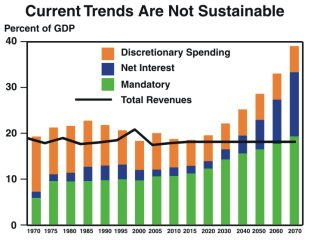
Is this overly negative thinking? I went to Whitehouse.gov and read through the OMB's assessment of America's future to find out. Unhappily, I found the following:

"While the near-term outlook for shrinking deficits is encouraging, the long-term picture presents a major challenge due to the expected growth in spending for major entitlement programs. In only two years, the leading edge of the baby boom generation will become eligible for early retirement under Social Security. In five years, these retirees will be eligible for Medicare. The budgetary effects of these milestones will be muted at first. But if we do not take action soon to reform both Social Security and Medicare, the coming demographic bulge will drive Federal spending to unprecedented levels and threaten the NationÂ’s future prosperity.

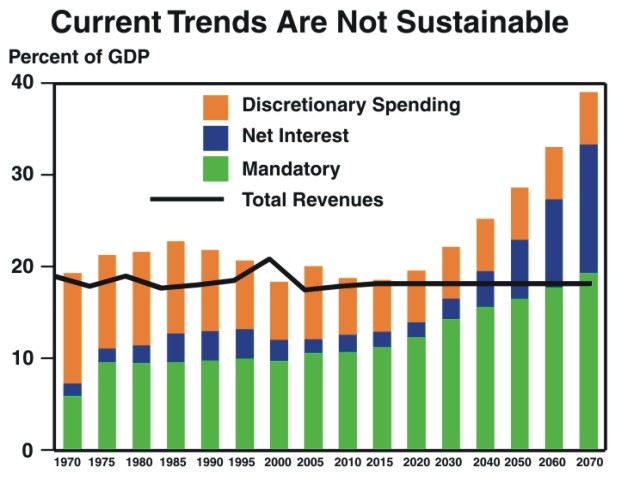
No plausible amount of cuts to discretionary programs or tax increases can help us avert this major fiscal challenge. As the accompanying chart shows, assuming mandatory spending continues on its current trajectory and the tax burden is held at historical levels, by 2040 Federal spending will accelerate to a level at which mandatory outlays and debt service would consume all Federal revenue. By 2070, if we do not reform entitlement programs to slow their growth, the rate of taxation on the overall economy would need to be more than doubled, placing a crushing burden on the economy that is required to produce the revenues to support the Government programs in the first place."

Wow. According to the OMB, by 2040 all our tax revenue will go to entitlement spending and debt service. How we will invest in the future - research, education, infrastructure - if we are seeing an ever smaller amount of US government revenues available for discretionary spending?

The technology market feels good right now - new companies, models, and innovation is strong. What frightens me is when the OMB and major bond holders forecast a financial meltdown and the eventual devaluation of the US currency, rising interest rates, and a social contract (entitlement spending) that will literally break the bank.

As the VC industry discusses globalization and the merits of offshore investing, a key part of the conversation may be the fundamental, long term macro trends that are shaping the face of future opportunity and innovation. Certainly, the OMB paints a bearish view of America and a compelling reason to start thinking about offshore investing and non-US dollar holdings.

I recently heard someone argue that capital is a coward - it seeks refuge in safe-havens. Unless, we in America are able to make difficult decisions and reduce the fixed costs in the governmemt budget, as GM is laboring to do today, capital will eventually flow out the US and to more attractive safe harbors. Hopefully, unlike energy policy/problems, these entitlement burdens will become part of the political discourse while we still have time to make painful choices to avert painful outcomes.

Tuesday, April 18, 2006

Concept to Company Update - Great Event

Tonight, VLAB and Hummer Winblad hosted a wonderful panel at Stanford Business School titled Concept to Company: Strategies for Swimming with the Sharks.

This year's Concept-to-Company event focused on the business formation of Cittio, a network management software company founded in 2001 and funded by Hummer Winblad last year. Ann Winblad moderated the panel, Jamie Lerner, Cittio's CEO served as the keynote speaker, and the panelists included Sandeep Johri, Oblix's founding CEO and currently HP Software's VP Strategy and Business Planning, Deborah Magid, IBM Software's Director of Strategy, and Elisabeth Rainge, IDC's Network Management analyst.

The evening's conversation centered on how start-ups best can enter mature markets dominated by incumbents. Network management is a $5+bn software market owned by IBM, HP, BMC, and CA. Jamie set out to answer how best to archetype an offering innovation, sales and delivery model, and marketing message that resonates with buyers in a market long controlled by larger vendors.

Jamie's advice centered on when to raise VC money, how to pick your VC partner, how to pitch VCs, how to sell against giants, and how to handle incumbents' FUD.

When To Raise VC Money
Jamie believes in bootstrapping companies. While I believe this is not a requirement, Jamie believes start-ups are best served by eliminating key market, customer, and product risks prior to soliciting venture firms. Jamie calls his strategy the "just add water approach;" walk in to meetings having validated a big market, shipped a solid product, sold paying customers, operated a well managed business, and hired a good team. He believes entrepreneurs should validate the following five hypotheses:
  • Demand - select a large, established market to operate in and prove the innovation
  • Product - develop a complete and working product
  • Customers - referenceable accounts, good logos, and revenues
  • Profitability - prove efficiency, discipline, and frugality
  • Team - key players in place to grow
It is worth noting that Jamie met all five criteria before he looked for funding. Quite simply put, he focused on providing easy to use, easy to deploy, easy to install, and simply priced products into a market long burdened by bloated products that poorly served the customer. The pain proved to be so great that he sold Gymboree and First Republic on full enterprise deals before he hired a single employee.


How to Pitch VCs
Jamie suggested the following structure for good pitches:
  • 10 slides
    • be crisp, clear, and articulate about the market need, offering innovation, and sales and delivery model
  • 5 year GAAP pro formas
    • commit to the intellectual exercise of building, with the management team, and model that lays out in detail the business model and key assumptions that drive the model
  • Demo
  • Raise amount and use of proceeds
  • Be comfortable talking extemporaneously about the business
  • Practice and iterate

Not All VCs are Created Equal

Jamie suggests that entrepreneurs select VC firms that match the following criteria:
  • Domain expertise - mentorship, advice, market knowledge, relationships, strategy, been there/done that
  • Relationship - mutual trust and respect, genuine friendship, gut instinct positive
  • Everyone rows - access to all members of the investing firm
  • Patience - recognition that there is no deadline for success and that the best plans may take longer than originally forecast
  • BOD - work hard to ensure a productive BOD dynamic and use VC BOD members to recruit value-added independents
  • Remember that you need the BOD and VCs when things go wrong and having experienced VC investors and strong relationships will be critical in navigating the storms
Selling Against the Big Guys
In order to sell against giants, Jamie laid out the following suggestions
  • He joked that selling against incumbents is more like jetskiing with whales than like swimming with sharks
  • Focus on competing with bloated products that are overly complex to install, overly complex to price, and where the cost of sale requires very large deal sizes
  • Sell into a market frustrated, scarred, and damaged by the incumbent vendors - lots of shelfware and history of failed implementations
  • Pick markets where the incumbents illustrate a history of incompetence evidenced by frequent CEO changes, failed mega acquisitions, failed customer projects, etc
  • Don't bloody your nose - sell where they cannot afford to compete (mid market or via delivery models they cannot afford to mimic). Don't take them head on - nip at their heels
  • Sell deal sizes their sales teams, cost of sales, and quota models cannot support
  • Leverage start-ups strengths
    • Speed, agility, service
    • Executive sponsorship
    • Pricing flexibility
    • Attention and support
  • Fight FUD and vendor viability attacks
    • Sell your business fundamentals when they question your viability and staying power
    • Walk the customer through the clear demand for the product, customer references and case studies, profitability or revenue run rate, and quality of the team
Jamie and the panel did a great job and for those of you who could not make it, I hope the notes above provide some insights into Jamie's great advice and bases for his great success to date.

Wednesday, April 12, 2006

Venture Stats

VentureSource, a division of Dow Jones, just released their Venture Capital Industry report for 2006. The report is co-authored with Ernst & Young.

For those who follow the VC industry, below are some interesting 2005 statistics:

  • Commitments to VC Funds, $22.2 bn. Up 18.7% from 2004
  • VC Financings, $22.1bn. Up 2.8% from 2004
  • IT Financings, $12 bn. Down 4% form 2004
  • Software Financings, $5.11bn, Down 6% from 2004
  • Number of Active Firms, 1,417
    • Down 49% from 2000, 61% if you define active as > 4 deals per year.
  • Number of exits, 397.
    • IPOs: 41, down 38% from 2004, with $2.24bn raised via IPO
    • M&A: 356, down 12% from 2004, with $27bn in total exit value
  • Number of private companies funded since 2000 net of 2005 exits: 5,406 with $132bn invested in them
    • Average of $24.4m invested in companies
    • At current exit rate, will take 13.6 years to get through backlog
  • Median M&A exit $47.5m
  • Median Pre-moneys
    • Seed $2m
    • A $5.4m
    • B $14m

Tuesday, April 11, 2006

Concept to Company

Next Tuesday April 18th at Stanford, Hummer Winblad and VLAB are hosting a great event titled Concept to Company.

For anyone considering starting a company and navigating how to take an idea to fruition, I strongly suggestion you attend. A write-up from VLAB follows:

"Every year, the MIT/Stanford Venture Lab (VLAB) has the honor of hosting a special session, called Concept-to-Company, moderated by Ann Winblad, co-founder of Hummer Winblad Venture Partners. Ann Winblad is a well-known and respected software industry entrepreneur and technology leader who has been chronicled in many national business and trade publications.

This years Concept-to-Company event will focus on the business formation of Cittio, a network management software company founded in 2001. No doubt, many people may question the viability for a startup to enter this mature market - where IBM, HP and other large companies own a majority share. Why would any VC decide to fund a start-up in this space? What strategies can be implemented to increase the chances of success? Hummer Winblad's investment in Cittio demonstrates how investors and entrepreneurs find clever ways to disrupt a mature industry.

In this panel, you will hear from the CEO of Cittio about their business formation strategies including; fund raising, product development and sales. We have also invited key representatives from IBM and HP to talk about how the incumbents plan to defend their turf."

Click here to read more on the panel.

Click here to register.

Friday, April 07, 2006

Post-close

Start-ups are by definition young, in constant motion, and experiencing massive change. The start-up environment and pressure to attract capital, talent, customers, and partners makes it challenging to take the time to plan carefully and wisely. I often notice post Series A close a sense of chaos amidst the hope and a need to quickly triangulate on key metrics to manage to and to report against.

Data-driven start-up management appears to be an oxymoron - there is by definition little data and hardly any trending possible. Despite the rapid changes, founders should move to quickly put in place templates, reports, and best-practices to manage with in order to reduce risk in the plan and unwise capital consumption.

Data can quickly overwhelm young companies and the real skill in management is to identify the key variables that drive value and progress. Every company is unique, however, a few useful first steps follow:

  • Develop an operating plan
    • I suggest the team develop, in concert with the BOD, a 18-36 month operating plan
    • At a high level, the operating plan defines the business model - what drives bookings, revenues, margins, headcount, and cash...
    • Develop a linked monthly income statement, cash flow, and balance sheet model that specifies, among other variables:
      • Key assumptions regarding bookings, revenue recognition, gross margin, op ex by department, headcount hires and cost per hire, rent, benefits, T&E, IT costs, programmatic marketing spending, cash, accounts receivable, payables, deferred revenue, capital expenditures, etc
  • Develop a compensation and incentive plan
    • Incentives drive behavior. Accordingly, it is important for young companies to think through sales compensation plans that drive desired results.
    • Similarly, senior management's compensation can be tied to critical corporate objectives, such as revenue, operating income, and period ending cash.
  • Develop an option budget that maps to the hires forecast in the operating plan
    • Post funding, start-ups typically reserve an unallocated option pool of ~20%.
    • Based on the hires in the operating plan, it is prudent to develop an option pool budget that allocates appropriate levels of budget grants to the forecast hires.
    • A cardinal sin is to blow through the option budget with key hires still TBD
  • Develop a reporting template
    • Data can overwhelm and distract. Accordingly, develop a one page tear sheet that summarizes the key financial performance indicators
    • A dashboard that compares actuals, for a given reporting period, to the operating plan (this is typically called variance analysis) along:
      • customer orders/bookings, average sales price, revenue, gross margin, op ex by department, operating income, total spending (net income plus capex), cash, accounts receivable, days sales outstanding, accounts payable, deferred revenue, and headcount
  • Develop a pipeline and forecasting methodology
    • Pick a sales forecasting methodology and build a sales pipeline that drives a forecast
  • Develop a sales rep performance review template
    • List sales reps, territories, months with the company, current quarter actual bookings per rep, year to date bookings per rep, current quarter quota per rep, total annual quota per rep and for whole team, and percentage of actual bookings to total quota for the given reporting period
    • Detail rep analysis helps to understand ramp times (how quickly a rep becomes effective), which reps are performing (which begs the question why), and which reps are not performing

While this list may be exhausting, it is by no means exhaustive and I am sure people can easily add to the list. If the team lacks the financial, planning, and analysis skills required to build the models and reports, one axiom of venture capital is that hiring a part-time CFO or FP&A analysis is rarely a bad investment. Rather, taking the time to build the right plans and reporting packages can save significant capital and help keep the team and BOD focused on the material strategy issues rather than using the BOD meeting attempting to discern the financial state of the business and if management is watching the store.

Tuesday, April 04, 2006

Enterprise Start-up Strategy

Today, I attended Software 2006, an enterprise software conference organized by the Sand Hill Group. The conference highlighted several important strategy concepts related to how to architect a next-generation enterprise software start-up. Keynote speakers included Ray Lane, a McKinsey & Co partner, and Dave DeWalt. The following were my take-aways on salient points.

First, enterprise software start-ups must be designed cognizant of current marketplace realities. While much has been written on the subject, Ray Lane summed up the startup vendor challenges well:

  • challenge of access to buyers
  • long evaluation cycles and committee based buying
  • integration requirements
  • customization requirements
  • installability
  • ROI analysis and business case/spend justification development
  • business model and licensing
  • renewals

Second, vendors cognizant of the challenges above need to architect solutions that foot to the following McKinsey equation:

  • software success = customer need x offering innovation x sales and delivery model.
  • What is the need? What is the product's advantage over the current state of the art? How is the product sold and deployed?

Third, speakers highlighted certain key characteristics for success; the need to identify whitespace, build products that install quickly and easily, a linear value realized/cost relationship, an entry strategy that adds value to single users (immediate value and short and distributed decision cycles) while scaling organically to hundreds, and a total enterprise value that grows with the cumulative user count.

There was significant discussion with regards to how Web 2.0 will impact the enterprise. McKinsey posits four key areas of opportunity:

  • Timely access to information and content (ex Google and Flickr)
  • Improved decision making via better use of data and presentation of relevant information (ex. Zillow)
  • Enhanced communication (ex. Skype, Yahoo! IM)
  • Better collaboration (ex. Socialtext, Jotspot, and Typepad)

Finally, Greg Gianforte, Rightnow's CEO and founder, offered some useful insights into enterprise go-to-market strategies for SaaS companies. His key point is that large customers require choice and levels of parameterization not required by the SMB market. He laid out five types of choice to consider:

  • Deployment choice (on-premise and hosted)
  • Payment choice (monthly term, term net thirty, and perpetual). He made the interesting point that payment choice allows vendors to tap both capital and operating budgets.
  • Upgrade choice. He believes that forced upgrades are rejected by large companies, accordingly, upgrade customization is important. This demands a competency in multi-tenant, multi-version support, with customer driven elections to upgrade from version to version.
  • Integration choice. If a system of record is hosted, think through integration options and ensure pooling of relevant data is possible.
  • Customization choice. Push configuration but be prepared to allow for presentation layer customization

All in all, a good day and one full of important ideas to consider when building and designing enterprise start-ups.

Wednesday, March 29, 2006

Marketing Best Practices

Capital efficiency and return on invested capital are the hallmarks of successful companies. Venture capital is a milestone driven investment model and companies benefit, with respect to dilution, by being able to achieve milestones and value creation on as little capital as practical.

A major area of potential inefficiency and burn is marketing. This post passes on a few marketing performance indicators that are worth tracking to ensure return on the marketing dollar.
At scale, software companies spend 20-30% of revenues on sales and marketing, while start-ups, typically spend 50-60%+. Marketing, when done well, can be a critical driver of sales leads and growth. The goal must be to avoid being in a company where you feel like paraphrasing John Wannamaker, who famously observed, "I know I am wasting 50% of my marketing budget -- my trouble is that I don't know which 50%."

The goal of a start-up's marketing plan should be to drive leads into the sales process. Ultimately, management needs to track the cost per lead and the cost per close. My suggestions are to track the following
  • Programs
    • advertising (home page ads, newsletter sponsorships, banner sponsorships, search engine key words)
    • direct email
    • outbound telemarketing
    • events
  • Costs per program
    • ex $2,000 to sponsor a newsletter geared to the target demographic
  • Reach
    • ex newsletter reaches 12,000 readers
  • Expected response rates
    • ex .5%
  • Actual response rates
    • ex .75%
  • Costs/lead = cost per program/leads from program
    • expected cost per lead = $2,000/60 = $33.33
    • actual cost per lead = $2,000/90 = $22.22
  • Leads/quarter from all programs
  • Average cost per lead/quarter
    • Total programmatic spend/total leads generated
Metric-driven management helps a young company quickly triangulate on what is working and what is not. Tracking costs, response rates, and the contribution of marketing to the success of the business helps make marketing more scientific and its contributions more tangible to the overall goal of reaching the next milestone as efficiently as possible.

Wednesday, March 22, 2006

Looking for a job in VC

In the last month, I have had the good fortune to speak to numerous graduate students regarding finding a job in venture capital. While much has been said about the process already, it appears the demand for guidance is undiminished. This post summarizes some of the advice I am giving people.

First, asking for how to get into VC is akin to asking how to get into medicine. Adam Smith famously stated that specialization is a function of market size. The VC market, while not as large as the health care industry, enjoys broad specialization and focus. As with medicine where one can be in internal medicine, orthopedics, pediatrics, etc, there are many flavors of funds with each flavor requiring and looking for different skill sets. VC firms differ by location, stage of investment, and industry focus. Later stage firms typically value financial analysis, deal structuring, and deal execution skills. Early stage firms typically value technology and market expertise combined with operating experience.

Second, the world is intensely competitive. To succeed you will need not only good fortune, but also a deep passion for the domain in which you operate. Accordingly, pick the stage, focus, and investment philosophy that maps to your skills and interests. There are simply too many smart people in the world who will run you over if you enter their market without the commensurate passion and commitment that comes from doing something you truly love.

Finally, if want to get into the early stage space, I believe the best path is the Zen approach. Ie. the harder you try the worse you will do and the more frustrated you will become. Focus not on getting into a VC firm right after graduate school, but instead on a market, company, and operating role that will provide the expertise, sets of relationships, and experiences that will prove valuable to a prospective VC firm employer. This is generally not a one year commitment but rather a multi-year investment that pays dividends in making you a more suitable candidate for hire and also provides the option value of discovering a joy for the operating side that may keep you in the executive ranks.

Thursday, March 16, 2006

Larry Sonsini

Last night, I attended an HBS dinner honoring Larry Sonsini as the Bay Area's 205 business person of the year.

In his acceptance speech, Larry reminisced on a 40 year career working with growth companies. Larry's career serves as witness to the many industry changing companies started here in the valley and to his role in advising many of them along the way. By decade he rattled off a list of clients - Bob Noyce, TJ Rogers, Steve Jobs, Larry Page, Jim Clark, etc - and the pioneering vcs - Arthur Rock, Tom Perkins, Don Valentine, etc - who funded them.

He closed with a comment on three traits the great entrepreneurs all share:

  • passion,
  • adaptability,
  • and not taking themselves too seriously.
Finally, he remains very bullish on the future of the valley. He took the audience back to the 1980s and to the fears that the Japanese would decimate the US tech industry. While he acknowledged challenges - education, burdensome regulation, etc - he remains confident that the next 40 years will be as bright if we continue to embrace change, reward innovation, promote meritocracy, and accept failure as a sign of trying something new.

Tuesday, March 14, 2006

Innovation Happens Elsewhere

I spent the last two days at pcforum 2006. Check out Technorati's tag page on the event for more detail. A highlight of the event for me was Bill Joy's talk. Bill discussed areas of opportunity. He commented on the threats endemic today from pandemics and of the drivers that led KPCB to raise a Pandemic and Bio Defense fund. Quick case in point - vaccination technology is still premised on 100 year old models based on using chicken eggs to grow vaccines. He also made a comment that I found very interesting, "Innovation Happens Elsewhere."

Bill's premise is that no company owns a monopoly on talent and innovation. As such, businesses need to be architected to leverage the innovation of others. Certainly the multiple benefits - cost, innovation, wealth - standards and open-systems have made possible speak to the value of building businesses that are premised on the axiom of distributed innovation. It turns out the quote comes from work done by Richard Gabriel, a distinguished engineer at Sun (Ron Goldman, Dick's co-author, pinged me to say the quote is from Bill and that they borrowed it from him. FYI). Dick Gabriel wrote a book titled Innovation Happens Elsewhere that focuses on open source software models. He has made the book freely available on his web site. I am certainly seeing the fruits of models based on the idea - open-source commerical derivatives, web 2.0 models that leverage 3rd party web services and components, and the rise and power of end-user content surpassing. As entrepreneurs design their businesses, it pays to think through how company and customers will leverage the undeniable fact that innovation will happen elsewhere.

Monday, March 13, 2006

Will Your Grandchildren See Dow 2,000,000?

Warren Buffet's recent letter to shareholder contains a few gems. In reading the letter, I am struck by his ability to simply and clearly articulate highly complex and challenging subjects - like insurance, derivatives, and signal rather than noise.

While the letter is full of interesting comments, one really struck me.

To paraphrase, from Dec 31 1899 to Dec 31 1999, the Dow Jones rose from 66 to 11,497. While a rise of 174x over the 100 years, the return to shareholders, a powerful illustration of the power of compound interest, was only 5.3%.

If we extrapolate the 5.3% rate of return over the next 100 years, the Dow Jones will close on Dec 31, 2099 at 2,011,011.23, or 11,497*(1.053)^100. The begging question is will the next 100 years see the same level of corporate wealth creation. Also, how many of you think the equity rate of return will not be higher than 5.3%? If the rate of return is 10%, for example, the Dow will hit 158,435,700 on Dec 31 2099.

Mr Buffet suggests that the replication of the past century's performance will be challenging. He argues that, "For investors as a whole, returns decrease as motion increases." His core premise and criticism is that shareholder wealth is a zero sum game. He argues that transactions (ie motion), transaction fees, and transaction agents (bankers, LBO funds, consultants) are transferring wealth from shareholders to service providers and threatening the future value of shareholder holdings. I suppose the key is to focus on true wealth creation rather than wealth transfer.

Thursday, March 09, 2006

Y Combinator

Today, I had the pleasure of attending Y Combinator's Winter Founders Program Angel Day.

Angel Day is a show-case events for the eight companies currently in the Y Combinator Program. Twice a year, the Y Combinator team selects 8-10 teams and provides them intense coaching, $6k in seed money per person, and the opportunity to build a company and product. While cynics may associate Y Combinator with the now pejorative synonym - incubator - I left struck by the incredible energy, creativity, and productivity of the current crop of companies. It is simply remarkable what 3-4 very smart and very dedicated engineers can build in 10 weeks. Read the NY Times article for more on the model. In brief, in return for the micro-seed investment, Y Combinator takes a ~6% stake in the company. The plan is to be very Darwinian - companies either take hold and flourish or go the way of all flesh. The Summer program is full but start thinking about applying for the winter program.

While I will not jump ahead of today's companies launch plans, a few public Y Incubator companies include Reddit, Textpayme, and Kiko.com.


Thanks to Paul, Trevor, and Jessica for a great event.

Tuesday, February 28, 2006

Cassandra

Bill Gross, Chief Investment Officer of PIMCO, writes a monthly essay, the Investment Outlook. PIMCO is a large fixed income investor and Bill's essays are wonderful reviews of economic, fiscal, and public policy.

His current essay - The Gang Who Could Not Talk Straight - is a highly critical review of the President's annual Economic Report.

In short, he argues that America's competitive position is being undermined by a collapse in our educational systems, sky rocketing health care costs, the lowest national savings rates in the developed world, and an addiction to foreign investment to cover for our inability to save. His conclusion is that these macro failings demand that investors begin to ship capital offshore to more attractive markets. His warnings, however, are important for all to hear. Hopefully, he and others like him, see Pete Peterson, will not be seen as Cassandras, but as concerned patriots helping us wake up to our daunting realities.

As investors, entrepreneurs, and technologists, we have a vital interest in functioning educational systems, health care markets, and positive net savings rates that allow for investment in the future rather than debt service payments to cover historical obligations and spending. If Gross Domestic Investment = Private Saving + Government Saving + Foreign Saving, then the low rate of private and government savings demands that we import capital. The key concerns are 1) that the debt service associated with the current borrowings drowns out the ability for net new investment or 2) foreigners stop providing us cheap capital and dollars available for investment (and hence growth) are limited.

A couple of his charts help tell the story.

Sunday, February 19, 2006

Broadcast versus Subscription Business Models

At Hummer Winblad, we are seeing a tremendous number of innovative consumer-facing subscription services. Be it on-line storage, photo sharing, social networking, or other creative ideas, there appear to be a myriad of businesses emerging that are dependent on subscription-based business models. A major challenge looms for these young companies in that the major Internet companies' business models - Yahoo, Google, AOL, and MSN, are based on broadcast economics. Their revenues are are tied to page views and ad impressions rather than recurring application revenues. Accordingly, many of the consumer companies we meet with boast great teams and compelling technology, however, their business models are orthogonal to the business models of the dominant Internet companies, whose models allow them to aggregate and provide compelling services and content for free.

Broadcast companies are incented to provide the best content and services possible to draw in more users, more page views, and more ad impressions. Broadcast businesses seek to maximize revenue per impression/costs per impression, and the wonderful scale these models have achieved with respect to ads sales, affiliate models, and infrastructure costs provide for rich marginal profit margins. Scale allows for economics of scope, whereby they can offer great services - for free - knowing that their costs to offer the service are far lower than competing pure-plays and that their ad businesses will reward incremental users and page views.

Subscription companies require a certain level of free to paid conversions to make sense. The challenge is that to compete with the free versions, vendors get caught in a feature battle, where each incremental feature is valued by an increasingly smaller pool of people. Google and Yahoo are able to hollow out subscription businesses, if and when they choose to enter a given market, and stand-alone companies without ad network revenues and dependent on subscription services suffer the consequences.

Subscription models are, in general, driven by four key areas: cost per acquisition, monthly average revenue per user (ARPU), free cash flow (EBITDA), and churn (cancellations/average users per period). Subscription models require a clear focus on acquisition costs, strategies to drive ever higher ARPU, and customer retention strategies. I meet with many companies who are well-versed in subscription economics, however, their business plans often do not sufficiently factor in the power of broadcast/ad models to challenge their revenue models.

Internet broadcast models appear to be dominant on today's Internet. Unlike a focus on ARPU and churn, broadcast models seek to optimize their ability to profile their user base and to serve increasingly relevant adverstisements to their users. Competition centers not on conversion ratios, churn, and subscription revenues, but rather on powerful analytics, user segmentation, and behavioral analysis that allows for "perfect" ad targeting.

Each model relies on a different set of competencies and different set of goals. Consumer subscription models seek to entice free trial users to move to paid services, while broadcast models seek to maximize users and monetize them via advertising.

IMHO, when designing a model today, start-ups should focus on the type of model most likely to succeed - broadcast or subscription - knowing full well that the major players will continue to add functionality and services in a quest for more page views and ad opportunities.

PS. What is interesting to me is that on cable and radio, we are seeing the rise of subscription services challenging broadcast media - eg. HBO and XM Radio. This may be a function of FCC restrictions on broadcast content but is an interesting contrast to the current consumer Internet.

Monday, February 13, 2006

Stanford Panel on Software Trends and New Company Formation


This Thursday at Stanford, Hummer Winblad and BASES are hosting a panel on software trends and new company formation.

Please see the above flier for details. We are lucky to have a wonderful group of panelists committed to the event. Please feel free to attend if you are in the area.

Thursday, February 09, 2006

The Kiss of Death

Venture capital is often described as a business of pattern recognition - experienced investors pick up on market patterns, management team dynamics, and seemingly random data points to draw powerful insights. While I am still relatively new to the industry, I am struck by a few capital structure patterns that are generally bad omens.

The Too Large "A" Round
Ideal company formation reminds me of agile programming - small teams driving quick, iterative cycles that allow for the most insights, appropriate changes in strategy, and, ultimately, the highest quality "product."

I often say that genius is a function of context, and until a company is fully immersed in the context of the given problem set the best insights and strategies are often not apparent.

Too much money too early and too many people too early interferes with the productive process of iteration. Large teams with lots of resources and a very uncertain sense of direction or purpose are a bad combination.

Too High "A" Round Post-Money Valuations
While a self-serving argument, an equally challenging problem is a too high "A" round post-money. High "A" round valuations are often Pyrrhic victories. High posts and middling execution often leaves a company in a grey zone whereby objective value creating milestones have not been clearly met, yet some qualitative progress has been made. A common result of such a financing is a bridge round that extends the runway and is designed to allow the company a quarter or two to "grow" into its post-money "A" round valuation. More often than not, the bridge becomes a pier and the company and founders suffer from a post-money that proved you can win the battle and lose the war because of it.

"A" round financing strategies should be tied to discrete logic tests and proofs and the goal should be to optimize the validation/dollars ratio. Can we validate the technology and business model on as little as capital as possible? The ratio forces founders to think through the material questions that need to be answered with the use of proceeds. Will the product work? Will customers buy it? Can we sell it? If so, how? How much do we need, with a slight cushion, to answer these questions? Given all the noise in a start-up, what are the real issues and risks we need to manage? The validation/dollars ratio is a measure of efficiency and a quasi measure of return on equity. Start-ups that maximize the ratio are generally rewarded for it.

A reasonable Series "A" raise and post-money combined with realized value-creating milestones generally leaves a company in an enviable position when raising the Series " B". The key hypotheses have been validated and a reasonable mark-up is possible.

To that end, Cooley Goodward's recent report on trends in venture capital reported that the median Q305 valuations for A-D rounds were $5m, $12m, $23.5m, and $41.71m respectively.

Patterns and data suggest that for software companies an $8-10m "A" post appears to maximize the probability of a healthy B round and good optics and pattern recognition.

Wednesday, February 01, 2006

DEMO

I will be at Demo next week in Phoenix. Given all the dynamic activity in the start-up world, I expect to see some great new companies emerge from stealth in AZ.

To set up a time to meet or grab a drink, please ping me (wprice@humwin.com).

Sunday, January 29, 2006

Superbowl Index

As the pundits debate next Sunday's Superbowl, my friend Dave Cotter's company, Mpire, developed a Superbowl Index based on eBay's listings of Seahawk and Steeler paraphernalia. On average, Seahawk items sell for ~$50 more.

The Index is a clever means of showcasing Mprie's Researcher product and is probably as accurate as any TV pundit when it comes to forecasting a winner. It looks like whoever wins, eBay will take a cut along the way:)

Friday, January 20, 2006

1 (800) 411-METRO

Matt Marshall recently wrote an article on the $8bn directory services market and other emerging mobile information models. Matt profiles a recent addition to the HWVP portfolio, Infreeda.

Infreeda provides nation-wide, human operator, ad supported 411 calls. Very simply, dial 1 800 411 METRO the next time you are looking for a listing and stop paying high fees (~$1.75 per call) for information.

Let us know your feedback.

Thursday, January 19, 2006

Instant Gratification

Last night, Hummer Winblad hosted a dinner at Stanford for GSB, CS, and EE students. Stanford students are remarkably entrepreneurial and the energy around new company formation is impressive.

Over dinner, several questions were raised with respect to design considerations for new enterprise software companies. In thinking through an answer, the following thoughts came to mind.

What is the time to value quotient? How long does it take for the customer to realize value from your product? Compare and contrast clicking on a URL to self-provision versus a two-month on-premise proof of concept.

What is the customization to value quotient? How much customization is required before the customer sees relevance and value?

How much manual labor is required to realize value? How many sales engineering and professional services hours are required to both explain the merits of the solution and have it running successfully in the customer's environment? The common element of MySQL or Salesforce.com appears to be that customers self-validate through low-risk experimentation without the need for vendor sales engineers.

What is the risk of experimentation? Does the customer need to pay for a proof of concept? Does the customer need to requisition IT resource (new servers, open up a firewall port, etc) to enable your product to showcase its benefit? As with the MySQL comment above, can the customer experiment and test the value proposition without material risk or expense?

What is the time to integration? Can the product provide standalone value that obviates the need for day one systems integration, a la SFA? To the extent integration is required, how standardized are the interfaces to relevant up and downstream systems that add value to the solution?

The consumer internet offers useful lessons and direction for the enterprise space. Customers self-provision, self-validate, self-integrate, and self-configure.

The dinner offered some great ideas and insights, and I look forward to seeing the great new companies that are currently being hatched on campus.

Wednesday, January 18, 2006

Share of Revenue and Profits


The NYT recently published an interesting article on the occasion of Google's market cap matching that of Warren Buffet's Berkshire Hathaway.

See the attached chart. The analysis looks at the relative claims of $10,000 worth of IBM, Google, Yhoo today, Yhoo peak valuation, and Berkshire Hathaway shares on respective revenues and net profits .

The analysis illustrates that a company's improvement in fundamentals may not be matched by a corresponding improvement in stock price. YHOO is down 66% from its peak while $10,000 of YHOO stock now has claim to 17.5x more revenue, 68x more net profit, and 14.5x more book value than at its peak valuation.

The separation from fundamentals and valuation, realistic forecasts and market cap, etc become particularly problematic when market sentiment changes. The questions of where is the floor and what is the intrinsic value are begged by the separation. With GOOG swinging $15 in a given day, it may pay to think about the analysis and YHOO's recent history.

Thursday, January 12, 2006

RSS Ad Stats


With RSS traffic and RSS reader adoption booming, ad impressions on traditional sites will inevitably go down. Web publishers will need to work out how to make money off of the RSS r/evolution via embedding ads in RSS.

For some very useful statistics on RSS advertising click-through-rates and RSS reader behavior, check out Pheedo's blog - Pheed Read #1 and # 2.

The feeds are instructive and suggest that RSS ads significantly outperform traditional web advertising wrt CTRs. Furthermore, given RSS subscriptions allow for more effective targeting and segmentation it is likely that the CPCs will be higher than with traditional on-line ads. Web publishers may find that driving RSS usage increases ad-related revenues despite a decline in "home site" web-site page views.

I would love to talk with people working actively in this area. Thanks to Pheedo for the data.

Wednesday, January 11, 2006

Living History - Sun Founders Panel

Tonight, the Computer History Museum in Mountain View hosted a fabulous event with the four founders of Sun - Vinod Kholsa, Scott McNealy, Andy Bechtolsheim, and Bill Joy. If you enjoy history and technology, I encourage you to come to future events and to support the only museum in the world dedicated to the collection and preservation of the software, documentation, hardware, images, and personal histories that represent the innovation and advances in IT.

The wonderful reality about the technology industry is that a significant number of IT industry pioneers and innovators are not only still with us (Jobs, Joy, Bechtolsheim, etc), but also remain vibrant participants in the economy they helped to create. Tonight really was living history with the people on stage recounting the founding of Sun in 1982 and the adoption of open systems, Unix, RISC, Java, network based computing, the constant ying and yang of fat vs thin clients, and the MSFT vs Sun world views.

Sun's sales in the first six years - $8.5m to $1bn- testify to its force as disrupter, and yet I have to tip my hat to the company and founder's staying power. Here we are 24 years later and 50% of the founders remain employees and Sun remains a force in the market place.

WRT disruption, it is instructive to note that open systems were lightly regarded by the investment community in 1982, which is very similar to Marc Benioff's experience raising money for SaaS-based CRM in the late 1990s. The common elements in both examples appear to be a price/performance ratio improvement and an alignment to the customers' interests that the competition's business model did not allow for. Yet the investment community, in both instances, reflected the incumbent's world view. It seems to be a truism that large companies in technology can innovate (Xerox Parc being the poster child) but that they remain vulnerable with respect to brittle cost structures, business models, and organizational dynamics that make it difficult to use the very technologies their research labs are innovating. Perhaps the best answer to "why can't a large company do what you do Mr Start-up," is to say they probably can but they can't afford to - history, that is living history, says that's true.

Wednesday, January 04, 2006

Personal Equity

Steve Bird of Focus Ventures wrote an interesting paper on what drives venture capital returns.

The paper looks at two investment cycles: the PC era of 1983-1987 and the Internet boom of 1997-2001. In the former era, the top 50 firms represented 13% of the industry and captured 44% of the value created. In the latter era, the top 50 firms represented 4% of the industry and captured 66% of the value created.

The moral of the tale to LPs is that if you cannot get your money in a top firm then don't invest in the asset class.

Click above to get the PDF.

Friday, December 30, 2005

Silicon Beat

Thanks to Matt over at Silicon Beat for recently profiling my blog. Silicon Beat is part of my daily routine and the site and reporting are consistenly good sources for the latest in the technology and start-up world.

Matt's reference to Hummer Winblad suggests that the firm has been quiet of late. It is worth noting that Hummer Winblad has been an active and successful software investor through three major technology cycles: PC, client/server, and the Internet era. The firm's track record of successful investments includes Arbor Software, Net Dynamics (sold to Sun), Adforce (sold to CMGI), Powersoft (merged with Sybase), Scopus (sold to SEBL), and Wind River.

In the past 18 months, the firm led investments in 14 companies including Akimbi, Palamida, Scalent Systems, Cittio, and ActiveGrid. Active portfolio companies include Omniture, Voltage Security, and Employease.

Thanks again to Matt for the post and to the entrepreneurs who read Silicon Beat, please be in touch:)

2005 Redux

According to Feedburner's Item Stats, the following posts topped this blog's most read list. Happy New Year and here's to a wonderful 2006.

Running on Empty
Search: The Rise of Specialization
The Golden Age of IT Buying and What Does it Mean for Investors
H1-B Aliens and the Myth of Free Labor Markets
Sales Forecasting
Sales Management
IBM: Standards, Customer Alignment, and Ecosystem-based Competition
The Cost of Optimism
Pat Your Head and Rub Your Tummy

Friday, December 23, 2005

Absurd Athleticism

Watch this Russian video for some incredible footage. It is sad to see such talent amidst such poverty. Hopefully, the market is efficient and Hollywood talent scouts are on their way.

Wednesday, December 21, 2005

Cap Table Hygiene

Venture capitalists are very much tabla rasa investors. One frequently hears about deals with "no hair," "plain vanilla terms," and good hygiene. Conversely, deals that come with cap table challenges (too many investors, too much prior preference, or onerous terms granted to a prior round) are often dead on arrival.

Why? My view is that company formation and growth is hard enough - one has to deal with market risk, technology risk, team risk, downstream financing risk, etc; therefore deals that layer "bad organizational/legal hygiene" as an additional risk factor into the investment evaluation tend to fail to secure investment.

In thinking of starting a company, it is worth understanding the VC industry's attraction to greenfield situations and is well worth thinking through two specific capitalization challenges that often create downstream pitfalls.

  1. Too Many Founders

A typical Series A sees the following equity ownership distribution: VC syndicate 50%, option pool 20%, founders 30%. Each subsequent financing will see founders diluted by roughly 20% per financing, such that after three rounds the founder shares represent 30%*.8^2, or 19.2% of the company. The per founder math is very simple - founder shares/# of founders. It almost seems redundant to state that too many founders can greatly impact the downstream economics of the founders, however, I have seen very smart, experienced founding teams launch with 5-6 founders and come to realize later that the per founder ownership in the entity creates real incentive problems. The VCs will rarely take less than 40-50% of a Series A and the pool is almost always 20%. Therefore it is important to think through the distribution of the remaining shares to ensure that each member of the team is truly required to get the company off the ground. Teams of 2-3 founders seem to be the norm and cap table issues, questions about equity (wrt fairness), often arise if the team gets much bigger.

2. Too Many Common Holders

All things being equal, the number of common shareholders is inversely proportional to a VC firm's interest in funding a company. The brutal reality of company formation is that often one must take capital from as many angels as necessary. While a small number of qualified angels can add needed runway and perspective, too many angels creates shareholder issues that may impact downstream financings, acquisitions, and legal liability. In raising angel money, try to limit the number of investors required to hit the financing target. When shareholder consents are required - financings, acquisitions, etc - the logistics of rapidly getting approvals can be problematic. I have seen some buyers require full shareholder consents, even if not legally necessary, in order to limit downstream problems relating to minority shareholder lawsuits.

Reality often dictates the necessity of sub-optimal strategies, however, if you can think through how many founders and how many angels to have in your next company you can limit the negative impact of "bad hygiene" on a venture financing.

Friday, December 09, 2005

Hip Hop Web

While listening to Tupac in the car today, it struck me that web 2.0 and rap music have a great deal in common.

The democratizing effect of "two tables and a microphone" allowed people without instrumental training to create wonderful music. Similarly, today's web tools are enabling thousands of web users to create content and applications without deep knowledge of programming languages and technology. Mashups are the web equivalent to rap's sampling, code jams the analog to rap's freestyle battles, beta launches the equivalent to demo tapes, shout-outs the analog to track-backs, Apple's Garageband software similar to Typepad or Jotspot. Moreover, the blogosphere and rap are perhaps the most self-referential creative mediums known to man, whereby songs and posts build off one another in a call and response manner. Mashup's are experiments that create rich blends of underlying applications, as rap tunes are created via the synthesis of jazz, funk, and soul classics. Creativity and innovation is redefined from ground-up development (100% original material) to innovations on the margin. Finally, web 2.0 and rap are both driven by young innovators, often around project-based interaction rather than long-term relationships.

The steady advance in web tools is introducing on-line creativity, rather than simply on-line consumption, to millions of people. As with rap, I think the world is richer for it.

Monday, December 05, 2005

How to respond to Nigerian Spam Mail

The ingenuity and implicit humor found in Nigerian spam mail inspired a close friend of mine, Mike Flynn, to send this incredicle response.

This could be the funniest thing I have read in a long time . Well done Mike.


Re: Next of Kin

Dear Paul,

By a most uncanny coincidence, I am also soliciting a barrister, preferably a national of your country, who worked with Shell development. By a most unfortunate series of events, I was being held hostage in the trunk of the car that claimed the lives of your client. Fortunately I was blown clear of the wreckage and was able to make my way through the jungles of Nigeria to the Plains of Arjuna dragging a dozen large boxes that I was informed by the sister of the mailman who claimed to be the ilegitimate heir to the throne of Uganda, Mr. Yanindada N'Golo Botticelli Vespa, manservant to your client, contained bars of gold bullion!

When I made it to the Baltic sea I was able to obtain safe passage (after many months of hardship as a fish monger's wife) in a freighter to northern Llapland where I met a Nordic Shaman named Odin who told me you would be contacting me after 23 full moons to fulfill my economic desires.

Paul, I feel I can trust and confide in you and feel from your words that you are a man of God and the people who will help me in my time of need. If you can help me with my immediate need of exporting 300,000,000 pink plastic monkeys to Jakarta I will then be in a better position to provide assistance in routing US$106M to my accounts in Lichtenstein.

be the ball Danny,
truly,
M

Dear Sir/madam

I am Barrister paul debayo Solicitor. I am the Personal Attorney to Mr
Thomas Anindya, a national of your country, who used to work with
shell development company in Nigeria.On the 2nd of may 1999, my
client, his wife And their three children were involved in a car
accident along Sagbama Express Road. All occupants of the vehicle
unfortunately lost there lives. Since then I have made several
enquiries to your embassy to locate any of my clients extended
relatives, this has also proved unsuccessful.

After these several unsuccessful attempts, I decided to trace his
relatives over the Internet, to locate any member of his family but of
no avail, hence I contacted you. I have contacted you to assist in
repartrating the money that belong to my client before they get
confisicated or declared unserviceable by the bank where this huge
deposits were lodged.

Particularly, the Bank where the deceased had an account valued at
about $30million dollars has issued me a notice to provide the next of
kin or have the account confisicated within the next ten official
working days. since i have been unsuccesfull in locating the the
relatives for over 3 years now I seek your consent to present you as
the next of kin of the deceased since you are from the same country
and bear the same last name ,so that the proceeds of this account
valued at $30 million dollars can be paid to you and then you and me
can share the money. 55% to me and 40% to you,while 5% should be for
expenses or tax as your government may require, I have the certificate
of deposit that can be used to back up any claim we may make. All I
require is your honest cooperation to enable us see this dealt
through.

I guarantee that this will be executed under a legitimate arrangement
that will protect you from any breach of the law.Please get in touch
with me by my email to enable us discuss further.

I WILL OBTAIN AFFIDAVIT FROM COURT WHEN YOU RESPONS TO ME.

Best regards,

Esq:paul debayo

Thursday, December 01, 2005

New Web Site

Hummer Winblad launched our new web site yesterday.

The site provides a great overview of the firm, timeline of investments since founding in 1989, and our process.

For those of you who know the firm well know that John's dog is a key member of the team.

See if you can find an overview on our honorary senior canine leader.